Mesenchymal Stem cell therapy

Umbilical Cord Mesenchymal Stem Cells is a promising therapy for Leukemia, GVHD, and Aplastic Anemia

Umbilical cord mesenchymal stem cells (UC-MSCs) are emerging as promising therapies for hematological diseases due to their high proliferation, low immunogenicity, and strong immunomodulatory properties. UC-MSCs support hematopoietic stem cell growth, reduce graft-versus-host disease (GVHD), and improve outcomes after stem cell transplantation. The therapy can potentially be applied in treating aplastic anemia, immune thrombocytopenia, and certain blood cancers. Their ability to regulate immune responses and target tumor cells makes them valuable in regenerative medicine and oncology.


Umbilical Cord Mesenchymal Stem Cells is a promising therapy for Leukemia, GVHD, and Aplastic Anemia Read More »

Ivermectin as a promising precision medicine against cancer

Ivermectin as a promising precision medicine against ovarian cancer

Ivermectin, widely used as an anti-parasitic drug, suppress ovarian cancer by targeting mRNA pathway of oncogene EIF4A3 which is responsible for the growth glioblastoma, hepatocellular carcinoma (liver cancer), pancreatic cancer, ovarian cancer, breast cancer, lung cancer, and bladder cancer. Ivermectin reduced cancer cell growth and migration while downregulating EIF4A3 and 116 related mRNAs. The findings suggest ivermectin has potential as a personalized ovarian cancer therapy and may support biomarker-driven prognosis and treatment monitoring.

Ivermectin as a promising precision medicine against ovarian cancer Read More »

Mood Disorders and Impulsive Aggression

Mood Disorders and Impulsive Aggression Drive Youth Suicide Risk

Researchers have found that mood disorders and impulsive aggression are major predictors of suicidal behaviour. Impulsive aggression often precedes depression, increasing long-term suicide risk. The patients were studied for over 5 years, and it was found that children of parents who had attempted suicide are nearly five times more likely to attempt suicide themselves, even after accounting for mood disorders. The findings highlight the importance of early mental health screening, emotional regulation interventions, and family-based prevention strategies to reduce suicide risk among high-risk adolescents and young adults.

Mood Disorders and Impulsive Aggression Drive Youth Suicide Risk Read More »

Microbial Electrochemical Technology Treats Nitrate and Arsenic-Contaminated Groundwater

Microbial Electrochemical Technology Treats Nitrate and Arsenic-Contaminated Groundwater

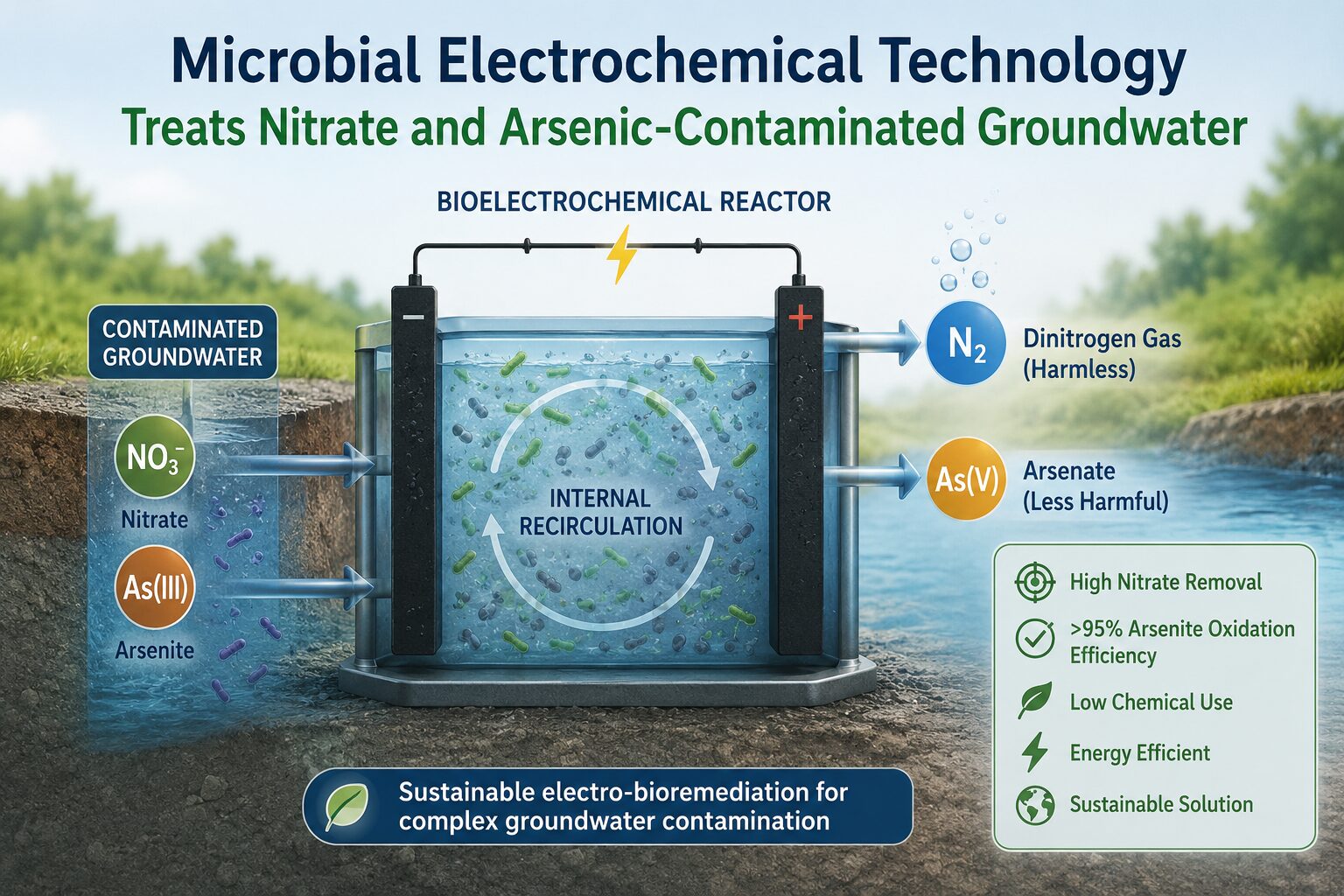
Microbial electrochemical technologies (METs) uses electro-bioremediation systems that can treat groundwater contaminated with nitrate and arsenite simultaneously. A continuous-flow bioelectrochemical reactor has been developed that reduces nitrate into harmless dinitrogen gas while oxidizing toxic arsenite into less harmful arsenate. The system can achieve high nitrate removal rates and over 95% arsenite oxidation efficiency under groundwater-like conditions. This works as the internal recirculation significantly improves treatment performance by enhancing mass transfers and microbial activity of denitrifying and arsenite-oxidizing bacteria like Sideroxydans sp and Achromobacter sp. Thus, electro-bioremediation as a sustainable, low-chemical, and energy-efficient solution for complex groundwater contamination challenges.

Microbial Electrochemical Technology Treats Nitrate and Arsenic-Contaminated Groundwater Read More »

Fetal Body MRI improves the diagnosis of fetal abnormalities

Fetal Body MRI Improves Prenatal Diagnosis and Neonatal Treatment

Fetal body MRI is improving prenatal diagnosis and neonatal treatment planning for congenital abnormalities. The motion-corrected 3D images obtained from MRI enhance the visualisation of fetal anatomy compared to traditional ultrasound alone and aids to determine atypical fetal position, reduced amniotic fluid volume, or high maternal body-mass index. Fetal MRI enables more accurate diagnosis, improves detection of complex abnormalities, supports surgical and delivery planning, and helps clinicians prepare for life-saving neonatal interventions such as airway management procedures, and improves outcomes for newborns with congenital conditions.

Fetal Body MRI Improves Prenatal Diagnosis and Neonatal Treatment Read More »

chatgpt image may 5, 2026, 10 13 12 pm

Electrolyzed Water Is Transforming Hospital Disinfection and Hygiene Practices

Electrolyzed water (EW) is a cost-effective, eco-friendly disinfectant with strong antimicrobial and antibiofilm properties. Produced by electrolysis of salt and water, it generates hypochlorous acid (HOCl), which rapidly kills pathogens by damaging cell structures. Findings show significant effectiveness in wound care, hand hygiene, oral health, and surface disinfection, with fast microbial reduction and minimal toxicity. EW demonstrates strong practical potential for safer infection control in clinical and healthcare environments, although short shelf life of EW and reduced efficacy in organic matter can be addressed.

Electrolyzed Water Is Transforming Hospital Disinfection and Hygiene Practices Read More »

chatgpt image may 4, 2026, 11 46 43 am

Clove Extract Shows Powerful Anticancer Effects Across Multiple Cancer Types

A study demonstrated the anti-cancer potential of clove ethyl acetate extract across multiple cancers, including breast, ovary, cervix, liver, pancreas, and colon cancer. Although the key bioactive compound was identified as oleanolic acid, the extract displays greater effectiveness, suggesting synergistic interactions. The clove extract significantly inhibited tumour growth, induced cell cycle arrest, and promoted apoptosis by regulating key genes like p21, E2F1 and survivin. Clove extract thus shows promise as a natural or complementary cancer therapy, with low toxicity.

Clove Extract Shows Powerful Anticancer Effects Across Multiple Cancer Types Read More »

chatgpt image apr 29, 2026, 12 13 37 am

Benzene Exposure Linked to Severe Systemic Sclerosis

Exposure to particulate (PM10) and benzene is associated with more severe skin involvement and reduced lung function. Benzene, in particular, is a potential environmental factor that influences the progression of systemic sclerosis. This disease is associated with early inflammation, immune dysfunction, and vascular injury, followed by progressive fibrosis of the skin and internal organs, especially the lungs. Higher benzene exposure may increase the vascular inflammatory-fibrotic burden, contributing to greater skin involvement and lung impairment, as reflected in DLCO measurements. Occupational exposure to substances such as crystalline silica dust, solvents, ketones, and welding fumes further elevates these risks.

Benzene Exposure Linked to Severe Systemic Sclerosis Read More »

chatgpt image apr 25, 2026, 04 44 06 pm

HOPES Program improves Mental Health, Skills, and Preventive Care in Older Adults

The HOPES program improves community living skills and self-efficacy among older adults with reduced psychiatric symptoms. This intervention combines psychosocial skills training with preventive healthcare for the oldies suffering from serious mental illness, such as schizophrenia, schizoaffective disorder, bipolar disorder and major depression. Compared with usual treatment, interventions such as HOPES can produce lasting functional and behavioral benefits, allowing preventive health care screening and advanced care planning, supporting greater independence and better long-term mental health outcomes in the ageing population.

HOPES Program improves Mental Health, Skills, and Preventive Care in Older Adults Read More »

chatgpt image apr 23, 2026, 11 28 45 am

Monsoon season increases the risk of parasitic eye infection

A study confirms that a spore-forming unicellular parasite widely causes eye infection, termed as acute microsporidial keratoconjunctivitis (MKC), peaks during the monsoon season. Environmental factors such as rainfall, high humidity, and wind speed significantly increase the infection rate. In India, keratoconjunctivitis cases rise sharply in September and are lowest in May. Other known causes of infections are exposure to soil, sports activities, and water contamination in swimming pools. Air pollutants like O₃, CO, NO₂, and SO₂ show little impact on infection rates, though higher ground-level ozone may offer some protective effect.

Monsoon season increases the risk of parasitic eye infection Read More »

st 2

Welcome to Sci-Tech Bulletin

Discover mind-bending science breakthroughs in your inbox every week

This field is required.

We don’t spam! Read our privacy policy for more info.

Scroll to Top