Ivermectin as a promising precision medicine against ovarian cancer
Ovarian cancer is one of the most challenging cancers to diagnose and treat. The patients are diagnosed at advanced stages, and treatment resistance continues to limit long-term survival. Developing entirely new cancer drugs often requires more than a decade of research and billions of dollars in investment. So, researchers are now exploring whether existing drugs can be repurposed to improve outcomes faster and at lower development costs. Developing entirely new cancer drugs often requires more than a decade of research and billions of dollars in investment.
Ivermectin as a promising anti-cancer drug
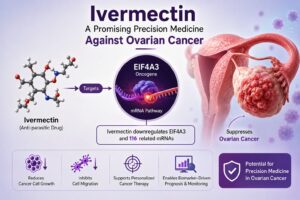
One such promising candidate in the area of drug repurposing is Ivermectin, a well-known anti-parasitic drug. It is FDA-approved as an antiparasitic treatment against parasites such as head lice, scabies, and river blindness. It has an established safety profile and repurposing it for oncology could potentially shorten development timelines and reduce costs. Scientists at the University Creative Research Initiatives Center, Shandong First Medical University, China have studied the anticancer activity of Ivermectin across several tumor types, including ovarian cancer (OC), pancreatic cancer, colon cancer, breast cancer, glioblastoma, melanoma, prostate cancer, lung cancer, and leukemia. They recently investigated how ivermectin may inhibit ovarian cancer growth at the molecular level and how its biological effects could support personalized cancer therapy. Through their work the scientists identified molecular signatures, mainly the mRNA, that could help guide personalized therapy and prognosis prediction in the future.
What makes ivermectin especially interesting is its ability to target multiple cancer-related mechanisms simultaneously, including:
- Tumor cell proliferation
- Drug resistance pathways
- Cellular energy metabolism
- Autophagy and apoptosis
- Cancer stem cell activity
- Protein translation pathways
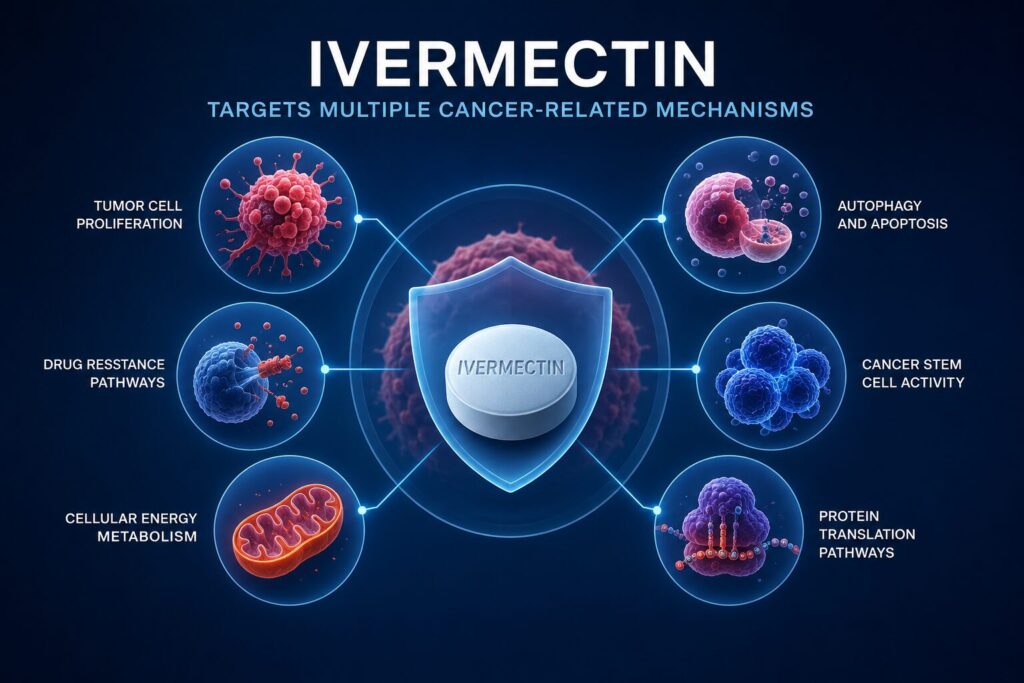
How Ivermectin modifies the cancer cell molecular pathways to stop cancer growth?
In vitro inhibition of cancer cell growth
The scientists first began their investigations by in vitro testing of the anti-cancer potential of Ivermectin at various concentration. It was found that the drug could significantly supress the metastatic potential of the cancer cells at the concentration of ~20 μM. This is particularly important because ovarian cancer mortality is strongly linked to metastatic spread within the abdominal cavity.
Regulation of long non-coding RNAs
In the further steps, 16 long non-coding RNAs were analysed which are known to be associated with ovarian cancer survival and EIF4A3 binding activity. qRT-PCR analysis results demonstrated the role of Ivermectin to in alteration of expression of lncRNAs. The advanced SILAC (Stable Isotope Labeling with Amino Acids in Cell Culture)-based quantitative proteomics method allowed researchers to identify reduced EIF4A3 protein expression with downregulation of 116 EIF4A3-binding mRNAs, involved in multiple pathways. Pathway analysis revealed involvement in:
- Cell cycle regulation
- RNA metabolism
- DNA repair
- Notch signaling
- Hedgehog signaling
- Mitochondrial translation pathways
In addition, lasso regression analysis identified three lncRNA ZNRF3-AS1, SOS1-IT1 and LINC00565 that helped to classify high-risk cancer group based on this signature showed significantly poorer survival outcomes.
mRNAs levels in ovarian cancer patients
To make these findings relevant with real-world patient outcomes, clinical and RNA sequencing data from 411 ovarian cancer patients in The Cancer Genome Atlas (TCGA) was analysed.
Ivermectin as multi-target cancer therapy Strategy
Cancer is rarely driven by a single molecular pathway. One reason many treatments fail is that tumors adapt through alternative signaling routes.
This study suggests ivermectin may simultaneously affect multiple pathways involved in:
- RNA processing
- Cell cycle regulation
- Mitochondrial function
- DNA repair
- Metabolic activity
That multi-target capability may prove valuable in overcoming treatment resistance.
New Biomarkers for Prognosis and Monitoring
The identified lncRNA-EIF4A3-mRNA axes modulated by ivermectin may eventually serve as:
- Predictive biomarkers
- Prognostic indicators
- Drug response monitoring tools
This aligns closely with the growing movement toward predictive, preventive, and personalized medicine (PPPM).
These lncRNA signature identified may help clinicians better stratify ovarian cancer patients according to risk. If validated in future clinical trials, these biomarkers could support:
- Earlier intervention
- More accurate prognosis estimation
- Better treatment selection
- Monitoring therapeutic response
Future Insights
In addition to the targeted anti-cancer potential effects of Ivermectin more preclinical and clinical studies are needed before ivermectin can be adopted as a standard ovarian cancer therapy.
- Anti-cancer effects of Ivermectin in primarily cell lines.
- Human clinical trials of Ivermectin as an anti-cancer drug.
- Optimal dosing strategies of Ivermectin for cancer treatment.
- Investigations on long-term safety of Ivermectin in cancer patients.