Electrolysed Water Is Transforming Hospital Disinfection and Hygiene Practices
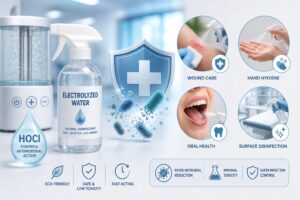
Healthcare-associated viral, bacterial and parasitic infections remain a serious global challenge, affecting millions of patients each year. The growing demand for safer, cost-effective, and environmentally friendly disinfectants has led researchers to explore innovative alternatives. Scientists at the Department of Food Science and Biotechnology, Kangwon National University, Korea, have elaborated and highlighted one such solution, i.e., electrolyzed water (EW), as a powerful antimicrobial agent with applications in the food industry, agriculture, livestock management and medical field. EW stands out as a practical, science-backed solution for modern healthcare challenges. Its combination of effectiveness, safety, and sustainability makes it a strong candidate for widespread adoption. From wound care to hospital sanitation, EW offers real-world benefits that align with current needs for safer and greener disinfectants.
What Is Electrolyzed Water?
Electrolyzed water is produced by passing an electric current through a dilute salt (NaCl) solution. This process generates different types of water with antimicrobial properties, including acidic, neutral, and alkaline variants.
EW contains active compounds like hypochlorous acid (HOCl), which are strong reactive oxygen species (ROS) and play a central role in killing bacteria, viruses, fungi, and biofilms by infiltrating the membranes of bacterial cells and killing pathogens through chlorination or oxidation, which destroys the key metabolic frameworks.
Discovery of Electrolyzed Water
Since its invention in the early 19th century in Russia, EW has been widely used in other parts of the world, including Japan, the U.S., Europe, and China. Especially, Japan played a major role in promoting electrolyzed water (EW) through government-backed regulations and research. Since the 1990s, Japanese health authorities have approved and reauthorized ERW-producing home-managed medical device. In 2002, the Ministry of Japan authorized the use of hypochlorous acid water on designated food additives. Recently, the US Food and Drug Administration (USFDA) approved electrolytically generated hypochlorous acid for food contact surfaces. In 2020, China also introduced standards allowing hypochlorous acid water for use on skin, hands, and mucous membranes. These regulatory approvals highlight the growing global acceptance of EW as a safe and effective disinfectant.
Types of Electrolyzed Water
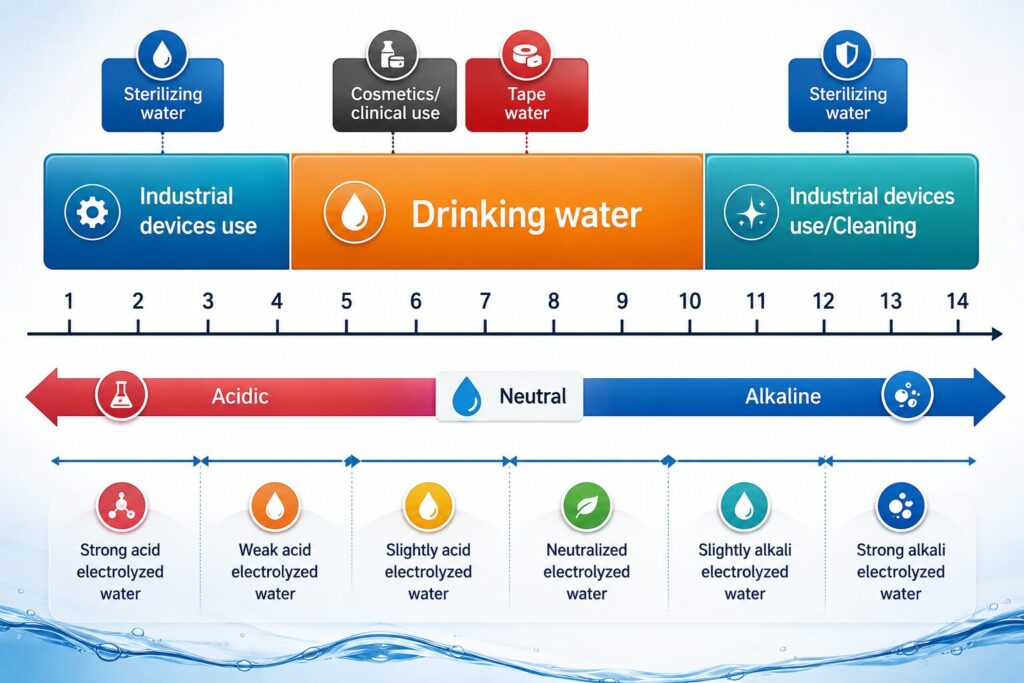
Different forms of EW are produced depending upon their strength and applications in various sectors or industries:
- Acidic electrolysed water (AEW) has a pH of 2-3
- Basic electrolysed water (BEW) has a pH of 10-13
- Slightly acid electrolysed water (SAEW) has a pH of 5.5–6.5
- Neutral electrolysed water (NEW) has a pH of 7-8
Applications of Electrolyzed Water
- Strong Antimicrobial and Antibiofilm Activity
One of the most important outcomes is EW’s ability to eliminate a broad range of pathogens.
- EW is effective against bacteria, viruses, spores, and fungi
- It can disrupt biofilms, which are responsible for up to 80% of human infections
This makes it especially valuable in hospitals, where biofilms often form on medical devices and surfaces.
- Hypochlorous Acid (HOCl) as the Active Agent
HOCl is the primary antimicrobial component in EW. Its effectiveness comes from:
- Neutral charge, allowing easy penetration into microbial cells
- Strong oxidative properties that damage proteins and DNA
Interestingly, HOCl is also naturally produced by the human immune system, which supports its safety profile.
- Rapid Disinfection Performance
EW demonstrates rapid microbial reduction. For instance:
- Significant bacterial reduction can occur within minutes
- In some cases, up to 5.8 log reduction in bacteria was observed in just 1 minute
This speed is critical in clinical environments where quick sterilisation is required.
- Safe and Environmentally Friendly
Unlike traditional chemical disinfectants, EW:
- Contains no harmful residues
- Reverts back to normal water after use
- Causes minimal irritation to skin and mucous membranes
These properties make it suitable for repeated use in sensitive environments like hospitals and clinics.
- Cost-Effective and On-Site Production
Another practical advantage is that EW can be generated on-site using simple equipment. According to the study:
- 1 litre can be produced in about 8 minutes
- It reduces the need for storage and transportation of chemicals
This lowers operational costs and improves accessibility.
Practical Applications in Healthcare
- Wound Care and Healing
The research shows that EW supports wound healing by:
- Reducing bacterial load without damaging tissue
- Promoting cell proliferation
- Breaking down biofilms that delay healing
Clinical observations reported significant wound size reduction and improved healing outcomes.
- Hand Sanitization
EW-based sanitizers are emerging as alternatives to alcohol-based products. Benefits include:
- Effective against common pathogens like E. coli and Staphylococcus aureus
- Less skin irritation with frequent use
- Potential use in fog or spray form for broader coverage
This makes EW particularly useful in healthcare settings requiring frequent hand hygiene.
- Oral and Dental Care
EW has shown strong antibacterial effects against oral pathogens. Applications include:
- Mouthwash solutions
- Dental equipment sterilization
- Prevention of dental plaque and infections
Studies cited in the paper show over 99% bacterial reduction in some cases.
- Surface and Environmental Disinfection
EW is highly effective for cleaning hospital environments, including:
- Floors, medical equipment, and bedding
- High-touch surfaces like door handles
- Water systems in dental units
The research indicates higher efficacy compared to some conventional disinfectants.
Scope of Research
EW is more than just a disinfectant. It is a versatile, clinically relevant tool with measurable outcomes and strong practical applicability. By combining robust antimicrobial performance with safety and cost-efficiency, EW represents a meaningful step forward in infection control and healthcare hygiene. Although EW has found its applications in diverse industries, improvements can be made to improve its stability, shelf life, enhanced delivery systems and its expanded use against drug-resistant pathogens.