Clove Extract Shows Powerful Anticancer Effects Across Multiple Cancer Types
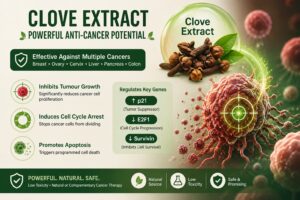
Scientists are extensively exploring the plant-based anti-cancer molecules, owing to their lowered toxicity and drug resistance that conventional chemotherapeutic drugs fail to fulfil. A recent study at the Department of Pharmacology and Medicine, CMU, Beijing, China, has proven that Syzygium aromaticum, commonly known as Clove, has shown the anti-cancer effects against multiple cancers, including breast, ovary, cervix, liver, pancreas, and colon cancer.
The study evaluated the anticancer effects of clove extract, both in laboratory (in vitro) and animal (in vivo) settings, focusing on the inhibitory effects of clove extract, the identification of the key active molecule in the clove extract and understanding the biological mechanisms involved.
Promising anti-cancer effects of Clove Extract
At first, the clove extract was prepared from the dried clove powder. Primarily, ethanol extraction was performed, followed by purification using ethyl acetate. Later fractionation through chromatography, such as HPLC (High-Performance Liquid Chromatography) and NMR spectroscopy, was used to identify active compounds in the ethyl acetate extract. Analytical evaluation of the purified compounds identified oleanolic acid (OA) as a major bioactive component present in the ethyl acetate extract of clove.
In vitro testing of the purified oleanolic acid (OA) and the extract on multiple human cancer cell lines, including Colon cancer (HT-29), Breast cancer (MCF-7), Liver cancer (BEL-7402), and Pancreatic cancer (PANC-1) showed that the cancer cell growth was markedly reduced due to the clove extract. Among the test samples, Oleanolic acid demonstrated strong cytotoxic effects, but the refined ethyl acetate extract was found to be more potent. Some of the key effects of the clove extract were that:
- It reduces tumour cell growth
- It has a killing effect on multiple cancer cell types.
- It prevents the regrowth of the of the cancer cells
- It has superior anti-cancer properties compared to the known drug 5-fluorouracil.
- It has a profound synergistic effect against the cancer cells.
- It has lower toxicity than the known drug 5-fluorouracil
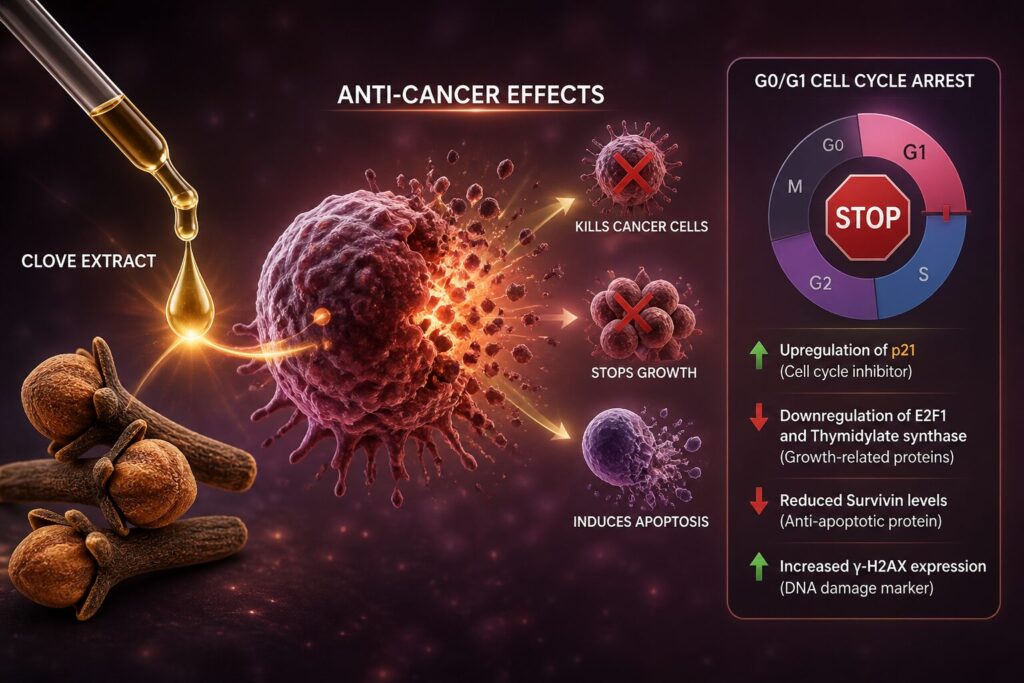
Biological Mechanism of the Anti-Cancer Effect of the Clove Extract
Further investigations to study the biological mechanisms involved in these anti-cancer activities of the clove extract demonstrated that the extract caused G0/G1 cell cycle arrest, preventing cells from progressing to the DNA replication phase. This suggests that the extract “pauses” cancer cell growth at an early stage, stopping tumour expansion. In addition, the extract also actively kills cancer cells in a controlled, biological way known as apoptosis or programmed cell death.
Molecular studies of these mechanisms further revealed that the clove extract effectively regulated the gene expression of the cell cycle proteins, such that:
- Upregulation of p21 (a cell cycle inhibitor)
- Downregulation of E2F1 and thymidylate synthase (growth-related proteins)
- Reduced survivin levels (a protein that prevents apoptosis)
- Increased γ-H2AX expression, indicating DNA damage
Can clove extract be used as a potential combination therapy?
This study also compared the anti-cancer effects of the clove extract with 5-fluorouracil (a
known chemotherapeutic) and demonstrated the enhanced effects of the treatment. The clove extract could, thus, profoundly enhance the effects of the existing anti-cancer treatments, reducing their required dosage, which will effectively lower the toxicity. This opens the door or integrative cancer therapies that combine natural and conventional approaches.
Future Research
While the findings are promising, the study also highlights areas for further investigation:
- Identification of additional active compounds
- Understanding metabolic effects in humans
- Clinical trials to confirm safety and efficacy
- Exploring synergistic combinations with existing drugs
These steps are essential before clove extract can be widely used in clinical settings.
Key Highlights:
This research thus provides strong scientific evidence that clove extract has significant anticancer potential against multiple cancer types. This positions it as a promising natural alternative or complement to chemotherapy. The enhanced anti-cancer effects of the extract highlight the importance of its synergistic interactions between its bioactive compounds, aligning with principles of traditional herbal medicine used in modern drug design. Also, the multi-target action of the clove extract reduces the likelihood of drug resistance, which is a major issue in cancer treatment. With its low toxicity and broad efficacy, clove extract stands out as a compelling candidate for future combination therapies.
As research continues, this humble kitchen spice may play a powerful role in the fight against cancer.