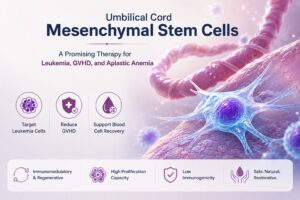
Umbilical Cord Mesenchymal Stem Cells is a promising therapy for Leukemia, GVHD, and Aplastic Anemia
What Are Umbilical Cord Mesenchymal Stem Cells?
Umbilical cord mesenchymal stem cells (UC-MSCs) are multifunctional stem cells that are found in umbilical cord. These are isolated from human umbilical cord tissue, particularly from a gelatinous substance known as Wharton’s Jelly. Unlike bone marrow-derived mesenchymal stem cells (BM-MSCs).
They are one of the most promising tools in regenerative medicine tissue engineering, and treatment of hematological disorders. Researchers are increasingly exploring how these stem cells can improve outcomes for patients with blood disorders, immune diseases, and complications following stem cell transplantation.
Some key characteristics of UC-MSCs:
- High self-renewal ability
- Rapid proliferation
- Multi-directional differentiation potential
- Low immunogenicity
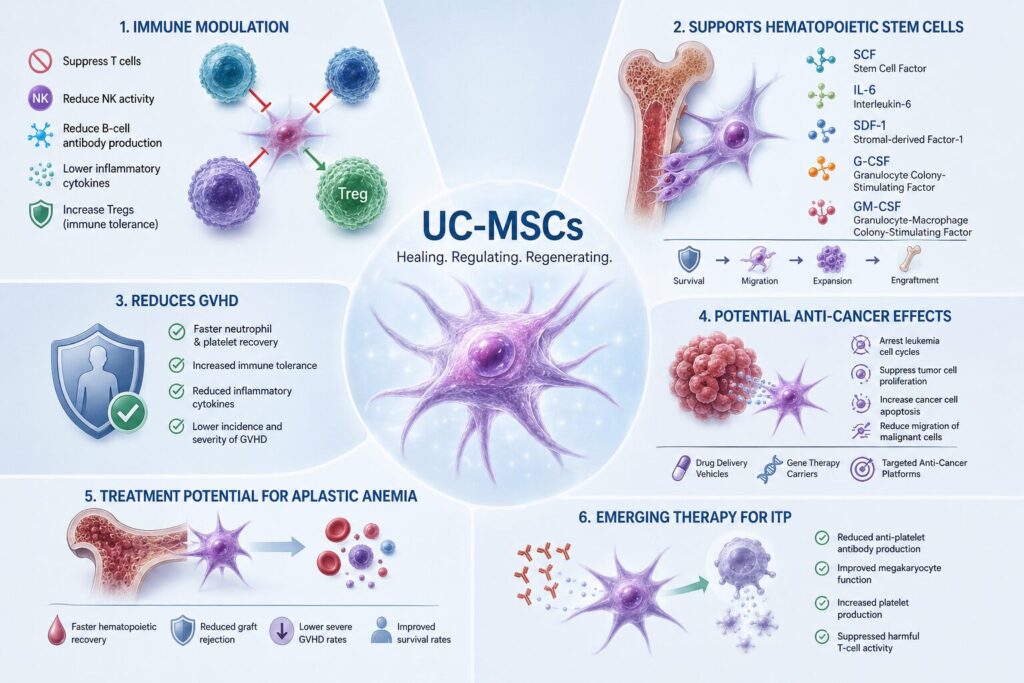
Biological applications of Umbilical cord mesenchymal stem cells
- Strong Immunomodulatory Properties
One of the most important findings is that UC-MSCs can regulate immune responses without triggering severe immune rejection. Researchers identified low expression of immune activation markers such as HLA-DR, CD80, and CD86, which contributes to their low immunogenicity.
Laboratory studies showed that UC-MSCs suppress:
- Activated T-cell proliferation
- Natural killer (NK) cell activity
- B-cell antibody production
- Inflammatory cytokine release
At the same time, they increase regulatory T cells (Tregs), which help control excessive immune reactions and this gives UC-MSCs strong therapeutic potential in transplantation medicine.
Thus, UC-MSCs are highly suitable for treatment of Graft-versus-host disease (GVHD), Autoimmune blood disorders, Organ transplant complications and Chronic inflammatory conditions.
- Support for Hematopoietic Stem Cell Growth
UC-MSCs help support hematopoietic stem cells (HSCs), which are responsible for producing blood cells. These secretes important growth factors include:
- Stem cell factor (SCF)
- Interleukin-6 (IL-6)
- Stromal-derived factor-1 (SDF-1)
- Granulocyte colony-stimulating factor (G-CSF)
- Granulocyte-macrophage colony-stimulating factor (GM-CSF)
These molecules improved stem cell survival, migration, and expansion that aid in bone marrow transplantation, cord blood transplantation, faster blood recovery after chemotherapy and improved stem cell engraftment.
- Reduction of Graft-Versus-Host Disease (GVHD)
GVHD remains one of the most serious complications after hematopoietic stem cell transplantation. Application of UC-MSCs for the GVHD supports
- Faster neutrophil and platelet recovery
- Increased immune tolerance
- Reduced inflammatory cytokines
- Lower incidence and severity of GVHD
It has been reported that repeated UC-MSC infusions increased regulatory immune cells while reducing harmful immune activity after transplantation, reducing transplant-related mortality, improving long-term survival, lowering hospitalization time and enhancing quality of life after transplant. These merits of UC-MSCs are being studied in clinical trials conducted by hospitals and transplant centers.
- Potential Anti-Cancer Effects
UC-MSCs are also proving of great benefit as anti-cancer therapy.
Laboratory studies demonstrated that UC-MSCs could:
- Arrest leukemia cell cycles
- Suppress tumor cell proliferation
- Increase cancer cell apoptosis
- Reduce migration of malignant cells
Researchers linked these effects to signaling pathways such as p38MAPK and cytokines like TGF-β and IL-6.
UC-MSCs possess the ability to migrate toward tumor sites makes them promising candidates for precision oncology. These are further being explored as:
- Drug delivery vehicles
- Gene therapy carriers
- Targeted anti-cancer treatment platforms
- Treatment Potential for Aplastic Anemia
Severe aplastic anemia (SAA) is a life-threatening condition where the bone marrow fails to produce enough blood cells. When UC-MSCs are combined with hematopoietic stem cell transplantation in SAA patients, this results in :
- Faster hematopoietic recovery
- Reduced graft rejection
- Lower severe GVHD rates
- Improved survival rates
For patients lacking fully matched donors, UC-MSC-assisted transplantation may provide:
- Expanded treatment access
- Safer transplantation options
- Better transplant success rates
This could be especially important in countries where donor availability remains limited.
- Emerging Therapy for Immune Thrombocytopenia (ITP)
The research also explored how UC-MSCs may help treat immune thrombocytopenia, an autoimmune disease that destroys platelets.
Experimental findings showed that UC-MSCs:
- Reduced anti-platelet antibody production
- Improved megakaryocyte function
- Increased platelet production
- Suppressed harmful T-cell activity
UC-MSC therapy could offer a new treatment option for patients who do not respond to steroids, immunoglobulins, or thrombopoietin receptor agonists.
Future Insights
umbilical cord mesenchymal stem cells have enormous potential in hematology and regenerative medicine. Their ability to regulate immune responses, support blood stem cell growth, and reduce transplant complications positions them as a promising next-generation therapy. From treating graft-versus-host disease and aplastic anemia to supporting cancer therapies and autoimmune blood disorders, UC-MSCs are moving closer to real clinical implementation.
Although the outcomes are promising, few concerns could be addressed, such as:
- Lack of standardized isolation techniques
- Variability between MSC populations
- Risk of malignant transformation during long-term culture
- Incomplete understanding of immune mechanisms
- Need for large-scale clinical trials
Researchers emphasized the importance of improving purification methods and establishing long-term safety profiles before widespread clinical use.