NanoLuc Biosensor Technology: Offering a simple & rapid detection of Nipah virus infection

Nipah virus (NiV) has emerged as one of the deadly threats after the COVID-19 pandemic. The virus is responsible for causing acute encephalitis showcasing symptoms like acute fever, headache, muscle pain, vomiting, and sore throat that appear between 4–14 days after exposure. Acute encephalitis in patients due to after 14 days of exposure to NiV had reported the mortality of over 80% globally from the year 2014-2023. Among the other countries with known reported cases of Nipah virus death, India has reported the highest mortality of 82.7%. These escalating mortality cases, especially in India accounting for 89.3-91.7% in the last decade raises a serious concern among doctors and scientists to find robust screening methods for early treatment interventions.
Currently, diagnostic methods used to detect Nipah virus infection include serum analysis of NiV specific antibodies using ELISA assay and Luminex bead-based assays that detect IgM and IgG antibodies or antigens. However, these diagnostic procedures are lengthy, complex and require trained professional, thus, limiting their use only in specialized laboratories. The main challenge in detection of NiV lies in obtaining clinical specimens from confirmed cases and prevent infection in the highly lethal environment.
Biosensor to detect Nipah Virus
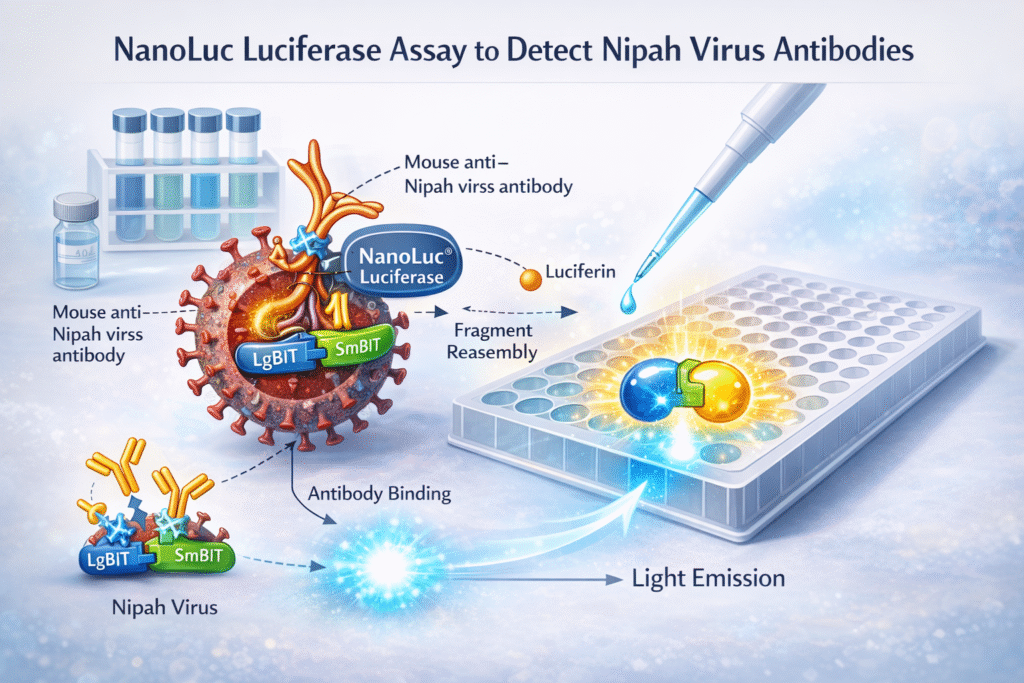
Scientist at Centres for Disease Control and Prevention, Atlanta, and University of Georgia, U.S.A have designed a Nanoluciferase (NanoLuc) technology-based biosensor that offers a simple alternative to detect deadly viral infections like SARS-CoV-2 and NiV with a sensitivity of 98.6% and specificity of 100%, highly correlating with the standard ELISA and neutralization assays. The technology is used to detect the antigen or antibodies in the serum or plasma samples of the patients providing fast, sensitive, wash-free detection of molecular interactions in solution without immobilization or complex instrumentation requirements. NanoLuc technology utilises NanoLuc luciferase fragments (LgBiT and SmBiT) to generate viral antigens fusion molecules. In the presence of anti-viral antibody these fragments reassemble, combines with a luciferin as a substrate and bioluminescence is produced, emitting light which is measured as NanoLuc depending on the presence of the antigen specific antibodies.
Detailed Research:
- Human serum and plasma samples were gamma-irradiated (5 × 10 6 rad) or heat inactivated (at 56°C for 30 min) to inactivate the Nipah virus in the samples.
- In controlled biosafety BSL-4, the virus strain was propagated in Vero E6 kidney epithelial cells to prepare infected cell lysates and slurries while control lysates were prepared from uninfected Vero E6 cells.
- For validation of the bioassay and cross-reactivity testing, monoclonal antibodies and hyperimmune ascitic fluids against NiV were used.
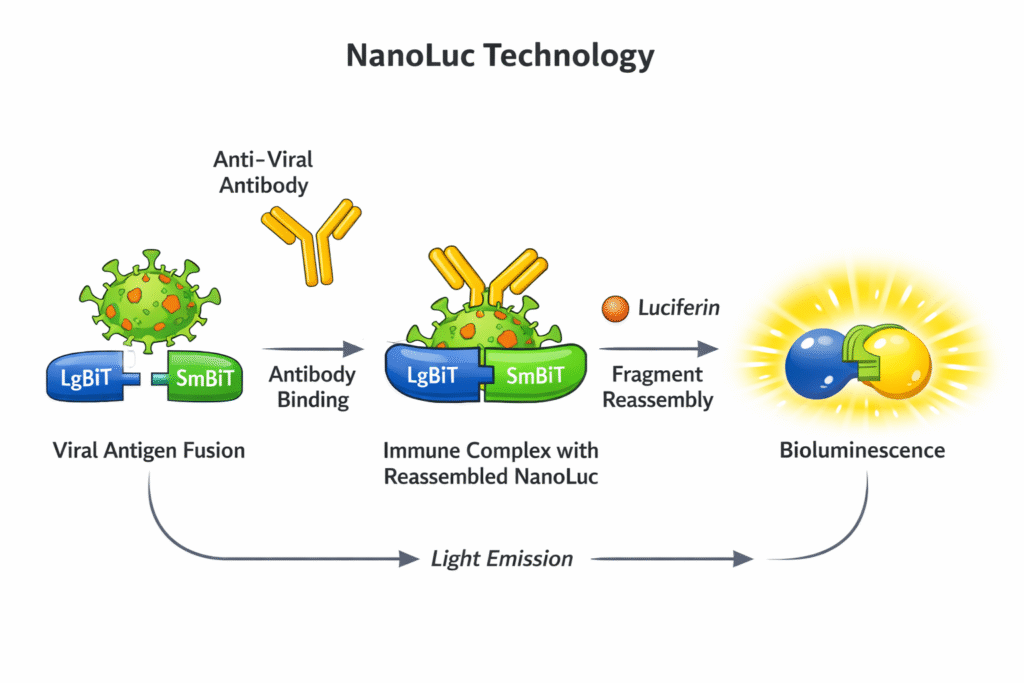
Biosensor design
- The soluble head domain of the NiV G glycoprotein was genetically fused to NanoLuc luciferase fragments (LgBiT and SmBiT) at the N and C-terminals and cloned into mammalian expression vector pEEV-Puro to express in Expi293F cells.
- Expressed fusion proteins were purified using HisTrap affinity and size-exclusion chromatography, quantified, and stored frozen.
- Different biosensor orientations and concentrations were tested using convalescent human serum to identify the optimal biosensor pair by comparing signal-to-noise ratios.
- Finally, C-terminal G-fusion biosensor was selected for all subsequent experiments due to superior performance.
Biosensor Validation
- At first equal volumes of biosensor solution and patient’s sample were mixed in the microplate and incubated for 20 minutes at room temperature.
- Addition of NanoLuc substrate for a around 10 minutes produced luminescence that was measured using a plate luminometer and the results were expressed as signal-to-noise ratios relative to negative control serum. Signal-to-noise ratios (SNR) for each experimental sample was obtained by dividing the relative fluorescence units (RLU) from the experimental samples by the mean RLU obtained from normal human serum triplicate reactions.
- The WHO First International Standard for anti-NiV antibodies was used to benchmark biosensor results.
- Biosensor signals were normalized and compared with ELISA and neutralization data from multiple laboratories.
- Receiver operating characteristic (ROC) curve analysis was used to estimate sensitivity, specificity, and area under the curve (AUC) to assess the efficiency of the biosensor to detect the NiV infection.
- In addition, cross-reactivity of the biosensor was tested with other paramyxoviruses and the results displayed specificity within the henipavirus group only.
- Pearson correlation coefficients were also used to compare biosensor results with ELISA and neutralization assays.
- Serial samples from NiV survivors were also analyzed to assess timing of seroconversion and durability of antibody detection over several years.
Scope and Application
The study demonstrates that the split NanoLuc NiV-G biosensor is a fast, accurate, and scalable alternative to ELISA for detecting past Nipah virus infection in humans and animals. The assay requires only mixing serum with reagents and reading luminescence, with no wash steps or species-specific secondary antibodies. Although early detection of acute infection is still a challenge, this technology is well suited for surveillance, retrospective outbreak analysis, and long-term sero-epidemiology, especially in resource-limited settings.