JPred4: Advanced Protein Secondary Structure Prediction for Modern Bioinformatics
Protein Secondary Structure Prediction: Why It Matters
Understanding how a protein folds into its three-dimensional structure is fundamental to understanding its biological function. Protein secondary structure describes local structural elements such as alpha-helices, beta-strands and coils. Although secondary structure does not provide the complete three-dimensional structure of a protein, it offers valuable information for protein modelling, fold recognition, functional-domain identification and experimental design.
Experimental determination of protein structures remains considerably slower than the generation of protein sequences using computational tools.
Scientists University of Dundee, UK have developed JPred: A Protein Secondary Structure Prediction Server, which provides an accessible computational method for predicting structural characteristics directly from amino acid sequences.
It demonstrates how improvements in computational methodology can translate into both higher prediction accuracy and a more practical research tool.
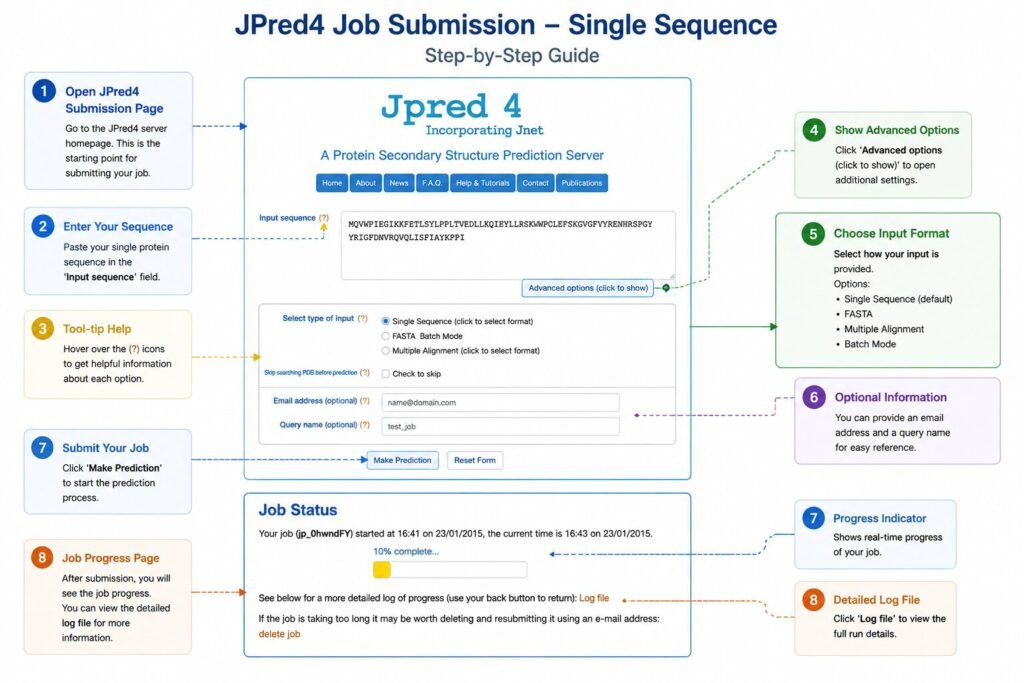
How Protein Secondary Structure Prediction Is Making Bioinformatics More Practical
JNet 2.3.1: The prediction engine
The central prediction engine in JPred4 is JNet 2.3.1, a neural-network-based algorithm designed to predict protein secondary structure and solvent accessibility. This engine is developed by retraining the earlier JNet 2.0 predictor.
For this, seven-fold cross-validation was performed and one representative sequence was selected from each of 1,358 SCOPe/ASTRAL superfamily domain sequences. This approach provides a diverse training foundation while helping reduce potential redundancy in the data.
Further incorporating evolutionary information for each protein sequence, multiple sequence alignments (MSAs) was generated using PSI-BLAST, searching the UniRef90 database. Rather than relying solely on the amino acid sequence itself, this approach uses information from related sequences to improve the prediction of structural characteristics.
Another technical improvement involved updating the hidden Markov model-building process to HMMER 3. Together, these changes strengthened the underlying computational pipeline while also simplifying the software architecture for future development.
Independent Blind Testing
A particularly important feature of the design was the use of a blind test. JNet 2.3.1 was evaluated using 150 sequences from 150 superfamilies that were not included in training.
The test sequences were selected to reproduce a similar distribution of secondary-structure compositions found in the training structures. This was intended to avoid bias in the reported accuracy.
This distinction matters because performance measured only on training data can give an overly optimistic impression of how well a predictive model performs on previously unseen proteins. By testing on sequences excluded from training, the researchers obtained a more meaningful assessment of real-world predictive performance.
Improved protein structure prediction using JPred4
The upgraded JNet 2.3.1 prediction engine produce measurable improvements over its predecessor.
JPred4 provides increased accuracy of 82% for the three-state secondary structure prediction accuracy, or Q3 score as compared with 81.5% for earlier JNet 2.0 engine. This means the system correctly predicts whether residues belonged to an alpha-helix, beta-strand or coil approximately 82% of the time in the blind test.
Improvements are visible in solvent accessibility prediction with:
- 0% for residues with more than 0% relative solvent accessibility
- 6% for residues with more than 5% accessibility
- 1% for residues with more than 25% accessibility
These results improved upon JNet 2.0, which achieved 88.9%, 82.4% and 77.8%, respectively.
Although these may seem to be relatively small percentage improvements, but in computational structural biology, incremental gains is valuable when applied across large numbers of protein sequences.
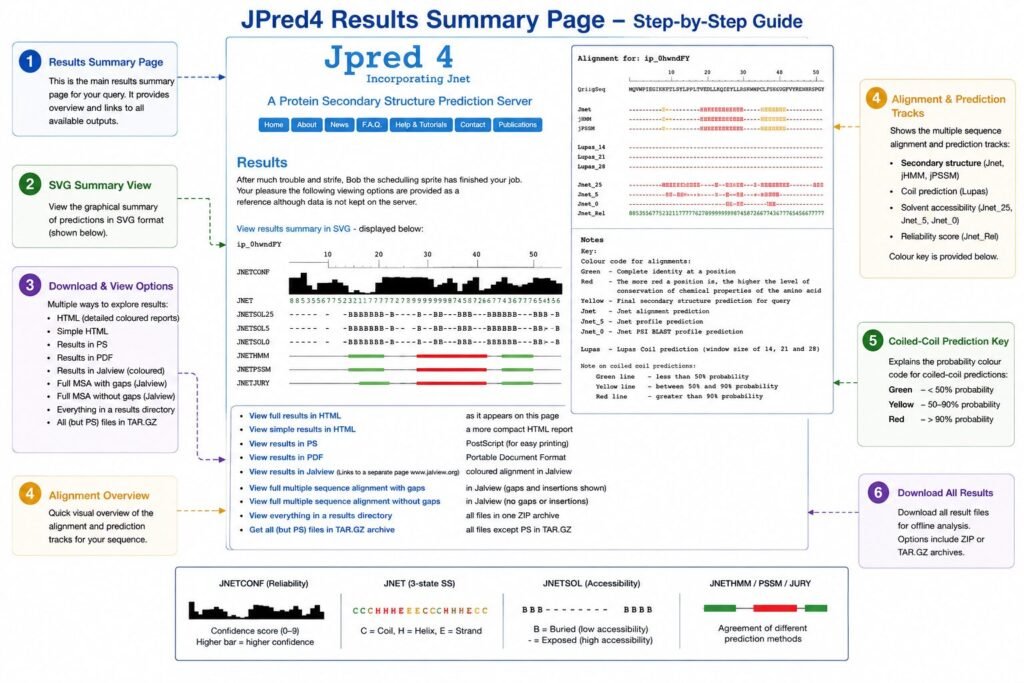
JPred4: Applications for Protein Structure Prediction
The most important contribution of JPred4 is not simply its accuracy. Its practical value comes from making protein sequence analysis faster and more accessible.
- Supporting Protein Structure Modelling
Secondary structure predictions can provide constraints for homology modelling and tertiary structure prediction. Researchers can use predicted helices, strands and coils as additional evidence when developing structural models of proteins for which experimentally determined structures are unavailable.
- Improving Fold Recognition
Secondary structure information can also support protein fold recognition. When researchers are attempting to determine whether an unknown protein belongs to a known structural family, predicted secondary structure can provide useful information alongside sequence similarity.
- Identifying Functional Regions
Predicted structural patterns can help researchers investigate potential functional domains. This can be particularly useful when working with newly identified proteins whose functions have not yet been experimentally characterized.
- Guiding Mutation Experiments
In structural biology, researchers highlight the potential of secondary structure prediction to guide site-specific and deletion mutation experiments. Understanding whether a residue lies within a predicted helix, strand or flexible region can help them formulate more informed experimental hypotheses.
- Accelerating Large-Scale Sequence Analysis
JPred4 supports single sequences, multiple sequence alignments and batch submissions. This makes the platform useful not only for individual investigations but also for projects involving many protein sequences.
The server’s reported median processing time is approximately 5 minutes, based on 50,000 consecutive user predictions analyzed in autumn 2014. When supplied with an existing MSA, predictions typically return within seconds because the computationally intensive PSI-BLAST search could be bypassed.
Usability of upgraded JPred4
The JPred4 upgrade is not limited to algorithmic performance. The web server is redesigned using Bootstrap and JavaScript, improving usability across different screen sizes and devices.
The resulting interface introduces scalable vector graphics (SVG), expands multiple sequence alignment visualization and improves reporting. The system also introduces improved email summaries and batch-result reporting. Instead of receiving separate emails for every sequence in a batch, users could receive a consolidated summary and archive of results.
Future Insights
The JPred4 presents a useful scientific software that requires both strong methodology and practical accessibility. It is a combined product incorporated with neural-network retraining, evolutionary sequence information, independent blind testing and software engineering improvements.
With faster predictions, batch processing, improved visualization and comprehensive alignment reporting, JPred4 is not merely a more accurate secondary structure prediction algorithm but a tool designed to fit into real research workflows.
For scientists analyzing proteins without experimentally determined structures, this approach can reduce the initial uncertainty surrounding a sequence and provide structural information that can be incorporated into subsequent modelling and experimental planning.