Personalized RNA Neoantigen Vaccine Stimulate Powerful T-Cell Responses in Pancreatic Cancer
Pancreatic Cancer: A Major Challenge in Modern Oncology
Pancreatic cancer, particularly pancreatic ductal adenocarcinoma (PDAC), is the third leading cause of cancer-related death in the United States and the seventh worldwide. It is one of the most aggressive and difficult-to-treat malignancies with poor overall survival rate of approximately 12%.
One of the greatest challenges is that pancreatic cancer is frequently associated with early disease recurrence and limited responsiveness to available therapies. Even after surgical removal, in 90% of cases recurrence remains extremely common, typically within a median of 7–9 months, while 5-year overall survival following resection has historically been only 8–10%.
Immunotherapies for the treatment of PDAC has not been an efficient strategy because unlike some cancers with high mutation rates, pancreatic cancer generally has a relatively low mutation burden, which was traditionally thought to result in fewer tumour-specific neoantigens, resulting in minimal activation of immune cells and rescue. To add on, PDAC is characterized as a largely non-inflamed tumour, with immune-excluded or immune-desert characteristics. Consequently, immune cells find it difficult mounting an effective response against the tumour.
So, an alternate approach that remains is surgery, as a potentially curative treatment for resectable PDAC. Depending on tumour location, patients may undergo procedures such as pancreaticoduodenectomy or distal pancreatectomy. However, surgery alone is rarely sufficient because microscopic residual disease or micrometastases can remain undetected and later develop into recurrent cancer. In such cases, adjuvant chemotherapy is therefore routinely used following surgery to reduce the risk of recurrence. Multi-agent chemotherapy can delay disease recurrence, but its effectiveness remains limited. Studies report that nearly 80% of patients still experience recurrence at approximately 14 months, with 5-year overall survival remaining below 30%.
These limitations reveal a critical therapeutic gap where the conventional treatments can remove or suppress visible disease, but they may not effectively eliminate microscopic cancer cells capable of initiating recurrence. This has driven interest in strategies that can harness the patient’s own immune system to recognize tumour-specific targets.
Personalized Vaccines for Cancer
An important insight behind the investigation of PDAC has been the search of potentially useful neoantigens. Earlier studies of long-term pancreatic cancer survivors found that tumour-specific neoantigens could stimulate T-cell responses. Tumours enriched with immunogenic neoantigens were also associated with substantially higher densities of activated CD8+ T cells and delayed recurrence. This provided the rationale for investigating personalized mRNA neoantigen vaccines.
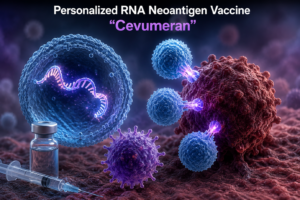
A Phase 1 study conducted as a part of Human Oncology and Pathogenesis Program in Memorial Sloan Kettering Cancer Center, New York, NY, USA. investigated an individualized vaccine called autogene Cevumeran for the treatment of PDAC. Instead of targeting the same cancer antigen in every patient, the approach identified mutations unique to an individual’s tumour and used them to create a customized vaccine.
The clinical trial provides preliminary evidence that personalized mRNA neoantigen vaccines can stimulate powerful, long-lasting T-cell responses in patients with surgically resected pancreatic cancer.
How the Personalized Pancreatic Cancer Vaccine Works?
The trial enrolled 34 patients initially. Following surgical removal of the tumour of 28 patients, researchers obtained tumour tissue and matched blood samples. Tumour and normal DNA were analysed using whole-exome sequencing, while tumour RNA sequencing helped identify expressed mutations. The researchers also determined each patient’s HLA type and used bioinformatic prediction to identify and rank potential neoantigens, which are tumour-specific mutations that can be recognized by T cells.
The selected neoantigens were then incorporated into an individualized uridine mRNA–lipoplex nanoparticle vaccine, with as many as 20 neoantigens per patient.
The treatment strategy was sequential rather than relying on the vaccine alone.
- Atezolizumab, an anti-PD-L1 immune checkpoint inhibitor, given to 19 patients
- Autogene cevumeran, the personalized mRNA neoantigen vaccine, given to 16 patients
- Modified FOLFIRINOX (mFOLFIRINOX) chemotherapy, given to 15 patients
The vaccine was targeted for administration within nine weeks after surgery, with tumour processing, sequencing, neoantigen selection and individualized manufacturing occurring during that period.
This approach is particularly significant where a personalized cancer vaccination was incorporated into an existing oncology workflow rather than being treated as an isolated laboratory experiment.
The investigators developed a detailed immune-monitoring strategy to determine whether the vaccine generated tumour-specific T cells.
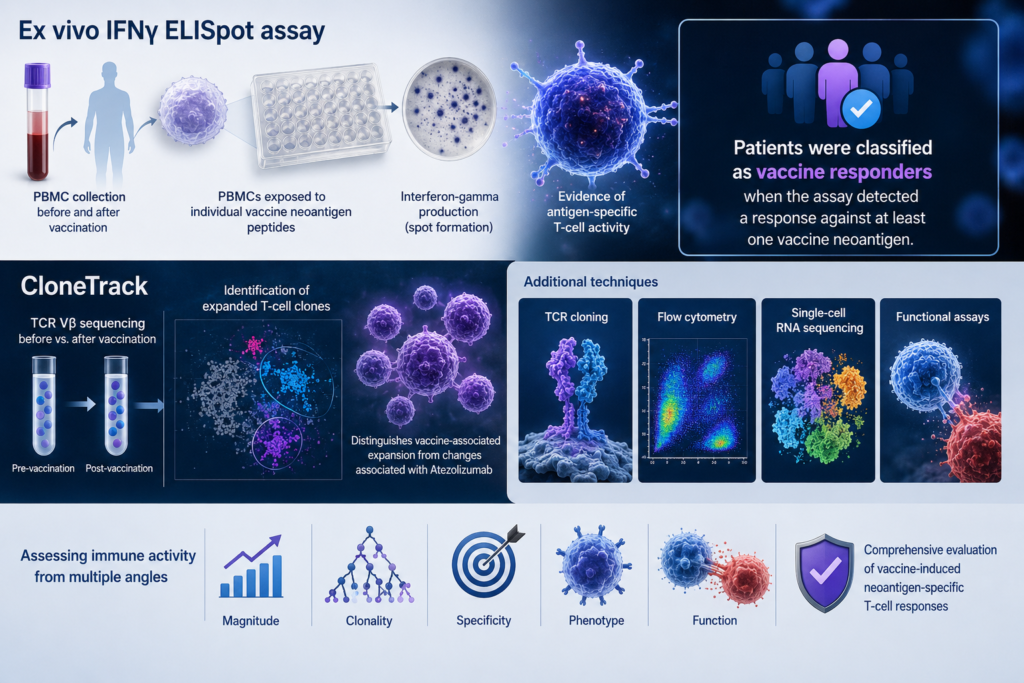
Ex vivo IFNγ ELISpot assay
The assay was conducted with the peripheral blood mononuclear cells (PBMCs), collected before and after vaccination, exposed to peptides corresponding to individual vaccine neoantigen, and measured interferon-gamma production, providing evidence of antigen-specific T-cell activity.
Patients were then classified as vaccine responders when this assay detected a response against at least one vaccine neoantigen.
CloneTrack
This newly developed mathematical and immunological method used T-cell receptor Vβ sequencing to identify T-cell clones that expanded following treatment. This helped researchers distinguish vaccine-associated immune expansion from changes associated with Atezolizumab.
Additional techniques, including T-cell receptor cloning, flow cytometry and single-cell RNA sequencing were used to investigate whether expanded T cells were genuinely neoantigen-specific and whether they possessed functional characteristics associated with cancer-killing activity.
In this way, immune activity was assessed from several angles: magnitude, clonality, specificity, phenotype and function.
Major outcomes from the Clinical Trial
Half of vaccinated patients developed strong immune responses
Among the 16 patients who received autogene Cevumeran, 50% developed detectable high-magnitude neoantigen-specific T-cell responses.
Across the evaluable vaccine targets, 25 of 230 administered neoantigens generated sufficiently strong responses for detection by ELISpot. Half of the responding patients recognized more than one vaccine neoantigen, demonstrating a polytopic immune response rather than reliance on a single target.
The magnitude of these responses varied substantially, ranging from approximately 100 to more than 2,000 IFNγ-producing spots per million PBMCs.
Powerful and Long-Lasting T Cells
CloneTrack provided another important insight. In all ELISpot-defined responders, researchers detected vaccine-associated T-cell clonal expansion, compared with only one of eight non-responders. In responders, multiple T-cell clones expanded from previously undetectable levels to as much as 10% of all circulating blood T cells, with a median peak of 2.8%.
Single-cell analysis confirmed the major population of CD8+ effector T cells among the expanded cells. These cells expressed Perforin, Granzyme B, Interferon-gamma and cytokines followed by degranulation after exposure to vaccine neoantigens. These vaccine-expanded clones persisted despite subsequent mFOLFIRINOX treatment, with some detectable for up to two years after surgery. Seven of seven patients who received a vaccine booster showed re-expansion of previously primed clones.
Delayed Cancer Recurrence
The most clinically intriguing finding was the association between vaccine-induced T-cell responses and recurrence-free survival.
After a median follow-up of 18 months, the vaccine responders had a higher median recurrence-free survival, not reached, as compared with 13.4 months among the non-responders. The reported hazard ratio was 0.08, with P = 0.003. A landmark analysis designed to reduce potential time-to-response bias produced a similar result.
A Potential Clue About Micrometastases
One particularly striking observation involved a patient who developed a small liver lesion after vaccination. The lesion contained all 15 vaccine-expanded T-cell clones identified in the patient’s blood. Molecular testing also detected rare cells carrying the same TP53R175H mutation found in the original tumour.
The liver lesion subsequently disappeared on imaging. While this single-patient observation cannot establish efficacy, it provides a compelling biological clue that vaccine-expanded T cells may be capable of reaching and eliminating microscopic metastatic disease.
Following the success of mRNA Vaccine: What comes next?
The practical implications of this research extend beyond pancreatic cancer.
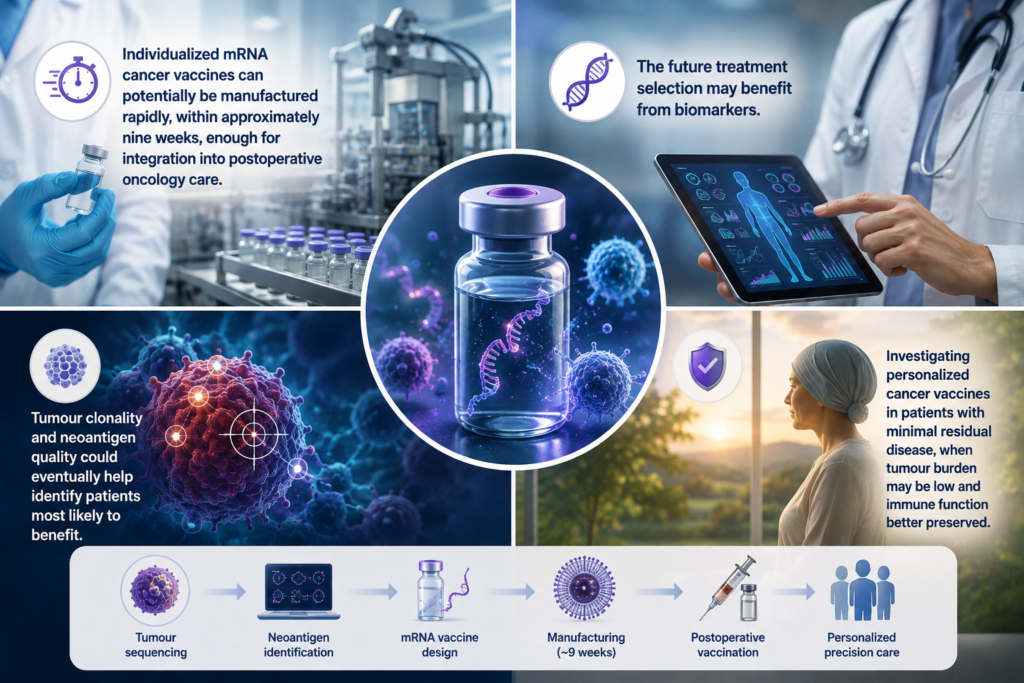
- Individualized mRNA cancer vaccines can potentially be manufactured rapidly, within approximately nine weeks, enough for integration into postoperative oncology care.
- The future treatment selection may benefit from biomarkers.
- Tumour clonality and neoantigen quality could eventually help identify patients most likely to benefit.
- Investigating personalized cancer vaccines in patients with minimal residual disease, when tumour burden may be low and immune function better preserved.
Future Insights
The promising phase I findings provide a strong foundation for further research. Larger, more diverse randomized clinical trials can build on these results to further evaluate the efficacy, biomarkers, and broader clinical potential of personalized mRNA neoantigen vaccines in pancreatic cancer.
This research changes an important assumption about pancreatic cancer immunotherapy. PDAC has traditionally been considered a difficult target for immunotherapy because of its relatively low mutation burden and poorly inflamed tumour environment. Yet this study demonstrates that individualized mRNA vaccination can turn patient-specific tumour mutations into targets for substantial T-cell activity.
The most promising lesson is that genomic sequencing, computational neoantigen prediction, rapid vaccine manufacturing and sophisticated immune monitoring can be connected into a personalized treatment pipeline.
The study provides an important proof of concept that a patient’s own tumour mutations can be transformed into a customized therapeutic vaccine. Measurable immune responses can be generated in a substantial proportion of patients, and those responses are associated with delayed recurrence.
For precision oncology, that combination of personalization, measurable immune activity and clinical feasibility may represent one of the most important directions for future pancreatic cancer research.