Decoding Cancer Treatment Outcomes with Explainable AI and Multimodal Real-World Data
Personalized Cancer Care Needs More Than a Single Predictor
Cancer prognosis is very challenging as it is rarely determined by a single factor such as tumor stage or age. A patient’s likely outcome is shaped by a combination of disease-related, biological and overall health characteristics like age, tumor stage, laboratory results, body composition, comorbidities, genetic profile and treatment history can interact in ways that are difficult for conventional scoring systems to capture.
Traditional cancer scoring systems often simplify this complexity by assigning importance to a limited number of variables. While these scores are clinically useful, they may not fully reflect the unique circumstances of an individual patient.
For example, tumor stage provides important information about the extent of cancer, but two patients with the same stage may have very different prognoses. Their age, physical condition, nutritional status, laboratory results, comorbidities, metastatic sites and other tumor characteristics may differ substantially.
Patient’s driven data is challenging
Modern patients generate a vast range of clinical information—from medical history, laboratory tests and tumor characteristics to imaging, body composition, genetic profiles and treatment records. However, conventional prognostic tools typically rely on a relatively small number of variables and often assess them independently. This can overlook the complex interactions that influence how an individual patient responds to treatment and how their disease progresses.
This complexity creates a major challenge for clinicians: how can they integrate hundreds of pieces of patient information without overlooking important relationships? This is where AI becomes potentially valuable. Instead of evaluating markers in isolation, machine-learning models can process many variables simultaneously and identify nonlinear relationships and interactions across them.
In essence, the approach moves from asking “What is this patient’s risk?” toward a more clinically meaningful question: “What factors are driving this patient’s risk, and how do they interact within their individual disease context?”
This is where artificial intelligence (AI) offers an important opportunity. Machine-learning models can analyze large, complex datasets and identify relationships that may be difficult to recognize using conventional approaches.
Explainable AI (xAI), developed by scientists of Institute for Artificial Intelligence in Medicine, University Hospital Essen, Germany, addresses this “black-box” problem by providing insight into the factors behind an AI prediction. The research examines whether combining multimodal real-world cancer data with deep learning and xAI could improve outcome prediction while revealing the patient-specific factors driving prognosis. This approach could help bridge the gap between the growing volume of healthcare data and the need for transparent, individualized cancer care.
Rather than simply producing a risk score, the approach attempts to explain why an individual patient receives that prediction. That distinction could be important for bringing artificial intelligence into everyday oncology.
How Explainable AI Could Transform Personalized Cancer Treatment
Combining Real-World Data with Deep Learning
For the building the database, electronic health records from 150,079 cancer patients treated at University Hospital Essen, were evaluated. The final study population included 15,726 adults who received systemic cancer treatment between April 2007 and July 2022.
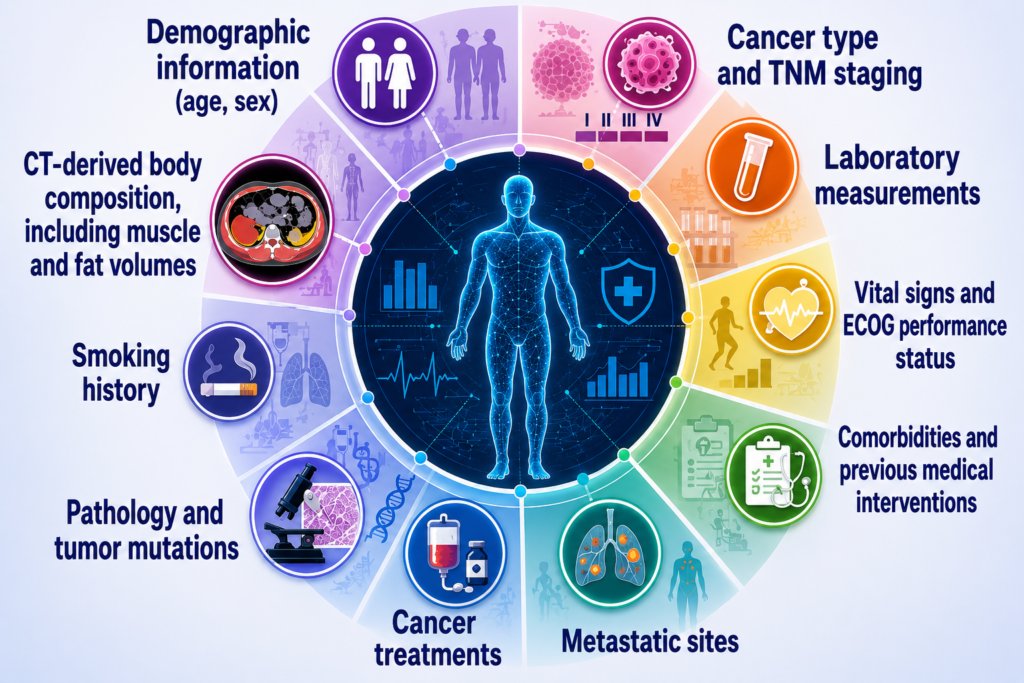
The dataset was deliberately multimodal. It included:
- Demographic information such as age and sex
- Cancer type and TNM staging
- Laboratory measurements
- Vital signs and ECOG performance status
- Comorbidities and previous medical interventions
- Metastatic sites
- Cancer treatments
- Pathology and tumor mutations
- Smoking history
- CT-derived body composition, including muscle and fat volumes
Different time windows around treatment initiation was used to capture clinically relevant information while limiting missing data. CT-derived body composition was assessed from abdominal scans obtained up to two months before treatment. A deep-learning system automatically quantified muscle, bone and different adipose-tissue compartments.
The final dataset contained 350 variables. In the dataset, continuous variables were standardized, extreme outliers were removed, and categorical and diagnosis-related information was encoded for machine-learning analysis. Missing values were handled using feature expansion so that the model could retain information about whether a clinical marker was available.
Two Cancer Outcomes Were Predicted
Two neural networks were trained to estimate:
- Overall survival (OS) — time from systemic treatment initiation to death.
- Time to next treatment (TTNT) — time until the next systemic treatment or death.
The model used a Cox proportional-hazards architecture with a fully connected neural network, similar to DeepSurv, a deep-learning model for survival analysis. DeepSurv uses a neural network to predict a patient’s risk of experiencing an event over time, such as death or disease progression.
Further, 5-fold cross-validation was used where 80% of the data were used for training, while the remaining data were divided into validation and test sets. Cancer entities were balanced across the splits. This pan-cancer strategy was adopted where instead of training completely separate models for individual cancers, the neural network learned from patients across multiple cancer entities, allowing it to identify prognostic patterns that may extend beyond tumor type.
Why Explainable AI Matters?
A highly accurate AI model is not automatically useful in medicine if clinicians cannot understand its reasoning.
Therefore layer-wise relevance propagation (LRP) was applied which is an explainable AI technique that works backward through the neural network to estimate how much each input variable contributed to an individual prediction.
These contributions were called AI-derived (AID) markers. Each AID marker combines the original clinical value with its calculated risk contribution.
A positive risk contribution indicated an adverse influence on prognosis, while a negative contribution indicated a favourable influence.
This creates a potentially practical concept: instead of telling an oncologist only that a patient is “high risk,” the system can provide a profile showing which factors are driving that risk.
AI Outperformed Conventional Prognostic Scores
Substantially, the pan-cancer model achieved an average:
- C-index of 0.762 for overall survival and
- 711 for time to next treatment.
Training across cancer types also improved performance compared with models trained on individual cancer entities.
Interestingly, the AI approach outperformed several commonly used clinical prognostic measures, including:
- UICC staging
- ECOG performance status
- Charlson Comorbidity Index
- Modified Glasgow Prognostic Score
For example, average C-index for overall survival was 0.75 with the xAI model versus 0.56 for UICC staging, while the xAI model also exceeded ECOG performance status, 0.81 versus 0.67, in the reported comparison.
When compared with a simplified Cox model using ten automatically selected variables, the pan-cancer xAI model still performed better: 0.75 versus 0.69 for overall survival.
The Model Revealed Clinically Relevant Interactions
One of the most interesting findings was that the prognostic effect of a marker could change depending on the patient’s broader clinical context.
1,373 significant interactions were identified among 8,294 examined marker pairs. For example, elevated C-reactive protein (CRP) was associated with a particularly high-risk contribution when platelet counts were low. The influence of CRP was weaker when platelet counts were high.
The study also identified:
- CRP,
- free triiodothyronine (fT3),
- ECOG performance status,
- M stage and
- LDH
These are among the most important markers for overall survival. Notably, the analysis suggested that fT3 may deserve greater attention in prognostic assessment than it currently receives in routine practice.
From Research to Practical Cancer Care
The platform offers an important “clinician’s guide.” to the oncologists, clinicians and healthcare advisors.
The system can display an individual patient’s risk contributions, showing which characteristics are associated with better or worse predicted outcomes.
In the study, the AI distinguished how factors such as CRP, platelet count, metastasis location, body composition, ECOG status and treatment contributed differently across patients.
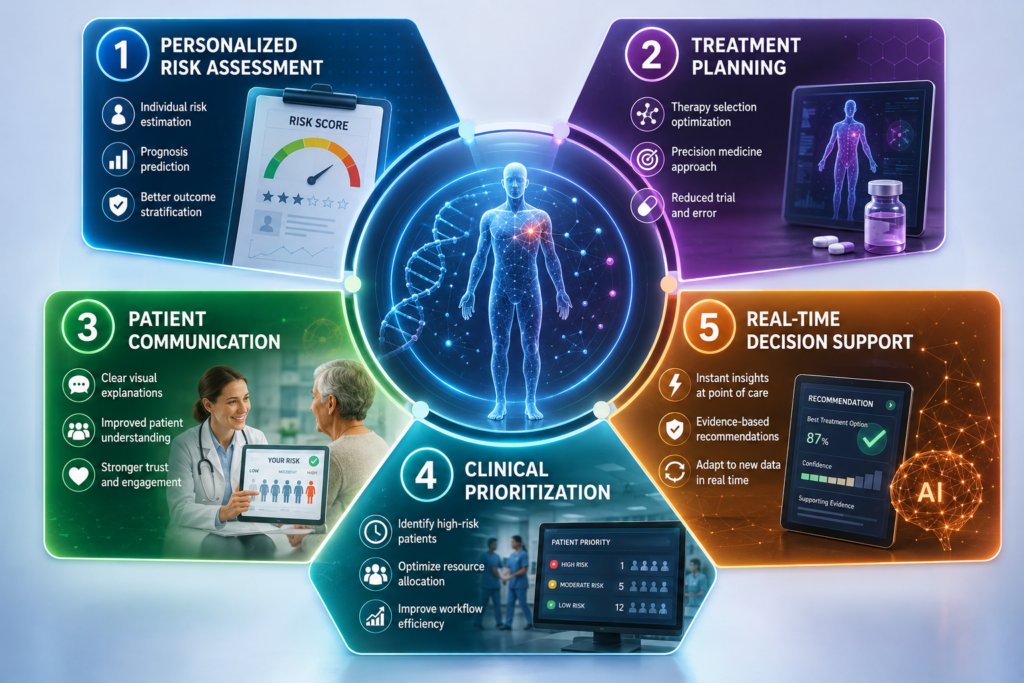
That could eventually support several aspects of oncology practice:
- Personalized risk assessment: Clinicians could supplement traditional staging with a broader patient profile.
- Treatment planning: AID markers could help identify patients who may require different treatment intensity or closer monitoring.
- Patient communication: Explaining the factors behind an AI prediction may make algorithmic recommendations easier to discuss with patients.
- Clinical prioritization: Healthcare teams could identify particularly concerning combinations of laboratory, functional and disease-related characteristics.
- Real-time decision support: Because many of these variables are routinely collected in electronic health records, the researchers suggest that similar systems could potentially be integrated into hospital workflows.
Validation Strengthens the Findings of xAI
To validate the findings of the platform, it was tested against an independent cohort of 3,288 patients with advanced non-small-cell lung cancer from the US-based Flatiron Health electronic health record-derived database.
The relationship between marker values and xAI risk contributions showed a strong correlation between the internal and external datasets, with Pearson’s r = 0.90. The xAI-derived relationships also correlated strongly with conventional Cox-model hazard ratios.
Future Insights
The study provides a proof of concept for explainable, data-driven oncology. The findings represent an encouraging step toward AI-assisted, personalized cancer care. Rather than replacing oncologists or randomized clinical trials, this approach has the potential to complement clinical expertise by helping physicians interpret complex patient data and identify patterns that may otherwise be difficult to detect.
Because the study used retrospective real-world data, factors such as confounding and selection bias need to be carefully considered. Future research involving larger and more diverse patient populations, additional cancer types, and broader external validation can help establish how consistently these findings translate across clinical settings.
The study clearly suggests that treatment-related findings should be viewed as hypothesis-generating rather than definitive evidence of treatment effectiveness, because treatments in real-world data are not randomly assigned. The authors therefore position this framework as a tool that can generate new clinical insights and inform the design of future randomized clinical trials.
Still, its central message is compelling: the future of personalized cancer treatment may depend not on finding one perfect biomarker, but on understanding how multiple pieces of patient information interact.
By combining multimodal real-world data, deep learning and explainable AI, this research moves cancer prognosis toward a model that is not only predictive, but also contextual and interpretable. That could be a crucial step toward more individualized, data-driven cancer care.