An Evidence-Based Digital Platforms Can Help Cancer Patients Make Informed Decisions
Why Reliable Online Cancer Information Matters
Cancer patients often face a large volume of medical information while simultaneously making important decisions about diagnosis, treatment, nutrition, side effects, and supportive care. Although the internet has become a major source of health information, online cancer content can vary substantially in quality, readability, and reliability. This creates a practical challenge: patients need information that is not only evidence-based but also understandable and easy to access.
A study conducted at Institute of Psychosocial Medicine, Jena University Hospital, Germany examined how cancer patients and patient navigators used a web-based knowledge database developed as part of the PIKKO project.
For this, a database, called “My PIKKO,” was designed to provide quality-assured, evidence-based cancer information in language suitable for medical laypersons. The study evaluated who used the platform, how frequently it was used, which topics attracted the greatest interest, how users evaluated the database, and whether its use was associated with changes in health literacy.
The outcomes of the study came out to be quite interesting and they provide practical lessons for hospitals, cancer organizations, healthcare professionals, and developers of digital health platforms. In particular, the study suggests that a carefully designed online cancer information system can support informed decision-making, while also revealing important barriers that must be addressed to improve accessibility and long-term engagement.
Cancer Database Design: Combining Real-World Usage Data with Patient Feedback
The PIKKO Project
The PIKKO project, was used as a German cancer care initiative that provides patients with additional support through three components: patient navigation, counselling and support services, and a web-based knowledge database. The analysis of the database itself used an observational design and followed STROBE reporting principles for cohort studies.
The “My PIKKO” knowledge database was designed specifically for patients rather than healthcare professionals. Its content was based on systematic literature searches in MEDLINE and EMBASE, with additional evidence sources used when necessary, particularly for rare tumors. The content was also compared with German clinical guidelines.
Importantly, the database was developed according to established quality criteria for health information, including DISCERN, HONCode principles, and Good Practice Health Information standards. The researchers also considered readability. Automated readability measures were incorporated into the editorial system to help ensure that the information remained understandable for people with approximately 9 to 10 years of schooling.
To examine the effects of using database both cancer patients and their navigators were enrolled.
The database contained information on:
- General cancer topics
- Cancer-specific information
- Social or legal issues.
The database also provided brief information regarding:
- Therapy
- Diagnosis
- Nutrition
- Physical activity
- Psychological support
- Side effects
- Palliative care
- Rehabilitation
- Insurance
- Financial matters
- Naturopathy
Data Sources in PIKKO Project
A major strength of the methodology was the combination of two data sources.
- Automatically generated logfiles recorded access to database content, including the pages and topics viewed and the timing of user activity.
- Patient surveys collected information about user experiences, reasons for non-use, perceived usefulness, and satisfaction.
- In addition, qualitative analysis was also incorporated, where open-ended patient responses were inductively coded into categories, allowing the researchers to identify practical reasons why some participants did not use the system and what improvements users wanted.
Health literacy was assessed repeatedly using the HLS-EU-Q47 questionnaire, in which higher scores indicate greater health literacy.
This mixed approach is particularly useful for digital health research because usage statistics alone cannot explain why people engage with a platform or why they stop using it.
The study strongly suggests that digital health platforms should not simply transfer technical or scientific information onto a website. Instead, evidence quality, readability, neutrality, and the needs of the target population should all be considered during content development.
What Cancer Information Did Patients Search For?
As observed, among patients who could potentially access the web-based knowledge database, 65.9%, used their login at least once.
Among patients who reported never using the platform, the most common reasons were:
- Technical difficulties
- Perceived lack of need
- Lack of time
- Avoiding information related to cancer,
- Health-related limitations
- Lack of motivation.
These findings have important implications for healthcare organizations implementing digital patient education tools. Providing a website or application is not sufficient by itself. Patients may need technical support, clear instructions, and encouragement from healthcare professionals. Digital literacy and emotional readiness can also influence whether patients choose to seek information online.
Requirement of different information between patients and patient navigators
For patients, some the major information sources searched are:
- Therapy
- Nutrition
- Side effects
- Carcinogenesis
- Psychological support
When considering the amount of time spent reading content, therapy remained the leading topic, followed by psychological support and carcinogenesis indicating that cancer patients need more than basic information about their diagnosis. They actively seek practical information that can help them understand treatment, manage side effects, make lifestyle decisions, and cope with the psychological consequences of cancer.
Among patient navigators, on the other hand, different pattern of use is observed where they serach more for:
- Therapy
- Naturopathy
- Legal regulations
- Financial support.
This suggests that healthcare support staff may use evidence-based databases not only for their own knowledge but also to prepare for questions raised during patient consultations.
A successful cancer information platform should, thus cover medical, psychological, lifestyle, and social needs because a cancer care does not end with information about treatment alone.
Patients Reported Better Support for Informed Decisions
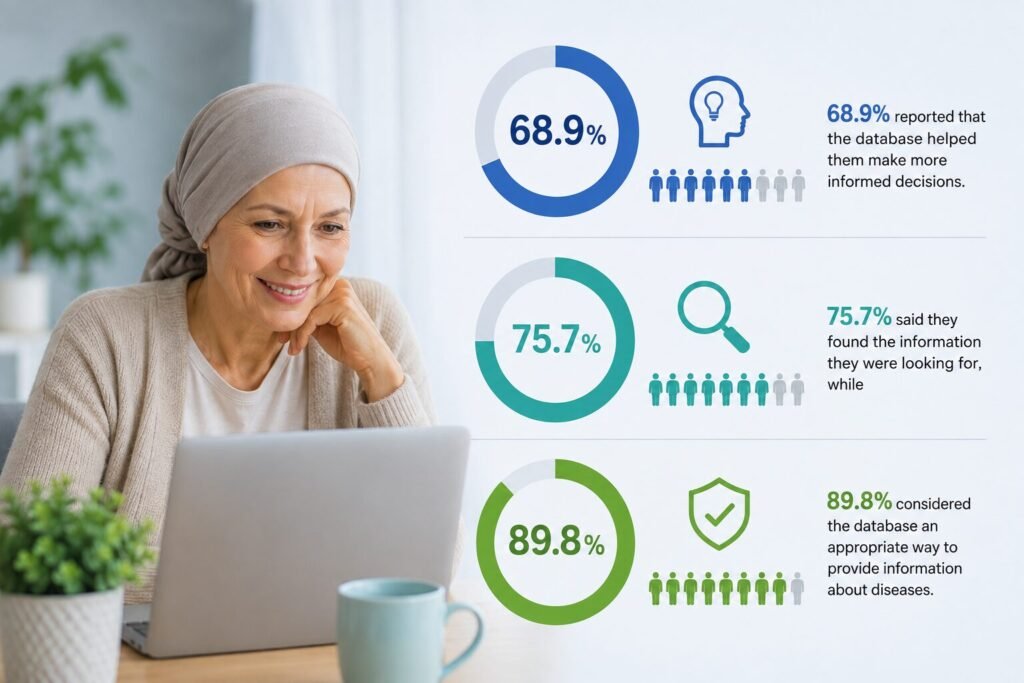
Among surveyed users:
- 9% reported that the database helped them make more informed decisions.
- 7% said they found the information they were looking for, while
- 8% considered the database an appropriate way to provide information about diseases.
The platform received an average rating of 2.16 on the German school grading scale, corresponding to a rating of “good.”
Additional Searches on the Database
Patients used the database for several practical purposes:
- Finding answer to questions about cancer or treatment,
- Obtaining a general or cancer-specific information.
- For scheduling appointments with physicians and patient navigators.
Evidence-based digital information can complement, rather than replace, communication with healthcare professionals. Patients may use online resources before appointments to prepare questions or afterward to better understand the information they received.
Health Literacy Benefits and an Important Limitation
When investigated to analyse the relationship between database use and health literacy., it was found that the patients with higher health literacy at baseline experienced greater improvements in health literacy when they used the database more frequently.
This finding is promising but also highlights an important challenge. Digital health tools may be most easily used by people who already have relatively strong health literacy and experience seeking information online. In fact, database users were significantly more likely than non-users to report that they usually used the internet to search for information.
Therefore, future digital health interventions should consider additional strategies for patients with lower health literacy or limited digital skills. Simplified navigation, multimedia content, guided onboarding, patient navigator support, and interactive assistance could potentially reduce these barriers.
Applications of the Healthcare and Digital Health Platforms
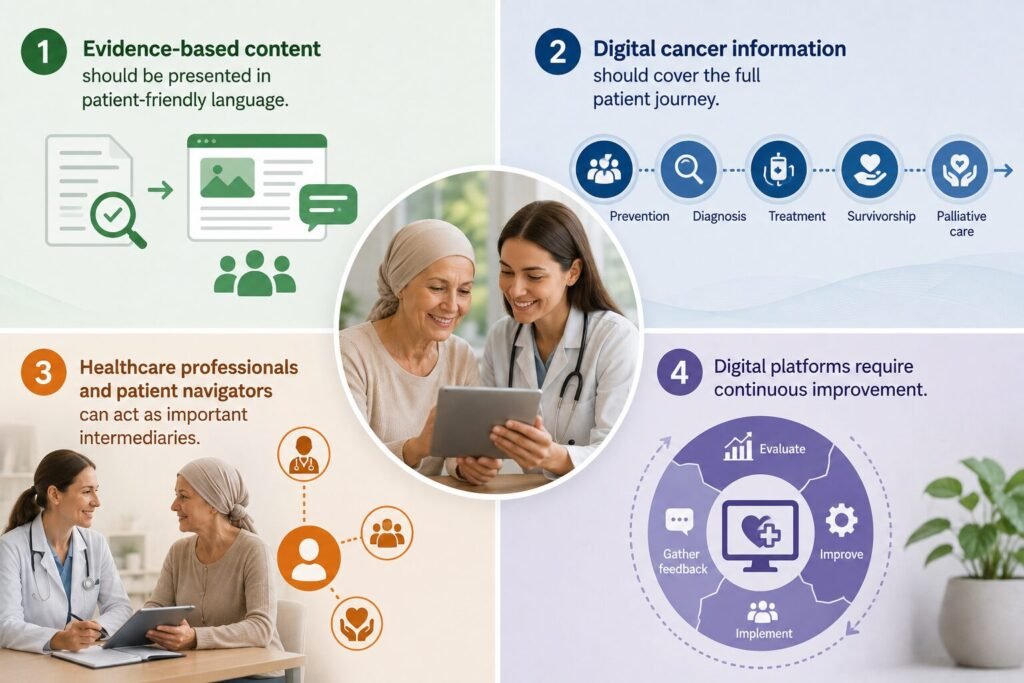
The PIKKO study offers several practical recommendations.
- Evidence-based content should be presented in patient-friendly language. Scientific accuracy is essential, but information that patients cannot understand has limited practical value.
- Digital cancer information should cover the full patient journey. Treatment, nutrition, side effects, psychological support, physical activity, financial issues, rehabilitation, and legal support can all be relevant.
- Healthcare professionals and patient navigators can act as important intermediaries. Patient navigators are responsible for approximately 1/3rd of all database accesses and uses the platform over longer periods. Their role can help patients locate reliable information and interpret it within the context of their individual care.
- Digital platforms require continuous improvement. Patients often request for more information, additional functions, greater interaction with medical staff, opportunities to communicate with other patients, and improvements in design and functionality.
In future, digital databases can be improved to include interactive features or conversion to a native mobile application.
Future Insights
Building Better Digital Cancer Information Systems
The PIKKO web-based knowledge database demonstrates the practical potential of evidence-based digital health information for cancer care. Approximately 2/3rd of patients used the platform that helped them to find relevant information and make more informed decisions.
Moving ahead with the technological advancement, digital platforms should provide information beyond medical treatment such as, side effects, psychological support, physical activity, social issues, and other practical concerns. Although some important technical barriers, limited time, motivation, and differences in health literacy can prevent some patients from benefiting from online resources.
For hospitals, cancer centres, healthcare organizations, and digital health developers, trustworthy online cancer information can be a valuable component of patient-centered care. When evidence-based content is combined with accessible language, professional support, and user-centered design, digital knowledge platforms have the potential to strengthen health literacy and support better-informed healthcare decisions.