Bilberry Pomace Shows Promising Anticancer Effects Against Breast Cancer
Bilberry Pomace and Breast Cancer
Breast cancer remains one of the most frequently diagnosed cancers among women worldwide, creating an ongoing need for preventive strategies and more effective, less toxic treatment approaches.
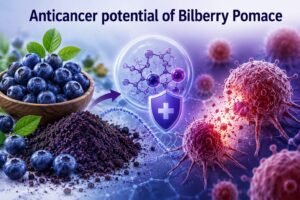
Most researchers are now shifting their interest towards natural compounds as a potential therapeutic molecule owing to their high molecular affinity and lowest toxicities. On similar principle scientists of Comenius University in Bratislava, Slovakia have investigated the anti-cancer potential of peel-enriched bilberry (Vaccinium myrtillus L.) pomace. Also called as European wild blueberry, the fruit is gaining scientific attention for its rich content of anthocyanins, flavonoids, phenolic compounds, fatty acids, and triterpenes. It contains peel and seed material that can retain bioactive compounds after juice production.
Rather than focusing only on conventional extracts, researchers examined the residual material left after bilberry juice production. This pomace is particularly interesting because the peel contains concentrated levels of secondary metabolites, including anthocyanins, flavonoids, phenolic compounds, fatty acids, and triterpenes.
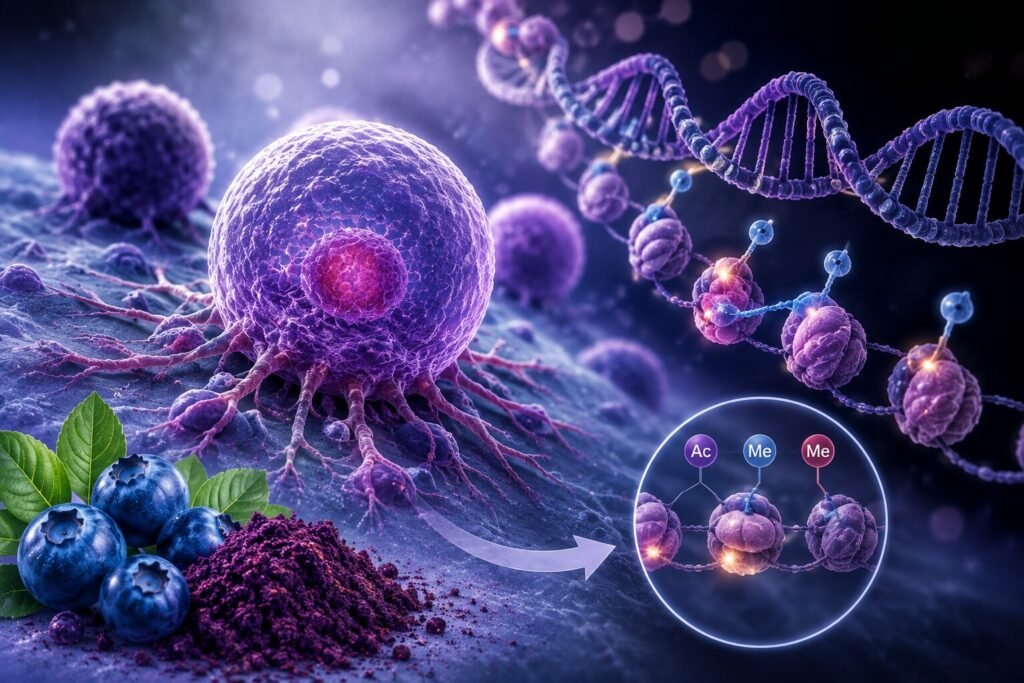
Bilberry Pomace Shows Promising Anticancer Potential
To study the anti-cancer activity of the peel-enriched bilberry pomace, two extracts were used:
- Methanolic extract (BILMeOH)-enriched in phenolic compounds, including anthocyanins, chlorogenic acid, and quercetin glycosides.
- Hexane extract (BILHEX)-containing predominantly nonpolar compounds, including unsaturated triacylglycerols and triterpene acids such as oleanolic and ursolic acids.
Advanced analytical platforms, including liquid chromatography–mass spectrometry and ultra-high-performance supercritical-fluid chromatography, were used to characterize these compounds.
Bilberry Reduces Tumor Growth
An aggressive 4T1 mammary carcinoma model in BALB/c mice, for triple-negative breast cancer was used where animals received diets containing either 0.3% or 3% bilberry peel-enriched pomace. Tumor growth was monitored repeatedly, while tumor tissues were subsequently examined histologically.
Compared with untreated controls:
- Tumour volume reduced by approximately 51% at the lower dose and 91% at the higher dose.
- Mitotic activity decreased by approximately 5% at the lower dose and 55% at the higher dose.
- The necrosis-to-tumor ratio also decreased by approximately 82% and 92%, respectively.
Importantly, these results represented growth delay rather than complete tumor eradication.
Bilberry Pomace provides chemopreventive effects
A second model used was NMU-induced mammary carcinogenesis in Sprague-Dawley rats, whose bilberry supplementation began before carcinogen exposure and continued for 14 weeks.
This model allowed researchers to examine potential chemopreventive effects, including tumor development, histological grade, apoptosis, proliferation, oxidative stress, cancer stem-cell markers, epigenetic changes, microRNAs, cytokines, and metabolic profiles.
Evaluations reveal that:
- At high-doses bilberry supplementation increased Bax expression, a pro-apoptotic protein, by approximately 153%, while reducing the anti-apoptotic protein Bcl-2 by 50%.
- Consequently, the Bax/Bcl-2 ratio increased by approximately 5%, supporting activation of programmed cell death.
- The apoptosis marker cleaved caspase-3 also increased significantly.
- At the same time, the proliferation marker Ki-67 decreased by 48% at the higher dose.
These findings suggest that bilberry may influence tumors through two complementary mechanisms: reducing cancer-cell proliferation while promoting apoptosis.
Antiproliferative activity of Bilberry Pomace
Bilberry extracts were tested against two human breast cancer cell lines:
- MCF-7, representing estrogen-receptor-positive breast cancer
- MDA-MB-231, representing triple-negative breast cancer
Importantly, both conventional 2D cell cultures and 3D tumor spheroids were used. The latter can better reproduce aspects of tumor architecture and treatment resistance.
Five extracts were initially screened, and the hexane extract, BILHEX, demonstrated the strongest anticancer activity. Researchers then investigated cell-cycle effects, apoptosis, mitochondrial dysfunction, and interactions with cisplatin.
When BILHEX was combined with cisplatin in both 2D and 3D breast cancer models, the interaction was predominantly additive. In 3D spheroids, however, the combination demonstrated synergistic cytotoxicity.
BILHEX activated the intrinsic apoptotic pathway, including mitochondrial membrane depolarization, cytochrome-c release, increased caspase-9 activity, and downstream activation of the apoptotic cascade.
Reduced Oxidative Stress and CD133 Expression
Another potentially important outcome of the study involved evaluation of oxidative stress.
When measured, malondialdehyde (MDA), a marker of lipid peroxidation, decreased by approximately 53% at the lower dose and 75.5% at the higher dose.
High-dose bilberry supplementation reduced CD133 expression by approximately 23% (P < 0.01) while other markers, including CD24, CD44, ALDH1A1, and EpCAM, did not change significantly.
Bilberry peel extract influences Epigenetics and MicroRNAs expression
- High-dose supplementation of the extracts could reduce H3K4me3 by 12%, increased H4K20me3 by 22.5%, and increased H4K16ac by 31%.
- MicroRNA profiling identified nine significantly altered microRNAs, with five meeting the predefined biological relevance threshold of a twofold change: let-7d-5p, let-7i-5p, miR-1224, miR-494-3p, and miR-6216.
It was found that a significant 12% absolute increase in RASSF1 promoter methylation at the high dose. These findings indicate that bilberry’s biological effects may involve multiple levels of gene regulation.
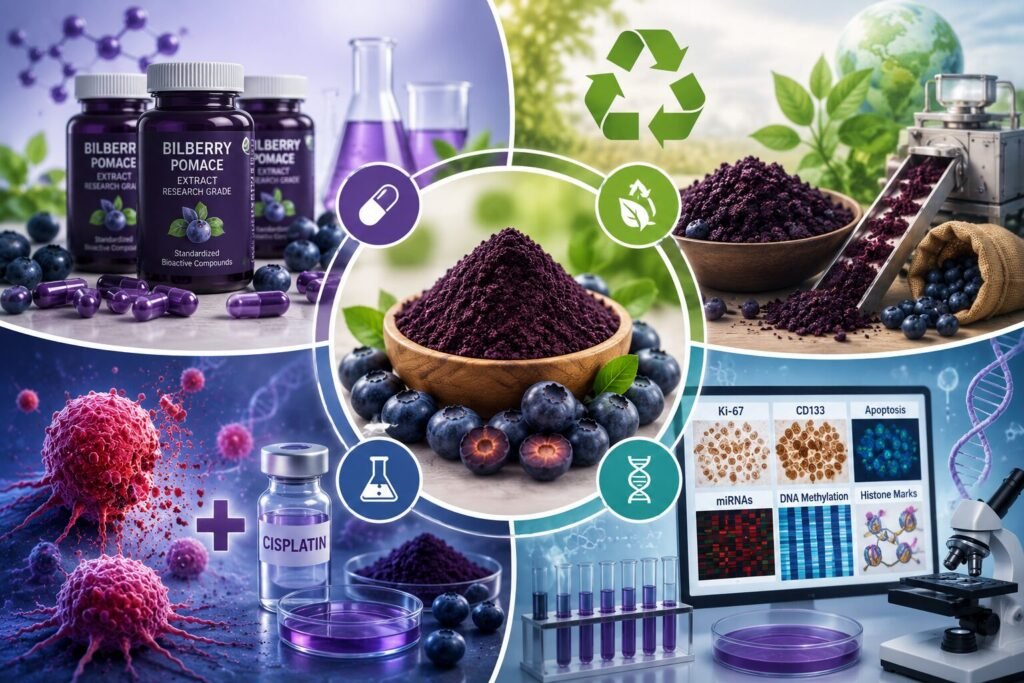
Could Bilberry Enhance Chemotherapy?
The findings point toward several potential applications.
Nutraceutical development: Bilberry pomace could provide a valuable source of bioactive compounds for standardized research-grade formulations.
Sustainable food innovation: Converting fruit-processing pomace into a potential high-value bioactive ingredient could help reduce agricultural waste.
Cancer-drug research: The observed cisplatin synergy provides a rationale for investigating bilberry-derived compounds as potential chemotherapy adjuncts.
Biomarker-guided research: Changes in Ki-67, CD133, apoptosis markers, microRNAs, and epigenetic markers could help researchers explore which biological profiles may respond most strongly to bilberry-derived interventions.
The study also reported favorable tolerability in the animal models, with no significant changes in body weight or food intake and no obvious gross pathology in major organs at the tested exposures.
Future Insights
The presented study is preclinical finding that demonstrated the anti-cancer potential of Bilberry pomace peel enriched extracts, suggesting that a standardized bilberry-derived compound or extract can be further investigated as an adjunct to conventional therapy.
Translational research may be designed further to confirm mechanisms, refine dosing, standardize formulations, and investigate biomarker-guided applications of the extracts.
Notably, bilberry peel-enriched pomace contains biologically active compounds capable of influencing multiple cancer-related pathways.
From tumor growth and apoptosis to oxidative stress, CD133 expression, epigenetic regulation, and chemotherapy interactions, the findings create a strong foundation for further research into natural anticancer agents and personalized cancer strategies.