
How Rising Temperatures and Heatwaves Affect Mental Health: Evidence from a Systematic Review and Meta-Analysis

Rising temperatures and increasingly frequent heatwaves may have consequences that extend beyond physical health. Climate change and global warming are of major concerns among environmentalists; however, it is now being discussed among health professionals as rising temperatures have been affecting our health and overall well- being.
To take a deep dive into this concern, a meta-analysis conducted at the School of Public Health, the University of Adelaide, South Australia, made an attempt to study the association between hot weather and poor mental health outcomes. This meta-analysis has found that higher temperatures and periods of extreme heat are associated with worsening mental health outcomes, including increased mental-health-related mortality and hospital visits.
The findings suggest that even relatively small increases in temperature may have measurable effects across large populations. The results also highlight the importance of protecting vulnerable groups and preparing healthcare systems for the mental health challenges that may accompany extreme weather events.
Effect of temperature on Mental Health
After thorough data mining and quantification of over 1.7 million deaths and 1.9 million mental health cases, the study found that higher temperatures are linked to worse mental health outcomes.
- Small Temperature Increases Matter
The study reports that for every 1°C increase in temperature, mental health-related mortality rises by 2.2% while the hospital visits increase by 0.9%. These numbers seem to be small at first glance, but as quantified across large populations, they translate into a significant public health burden.
These findings are particularly important because climate change is associated not only with isolated extreme weather events but also with gradual increases in average temperatures in many parts of the world.
- Mental Health conditions that are more affected
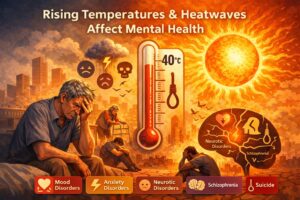
Specific disorders like substance-related psychosis, depression, anxiety, and neurocognitive disorders, Organic mental disorders like Alzheimer’s, infections, stroke, toxins, or traumatic brain injury (TBI) and Mood disorders, anxiety, and schizophrenia were all associated with higher hospital admissions in regions such as Asia, Oceania, Europe, North and South America, which report to have increased temperature over last decade.
- Risk of amplified heatwaves
A heatwave is described as an extreme heat period of 3 or more consecutive days where local excess heat accumulates over a sequence of unusually hot days and nights.
Also, when the mean temperature reaches or exceeds the 95th percentile of mean temperature for at least 3 days, physicians report a significant increase in mental health-related illness among their patients. These also increase the risk of suicide and self-harm among patients who are suffering from any kind of brain disease.
Patient groups that are more vulnerable to increased temperature
Increased temperatures lower the body’s efficiency, particularly for those tasks that require physical effort or high-level cognitive concentration. High heat affects attention, memory, and recognition, which is also linked to sleep disruption, affecting the overall performance of the human. High temperature also affects the levels and balance of the neurotransmitters serotonin and dopamine in the brain, which have roles in mood, cognitive function, and complex task performance.
People who are more likely to be affected due to high temperatures are:
- Older adults who are 65 years of age and older
- Men are comparatively more affected among others, most likely due to higher skeletal muscle mass and high levels of testosterone that generate more internal heat.
- People of lower income levels, living in tropical and subtropical climates, have higher effects of rising temperatures.
Which Mental Health Conditions May Be Affected?
The analysis found associations between higher temperatures and increased hospital admissions or adverse outcomes involving a range of mental health conditions.
These included conditions such as:
- Depression and other mood disorders
- Anxiety-related disorders
- Schizophrenia and other psychotic disorders
- Substance-related mental health conditions
- Neurocognitive and organic mental disorders
The findings suggest that the relationship between temperature and mental health is not limited to a single psychiatric condition.
Also, extreme temperatures may interact with multiple factors, including existing health conditions, living environments, access to cooling, socioeconomic circumstances, and the capacity of healthcare systems to respond during periods of extreme heat.
Measurable actions to be taken to tackle the rising temperatures
The study highlights several priorities:
- Developing effective heat-health preparedness plans
- Identifying and supporting vulnerable populations
- Strengthening healthcare and mental health services during extreme weather
- Improving access to cooling and heat-resilient housing
- Incorporating mental health into climate and public-health planning
- Supporting research to better understand how heat exposure affects different mental health conditions
1) Public Health Planning
Health systems can proactively plan to prepare their medical inventories for medicines and ventilators for increased demand during hot periods. Hospitals may increase their staff during heatwaves. Emergency services can anticipate spikes in mental health cases. Physicians should keep note of early warning signs and symptoms of patients who are especially more likely to be suffering from mental health-related illness.
2) Urban Design and Policy
City administration and urban design must take note of increasing the green spaces to lower urban temperatures. People should improve their housing insulation and cooling systems, which may reduce heat exposure and provide an ambient environment for all.
3) Support for the vulnerable groups
Older adults, people with existing mental health conditions, socially vulnerable populations, and individuals with limited access to cooling may benefit from targeted outreach during heatwaves.
4) Awareness about climate change
Most important of all is to raise alarms about climate change and adopt sustainable and renewable alternative solutions such as Cool Roofs, bamboo sheds, geothermal air-conditioning, solar-powered cooling, ice-powered air conditioning and water coolers, swamp coolers can be used to effectively lower the temperatures.
People should be aware that the environmental rise in temperatures due to increasing pollution is seriously affecting our physiological and mental well-being. We, as responsible dwellers of this planet, should come forward to make it a thriving and nourishing entity of the future.






Pingback: HOPES Program improves Mental Health, Skills, and Preventive Care in Older Adults - Sci-Tech Bulletin