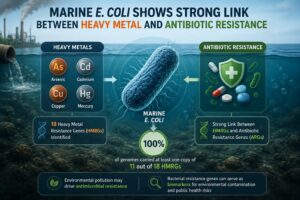
Marine E. coli Shows Strong Link Between Heavy Metal and Antibiotic Resistance
Heavy Metal Resistance in Marine E. coli: What This Groundbreaking Research Means for Public Health
Environmental pollution is increasingly becoming a global public health issue rather than just being an ecological concern. Heavy metals such as arsenic, cadmium, copper, and mercury are naturally occurring elements, but industrial activities have significantly increased their concentrations in ecosystems worldwide. These toxic metals persist in water and soil for decades and can influence bacterial adaptation. Researchers have increasingly suspected that exposure to heavy metals may indirectly promote antibiotic resistance in bacteria.
To validate this suspect, researchers at the Department of Epidemiology and Department of Environmental and Occupational Health Sciences, University of Washington have investigated heavy metal resistance genes (HMRGs) in Escherichia coli (E. coli) from the marine ecosystem. These isolates were obtained from the Salish Sea watershed ecosystem which is a marine region with a long history of environmental pollution. It was found that heavy metal contamination in marine ecosystems may contribute to the spread of antimicrobial resistance (AMR), which is one of the biggest threats to modern medicine.
Whole Genome Sequencing
Whole genome sequencing (WGS) was executed to analyze 308 E. coli isolates collected from various environmental and animal sources such as marine water, freshwater streams, harbor seals, harbor porpoises, river otters and fish species such as English sole. Out of these, 224 isolated were obtained from water sources while 84 came from marine mammals. These isolated were also tested for phenotypic antibiotic resistance using laboratory susceptibility testing methods aligned with Clinical and Laboratory Standards Institute (CLSI) standards.
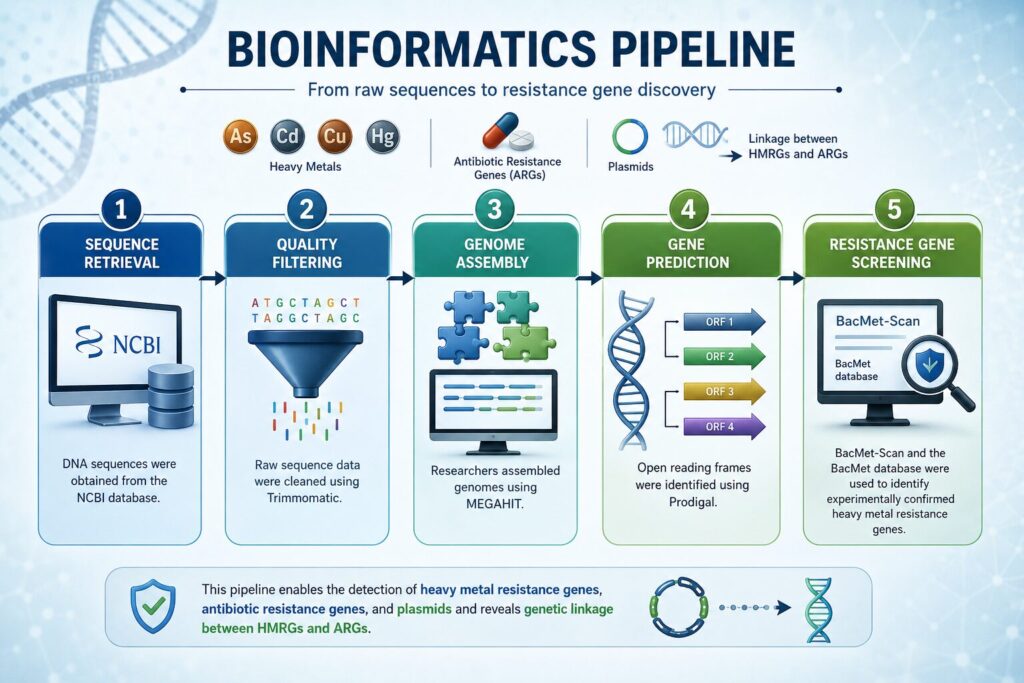
Bioinformatics Pipeline
A sophisticated bioinformatics workflow was implemented to detect both heavy metal resistance genes associated with resistance to arsenic, cadmium, copper, and mercury. In addition, antibiotic resistance genes (ARGs) and plasmids were also screened and studied for genetic linkage between HMRGs and ARGs using following methodology:
- Sequence Retrieval
DNA sequences were obtained from the National Center for Biotechnology Information (NCBI) database.
- Quality Filtering
Raw sequence data were cleaned using Trimmomatic software to remove low-quality reads.
- Genome Assembly
Researchers assembled genomes using MEGAHIT.
- Gene Prediction
Open reading frames were identified using Prodigal.
- Resistance Gene Screening
BacMet-Scan software and the BacMet database were used to identify experimentally confirmed heavy metal resistance genes.
Linkage between Heavy Metal Resistance Genes and Antibiotic Resistance
- HMRGs are widespread
Across the E-coli genome HMRGs are universally present, carrying at least one copy of 11 out of 18 HMRGs. The isolates obtained from the Salish Sea watershed carried between 14 and 20 HMRGs each. The most common resistant genes identified included:
- cutF/nlpE (copper resistance)
- robA (cadmium/mercury resistance)
- arsC (arsenic resistance)
Among these genes, copper resistance genes were especially prevalent throughout the ecosystem. The findings suggests that copper resistance helps bacteria survive harsh environmental conditions including, acidic environments, temperature stress, and toxic metal exposure. This indicates that environmental copper contamination may be exerting strong selective pressure on marine bacterial populations.
- Genetic Link Between Heavy Metal and Antibiotic Resistance
Among the 25 antibiotic-resistant isolates 80% carried HMRGs, ARGs, and plasmid sequences and 40% displayed physical linkage between HMRGs and ARGs on their genomes.
This data is significant because linked genes can spread together through bacterial populations. In other words, heavy metal pollution may indirectly encourage the spread of antibiotic resistance in bacterial population.
Several other important linked resistance genes were identified, including:
- sul2
- catA1
- cusS
- tet(A)
These genes are located on plasmids, which are mobile genetic elements capable of transferring resistance traits between bacteria.
- Critical role of Plasmids
In the isolated E-coli species, plasmids were highly prevalent in resistant isolates. About 56% of all isolates and 80% of antibiotic-resistant isolates carried plasmid sequences. This finding reinforces the concern that environmental bacteria can serve as reservoirs for resistance genes that may eventually reach human pathogens.
- Resistance Patterns are spread throughout the ecosystem
Interestingly, no measurable geographic variation in heavy metal resistance gene prevalence, even near Superfund sites. This suggests that heavy metal contamination may already be widespread throughout the ecosystem rather than localized around polluted areas.
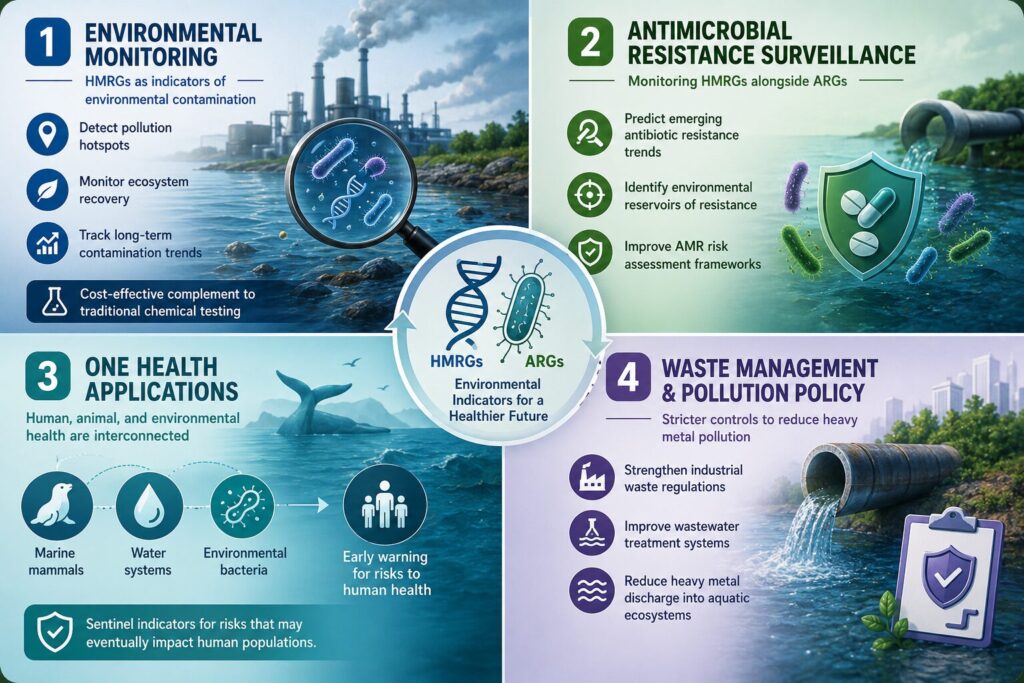
Environmental implications of HMRGs and ARGs
- Environmental Monitoring
Bacterial heavy metal resistance genes may act as biological indicators of environmental contamination. Public health agencies and environmental regulators could use HMRG surveillance to:
- Detect pollution hotspots
- Monitor ecosystem recovery
- Track long-term contamination trends
This provides a cost-effective complement to traditional chemical testing methods.
- Antimicrobial Resistance Surveillance
A growing body of evidence suggests that environmental pollution contributes to antimicrobial resistance. Monitoring HMRGs alongside ARGs could help
- Predict emerging antibiotic resistance trends
- Identify environmental reservoirs of resistance
- Improve AMR risk assessment frameworks
- One Health Applications
A “One Health” approach, that recognizes human, animal, and environmental health as interconnected entities could be implemented. Marine mammals, water systems, and environmental bacteria can serve as sentinel indicators for risks that may eventually impact human populations.
- Waste Management and Pollution Policy
The persistence of heavy metal resistance genes highlights the importance of stricter environmental pollution controls. Policies can be made to:
- Strengthen industrial waste regulations
- Improve wastewater treatment systems
- Reduce heavy metal discharge into aquatic ecosystems
Future Insights
Antibiotic resistance is often viewed solely as a healthcare problem, but this study reveals that environmental pollution may also be driving the crisis. Heavy metals remain in ecosystems far longer than antibiotics, continuously exerting selective pressure on bacterial populations. As bacteria adapt, they may simultaneously acquire resistance to clinically important antibiotics.
Through advanced whole genome sequencing and bioinformatics analysis, researchers demonstrated the important connections between environmental pollution and microbial evolution. As global concern over antimicrobial resistance grows, studies like this emphasize the need for integrated environmental and healthcare strategies. Understanding how pollutants shape bacterial resistance patterns could play a vital role in protecting both ecosystem and human health in the future.