
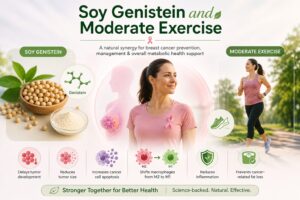
Soy Genistein and moderate exercise improve anti-cancer responses in breast cancer models
Lifestyle Strategy for Breast Cancer Prevention
Breast cancer remains one of the most prevalent cancers and a leading cause of cancer-related mortality among women worldwide. While genetic factors contribute to disease risk, lifestyle factors such as obesity, high-fat diets, and physical inactivity play a significant role in breast cancer development and progression. To better understand the combined effects of nutrition and exercise, researchers are investigating how dietary interventions and physical activity work together to support cancer prevention and improve outcomes.
A recent study conducted at Department of Nutritional Science and Food Management, Korea, studied the effects of genistein supplementation and regular moderate-intensity exercise on metabolic health and breast cancer development. Their study suggest that these lifestyle strategies may influence key biological processes, including apoptosis, immune regulation, inflammation, and adipose tissue metabolism, all of which are closely linked to breast cancer progression.
Genistein and Exercise in Breast Cancer Management
Genistein is a naturally occurring isoflavone found in soy foods. Previous researches has shown that it possesses antioxidant, anti-inflammatory, and anti-estrogenic properties that may inhibit cancer cell growth and promote programmed cell death (apoptosis).
Exercise, meanwhile, has long been associated with reduced cancer risk. Physical activity stimulates the release of myokines which are bioactive molecules produced by muscles, that influence immune function, inflammation, and tumor development.
Although both interventions have demonstrated benefits individually, researchers sought to determine whether combining genistein supplementation with moderate-intensity exercise would produce stronger anti-cancer effects.
How Genistein and Exercise reduce breast cancer progression
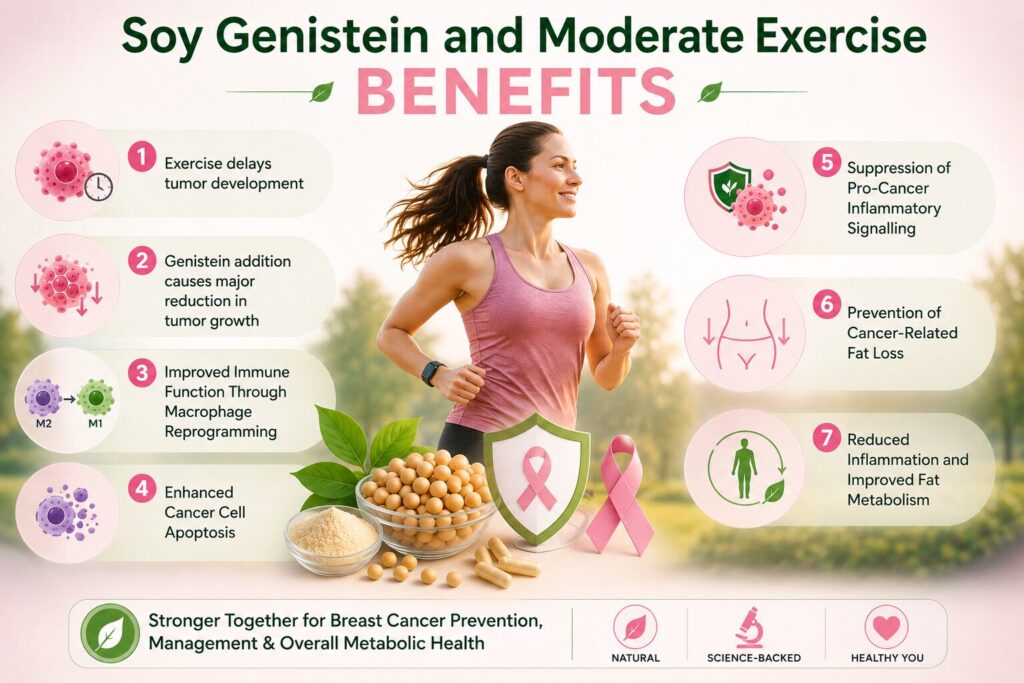
- Exercise delays tumor development
Moderate-intensity exercise delays tumor formation and reduced tumor incidence. When tested in mice, tumours appeared later in the exercise-treated groups, indicating a meaningful delay in cancer progression.
The findings reinforce existing recommendations that regular physical activity can be a powerful lifestyle intervention for reducing cancer risk and slowing disease progression.
- Genistein addition causes major reduction in tumor growth
Introduction of genistein diet, 5 times per week, to the exercising mice group, have found to substantially reduce tumor size and weight. These mice were also subjected to treadmill training for five days per week consisting of:
- 10-minute warm-up
- 30-minute moderate-intensity exercise at 13 m/min
- 10-minute cool-down
The mice were monitored for body weight, tumor growth, tumor incidence, and metabolic changes throughout the experiment.
Compared with the high-fat diet cancer group:
- Genistein reduced tumor weight by 22.3%
- Exercise reduced tumor weight by 84.0%
- Combined treatment reduced tumor weight by 89.9%
While exercise alone produces the strongest effect, the combined intervention greatly reduces overall tumour size. For individuals at increased risk of breast cancer, combining a physically active lifestyle with soy-rich dietary patterns may provide additional protective benefits.
- Improved Immune Function Through Macrophage Reprogramming
In addition to in vitro findings, in vitro experiments using human monocytic U937 cells confirmed that genistein and exercise:
- Increased M1 macrophage marker CD68
- Reduced M2 markers CD163 and Arg1
- Produced the strongest immune-modulating effects when combined
This finding suggests that lifestyle interventions can influence the tumor microenvironment, helping the immune system become more effective at identifying and attacking cancer cells.
- Enhanced Cancer Cell Apoptosis
Incorporation of genistein in the diet with daily exercising has also been found to:
- Reduced anti-apoptotic Bcl-2 protein levels
- Increased pro-apoptotic Bax protein expression
- Increased cleaved caspase-3, a key marker of cell death
These changes indicate that the treatments helped trigger cancer cell self-destruction.
- Suppression of Pro-Cancer Inflammatory Signalling
Laboratory experiments revealed that genistein and exercise-related myokines suppressed activation of the JAK1/STAT6 signaling pathway, which is strongly associated with M2 macrophage formation and tumor progression.
By blocking this pathway, the treatments reduced cancer-supportive immune responses. Thus, by targeting inflammatory pathways is an increasingly recognized important strategy in cancer prevention and management. These findings suggest natural interventions such as dietary bioactive natural supplements and healthy lifestyle may complement conventional approaches adopted to treat and prevent cancers.
- Prevention of Cancer-Related Fat Loss
Cancer often causes unhealthy metabolic changes, including adipose tissue wasting and cachexia. Remarkably, despite tumor development, genistein and exercise helped preserve both subcutaneous and visceral fat stores. Researchers found significant restoration of adipose tissue mass in treatment groups compared with untreated cancer-bearing mice.
Hence, maintaining healthy body composition during cancer treatment can support physical function, improve quality of life, and potentially enhance treatment tolerance.
- Reduced Inflammation and Improved Fat Metabolism
The combination therapy, combining genistein and exercise improves metabolic health by:
- Increasing genes involved in adipogenesis and fat storage
- Reducing genes associated with lipolysis (fat breakdown)
- Lowering inflammatory cytokines such as TNF-α and IL-1β
These effects help counteract cancer-associated metabolic dysfunction. The findings suggest that exercise and genistein may help preserve metabolic resilience in individuals experiencing chronic inflammation or cancer-related weight loss.
What This Means for Human Health
Although this study was conducted primarily in mice and laboratory cell models, the findings provide strong evidence that combining soy-derived genistein with regular moderate-intensity exercise may offer multiple protective mechanisms against breast cancer.
This groundbreaking research highlights the potential of integrating nutrition and exercise as complementary strategies in breast cancer prevention and support. Moderate-intensity exercise emerged as the most powerful individual intervention, while the addition of genistein further enhanced several biological pathways linked to cancer suppression. Thus, genistein supplementation and regular moderate-intensity exercise together exhibit significant anti-cancer effects through regulation of apoptosis, macrophage polarization, inflammation, and adipose tissue metabolism.
As clinical studies continue to explore these findings in humans, adopting an active lifestyle and consuming soy-rich foods may represent practical, evidence-informed steps toward supporting long-term breast health.
Pingback: Cucurbitacin D reduces colorectal cancer cell growth through multiple signalling pathways - Sci-Tech Bulletin