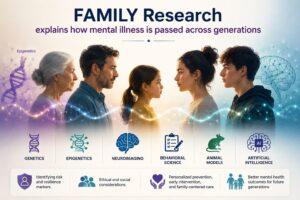
FAMILY Research explains how mental illness is passed across generations
Early Prevention and Risk Prediction of Mental illness
Mental illness often runs in families, yet healthcare systems have traditionally focused on treating individuals rather than understanding family-wide patterns of risk. A groundbreaking European research initiative known as FAMILY (Understanding and Predicting the Intergenerational Transmission of Mental Illness) is changing that paradigm. By combining genetics, neuroscience, epigenetics, artificial intelligence, and social sciences, the project aims to uncover how mental health risks are passed from parents to children and how resilience can be strengthened to prevent future disorders.
Understanding Family Mental Health Risk Matters
Research consistently shows that children of parents with severe mental illnesses face substantially higher risks of developing mental health disorders themselves. As the research highlights that more than 50% of children with a parent affected by severe mental illness develop a mental disorder by early adulthood. Despite this well-established risk, family history remains underutilized in mental health diagnosis, prevention, and treatment planning.
The consequences of overlooking family risk include:
- Delayed diagnosis of mental health conditions
- Missed opportunities for early intervention
- Limited resilience-building strategies
- Increased long-term healthcare burden
- Persistent intergenerational cycles of mental illness
The FAMILY consortium seeks to address these gaps by developing a comprehensive understanding of how genetic, environmental, biological, and social factors interact across generations.
FAMILY integrates a Multidisciplinary and Multimodal Approach
FAMILY model primarily aims to deliver:
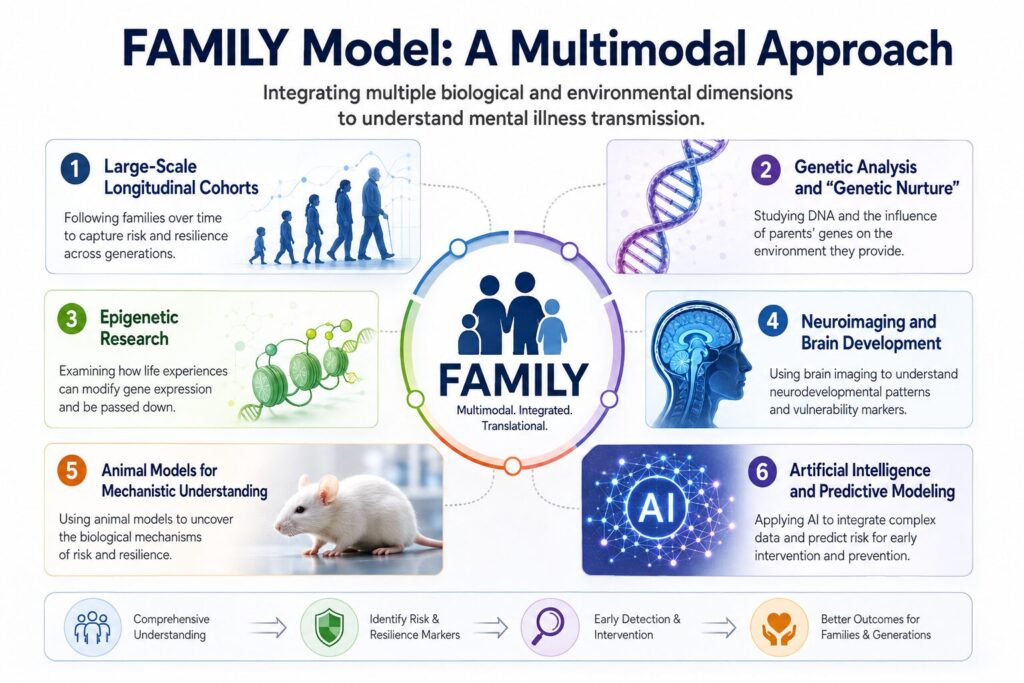
Rather than focusing on a single factor, researchers integrated multiple biological and environmental dimensions to understand mental illness transmission. Following multimodal approach integrated in the FAMILY framework.
- Large-Scale Longitudinal Cohorts
Datasets were prepared from cohorts that include:
- Genetic profiles
- Epigenetic markers
- Brain imaging data
- Behavioral assessments
- Environmental exposures
- Clinical mental health outcomes
- Genetic Analysis and “Genetic Nurture”
The genetically informed causal inference techniques help to distinguish between:
- Direct genetic inheritance, where children inherit risk genes from their parents.
- Genetic nurture, where parental genes influence the child’s environment and upbringing, indirectly affecting mental health outcomes.
Using polygenic risk scores and advanced statistical models FAMILY helps to understand how parental mental health influences offspring through both biological inheritance and environmental pathways.
- Epigenetic Research
The FAMILY project explores how environmental experiences alter gene activity through epigenetic mechanisms such as:
- DNA methylation (DNAm)
- Circulating microRNAs (miRNAs)
Researchers examine biological samples collected at birth and throughout development to determine how parental mental illness may influence children’s long-term mental health through epigenetic changes.
These epigenetic markers may become:
- Early-warning indicators of psychiatric vulnerability
- Targets for preventive interventions
- Biomarkers for personalized mental healthcare
- Neuroimaging and Brain Development
The project uses advanced neuroimaging techniques, including:
- Structural MRI
- Diffusion tensor imaging
- Functional MRI
Researchers investigate how parental mental illness affects offspring brain development and identify brain patterns associated with future psychiatric symptoms.
These findings may help clinicians:
- Detect risk before symptoms appear
- Monitor developmental trajectories
- Tailor interventions to specific neurodevelopmental profiles
- Animal Models for Mechanistic Understanding
To establish causal relationships that cannot be ethically tested in humans, the FAMILY consortium uses carefully designed animal studies.
These models allow researchers to investigate:
- Effects of maternal stress
- Genetic transmission pathways
- Environmental influences
- Potential protective interventions
Researchers can separate prenatal, postnatal, genetic, and caregiving effects to better understand how mental illness risk develops across generations. Thus, animal model provide critical evidence for designing future prevention programs and therapeutic strategies.
- Artificial Intelligence and Predictive Modeling
One of the project’s most ambitious goals is the creation of individualized risk prediction models.
Researchers combine:
- Genetics
- Epigenetics
- Brain imaging
- Behavioral data
- Environmental information
- Family history
Using multimodal machine learning and normative modeling techniques, the model predicts which individuals are most likely to develop mental health disorders in the future.
This could lead to:
- Earlier identification of vulnerable children
- Personalized prevention plans
- More targeted mental healthcare resources
- Improved clinical decision-making
Real-World Applications of the FAMILY Project
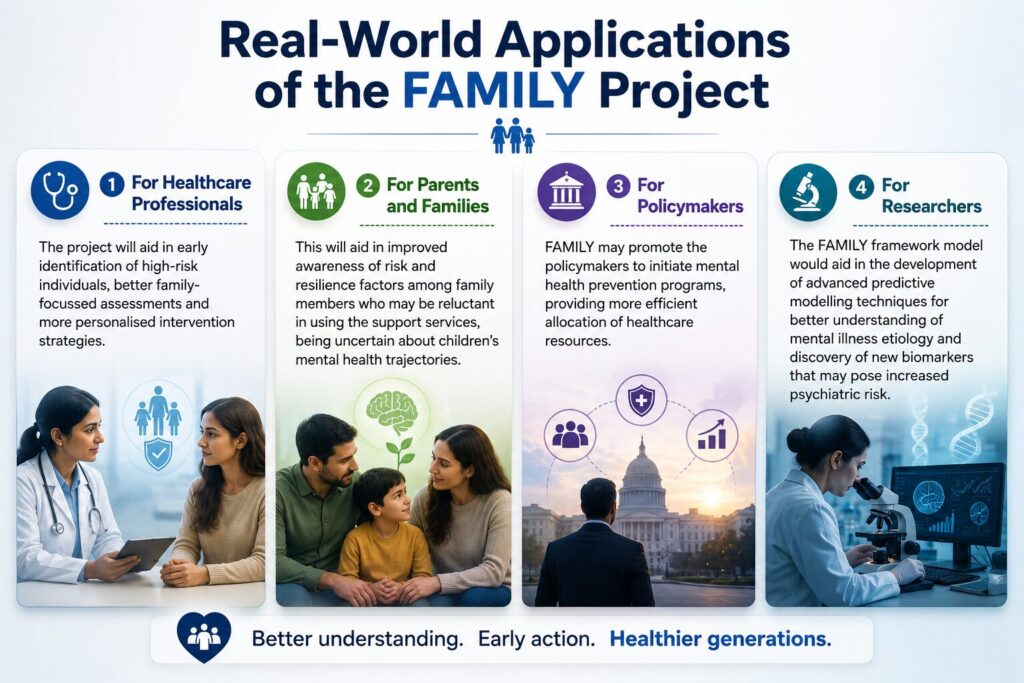
- For Healthcare Professionals
The project will aid in early identification of high-risk individuals, better family-focussed assessments and more personalised intervention strategies.
- For Parents and Families
This will aid in improved awareness of risk and resilience factors among family members who may be reluctant in using the support services, being uncertain about children’s mental health trajectories.
- For Policymakers
FAMILY may promote the policymakers to initiate mental health prevention programs, providing more efficient allocation of healthcare resources.
- For Researchers
The FAMILY framework model would aid in the development of advanced predictive modelling techniques for better understanding of mental illness etiology and discovery of new biomarkers that may pose increased psychiatric risk.
The greatest contribution of FAMILY lies in shifting mental healthcare from reactive treatment toward proactive prevention. Through earlier risk identification, improved understanding of resilience, and family-centered care strategies, FAMILY has the potential to break the cycle of mental illness across generations and improve outcomes for millions of families worldwide.