
Therapeutic Gardens Support Stress Recovery and Mental Well-Being
Nature-Based Therapy for Stress Recovery
Stress-related illness can profoundly affect daily functioning, work capacity, and overall quality of life. As interest is growing in holistic and supportive approaches to mental health, nature-based therapy (NBT) has emerged as a promising intervention that combines therapeutic practices with meaningful experiences in natural environments.
Study conducted at the Nacadia Therapy Garden in Denmark by the researchers of University of Copenhagen, provides valuable insight into how people with severe stress-related symptoms experience nature-based therapy. The research explored how participants experienced the therapeutic process and which elements helped them develop new strategies for managing everyday life.
The findings suggest that a carefully designed natural environment can provide more than a pleasant setting. When combined with psychological support, mindfulness-based practices, meaningful activities, and personal freedom, a therapeutic garden may create conditions that help individuals feel safe, become more aware of their needs, and develop practical coping strategies.
Exploring the Lived Experience of Nature-Based Therapy
In the study phenomenological approach known as reflective lifeworld research (RLR) was applied to understand the participants’ lived experiences rather than simply measure predefined clinical outcomes.
The study focused on individuals suffering from stress-related illnesses severe enough to result in an inability to work. These participants were subjected to 10-week nature-based therapy programme in which the overall therapeutic process aligned the participants toward seeing life from new perspectives.
Participants initially needed time to become familiar with the therapy programme, the garden, and the other participants. sHowever, as participants developed routines and discovered places within the garden that suited them, they increasingly experienced a sense of comfort and belonging.
The semi-structured interviews included open-ended questions, allowing participants to describe their impressions of the therapeutic garden, their preferred activities, and their experiences in specific locations.
Other additional sources of information was gathered to strengthen the understanding of the therapeutic context. These included:
- Interviews with the therapists
- Behavioural observations within the garden
- Participants’ personal logbooks
- Repeated interviews throughout the therapy programme
A whole-parts-whole process analysed the interview answers:
- First an overall understanding of the participants’ narratives was developed,
- Then meaningful units within the interview material were identified.
- These were then grouped into themes, and
- Developed in a broader interpretation of the essential meaning of the therapeutic experience.
This methodology is particularly valuable because stress recovery is highly individual. Two people may experience the same environment or activity differently depending on their energy levels, emotional state, personal history, and current needs.
What Did the Nature-Based Therapy Program Include?
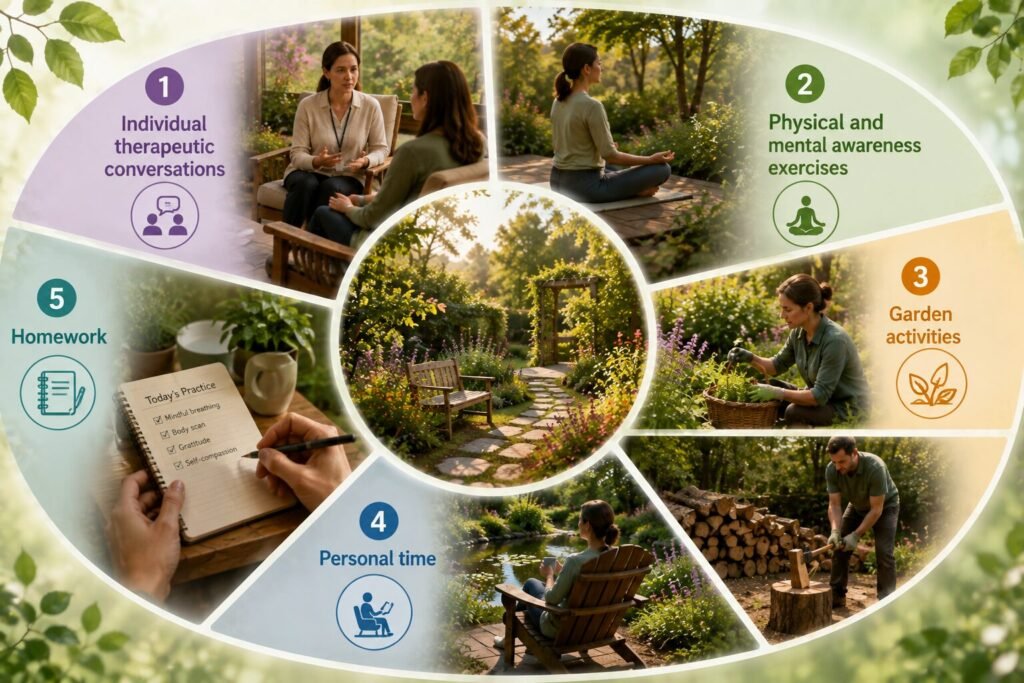
The Nacadia programme lasted 10 weeks, with participants attending three times per week for three hours per session. The intervention integrated five interconnected components:
- Individual therapeutic conversations, incorporating mindfulness-based cognitive therapy.
- Physical and mental awareness exercises, including meditation and body scanning.
- Garden activities, such as collecting herbs and chopping wood.
- Personal time, allowing participants to choose how they wanted to use the therapeutic environment.
- Homework, designed to help participants practise therapeutic techniques in everyday life.
Notably, the programme was flexibility. Participants were not expected to respond to every activity in the same way. Instead, the programme allowed them to select activities and environments according to their changing physical and psychological capabilities.
The therapy garden itself was intentionally designed as part of the intervention with physical environment and therapeutic activities being closely connected. This natural setting provided opportunities for solitude, social interaction, sensory experiences, physical activity, and reflection.
The Importance of Choice and Flexibility in Stress Recovery
A particularly important outcome of the study was the development of safety and freedom. Participants value places where they feel sheltered and less exposed. Feeling of being protected reduce external demands and create psychological space for exploration.
During the exposure to NBT in the Therapeutic Garden, it was found that peoples capabilities change from day to day. On one occasion, a participant might have sufficient energy for physically demanding garden work. On another day, the same individual might need rest, quiet, or minimal stimulation.
Availability of different options allow people to respond more appropriately to their current needs. For example, some participants prefer repetitive physical tasks when their minds are restless, while others sought quiet locations for reflection. On the other hand, some want social interaction, whereas others prefer solitude.
Practical application for healthcare and wellness programs
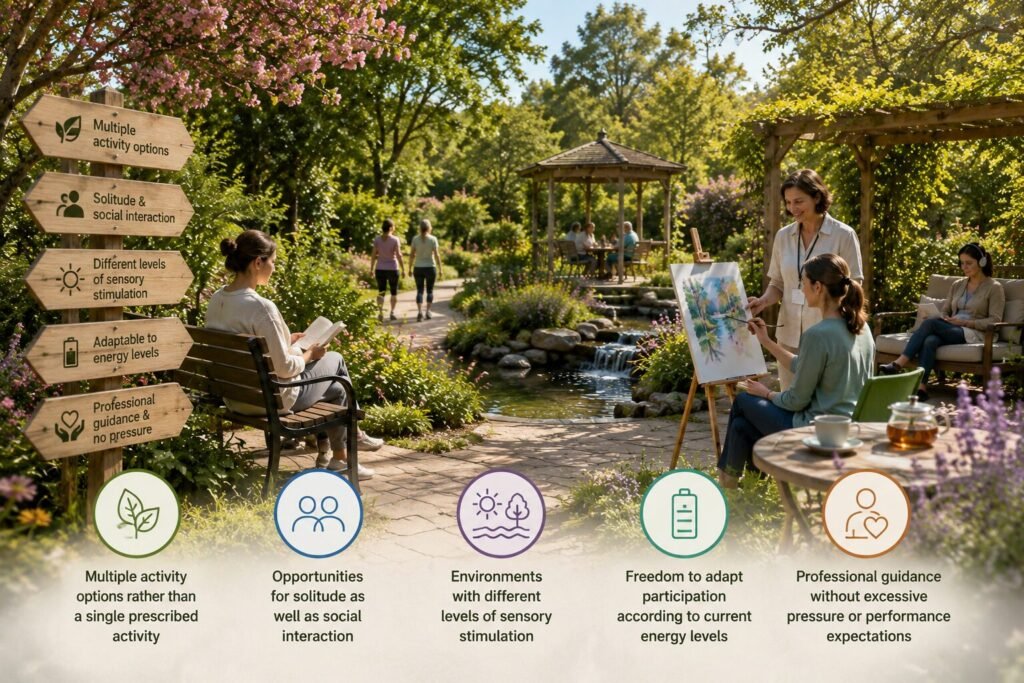
Stress recovery programmes may benefit from offering participants:
- Multiple activity options rather than a single prescribed activity
- Opportunities for solitude as well as social interaction
- Environments with different levels of sensory stimulation
- Freedom to adapt participation according to current energy levels
- Professional guidance without excessive pressure or performance expectations
The findings suggest that recovery does not necessarily follow a simple, linear pattern. Instead, people may experience fluctuating levels of physical and mental capacity while simultaneously developing a greater ability to recognise and respond to their needs.
Nature as a Tool for Mindfulness and Self-Reflection
People recognise tendencies related to performance pressure, competition, or the need to complete tasks quickly. These patterns resemble the behaviours they experienced in everyday life and, in some cases, associated with stress.
-The NBT provides increased awareness of habitual and potentially destructive patterns of thinking and behaviour. People begin to notice these patterns and experiment with alternative responses.
-Nature also appears to support mindfulness through sensory experiences. People start paying greater attention to sounds, textures, light, smells, and other environmental features. These experiences are not limited to the therapy garden but can be applied later in the daily lives.
-Some people notice sensory experiences during the walks in the local parks or gardens, some use the sound of water at home to support relaxation, while another used a pinecone as a sensory object to help regain calm when experiencing intrusive or disturbing thoughts.
The therapeutic experiences developed in a supportive environment can potentially be adapted into simple, accessible strategies for everyday life.
A New Perspective on Stress Recovery
The research offers useful insights for landscape architects, healthcare professionals, therapists, rehabilitation specialists, and organisations developing stress recovery programmes.
A therapeutic natural environment should consider the following principles:
- Provide a Sense of Safety
People should feel protected and less exposed. Gardens and outdoor therapeutic spaces should include sheltered areas where individuals can withdraw when necessary.
- Offer Different Types of Experiences
A single type of landscape may not meet everyone’s needs. Effective therapeutic environments can provide quiet areas, active spaces, natural features, sensory experiences, and opportunities for social interaction.
- Support Personal Choice
The NBT should allow the people to select activities according to their current capabilities. Flexibility may therefore be more beneficial than rigid participation requirements.
- Integrate Nature with Professional Support
The Therapeutic Garden should not be used as a standalone treatment. The therapeutic experience must involve interaction of the environment, psychologists, mindfulness practices, garden activities, personal reflection, and relationships with others.
- Encourage Transfer to Everyday Life
One of the strongest practical applications is helping participants identify strategies they can continue using after the formal programme ends. A therapeutic intervention becomes more relevant when participants can adapt what they have learned to their homes, workplaces, neighbourhoods, and daily routines.
Future Insights
A supportive space should not simply be visually attractive. It should provide different degrees of privacy, sensory stimulation, activity, and social interaction. Therapeutic gardens can function as supportive environments for people experiencing severe stress-related illness.
The healthcare providers, therapists, landscape architects, and organisations developing stress recovery programmes should focus on developing a therapeutic environment that could provide safety, flexibility, meaningful experiences, and opportunities for individuals to discover their own pathways toward recovery from stress.