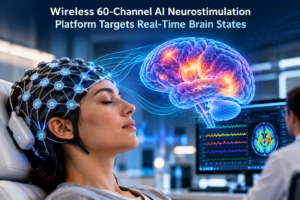
Wireless 60-Channel AI Neurostimulation Platform Targets Real-Time Brain States
- Dr. Diksha Varma
- September 30, 2026
- 5 mins
Next Generation of Brain-Computer Interfaces
The next generation of brain-computer interfaces and neurostimulation technologies is moving beyond fixed stimulation toward systems that can sense brain activity, interpret it in real time and respond with precisely targeted stimulation. This concept, known as closed-loop neuromodulation could be particularly valuable for neurological and neurocognitive conditions in which brain states change from moment to moment.
Traditional closed-loop neurostimulation systems can be highly effective for conditions such as epilepsy and movement disorders, but they often work with a relatively small information footprint. These neurostimulation systems was designed around a different premise of complex cognitive functions such as memory, may depend on activity distributed across multiple brain regions and frequency bands.
Researches showed that memory success can be predicted from neural activity spanning regions including lateral temporal, medial temporal and prefrontal cortices. Multivariate models incorporating spectral information from many electrodes can therefore provide richer information than systems monitoring only one or two neural signals.
This is where the 60-channel architecture becomes important.
A recent design by researchers from Rutgers University presents the Smart Neurostimulation System (SNS), a wireless, 60-channel, AI-enabled neurostimulation platform designed to combine high-density neural recording, onboard spectral analysis, machine-learning-based brain-state decoding and programmable electrical stimulation in a single system. The platform is developed with applications such as memory restoration in mind. Unlike conventional adaptive systems that may rely on only a small number of recording channels or a single neural feature, the SNS is designed to monitor distributed brain networks and identify complex patterns of neural activity.
The study is preclinical evidence that the system can record neural activity, classify behavior and modulate brain activity according to stimulation parameters. The study demonstrates device functionality rather than clinical efficacy in humans. However, the technology still requires human clinical validation.
The 60-Channel Smart Neurostimulation System: How it works?
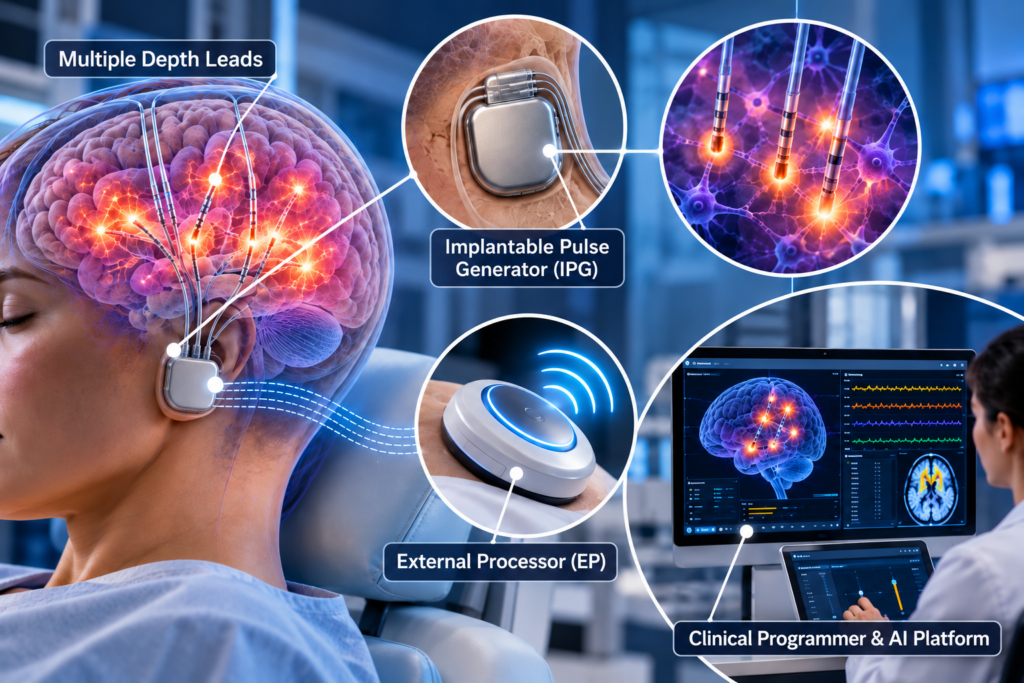
The platform uses four depth leads containing up to 16 electrodes each, with 60 contacts available for sensing and stimulation. The system was designed to capture neural activity across distributed brain networks while retaining the ability to stimulate selected targets.
The SNS integrates several components:
- Implantable pulse generator (IPG): Processes neural signals and controls stimulation.
- Multiple depth leads: Provide distributed neural sensing and stimulation.
- External processor (EP): Provides wireless inductive power and acts as a communications hub.
- Clinical programmer and AI platform: Support personalization, model development and therapy optimization.
The system can stream neural data at 500 Hz, while onboard processing estimates spectral power across frequencies from approximately 3–180 Hz. The embedded system can make therapy decisions every 128 milliseconds and, when a stimulation decision is triggered, apply stimulation within 25 milliseconds of the relevant neural data entering the processing buffer.
This architecture is significant because sensing, processing and stimulation aren’t separate steps performed by disconnected systems. They’re integrated into a platform intended for real-time, brain-state-dependent neuromodulation.
A Wireless 60-Channel AI-Enabled Neurostimulation Platform: A New Approach to Brain-Responsive Therapy
A multi-stage development and validation strategy was adopted.
- Determining the Required Number of Channels
Before building the system, analysis of publicly available intracranial EEG data was done from the Restoring Active Memory project.
Then, classifiers using subsets of 4, 8, 16, 32 and 64 electrodes were compared. Models using 4–32 electrodes showed statistically significant reductions in performance compared with the full dataset, whereas models using 64 electrodes did not significantly differ from the full-channel models. Both had mean AUC values around 0.62 in the held-out data.
This analysis supported the choice of approximately 64 contacts as a practical architecture for distributed memory-state decoding.
- Engineering the SNS
The implant incorporates a custom application-specific integrated circuit with 64 sensing/stimulation channels. The system supports charge-balanced, biphasic stimulation and configurable parameters including amplitude, frequency, pulse width and duration.
The system also incorporates wireless communication and inductive power transfer. The implant consumes approximately 20 mW during autonomous therapy delivery, with estimated total system power consumption of about 40 mW after accounting for inductive transfer efficiency. The external processor can operate for more than eight hours on a 210 mAh battery.
- Preclinical Ovine Study
Then, SNS was evaluated in three freely moving sheep.
Following IACUC approval, CT imaging was used to plan electrode trajectories. Each animal received an implanted SNS pulse generator and depth leads, followed by a six-day recovery period before recordings and stimulation began. The study investigated two central questions:
- Can the system record neural activity and decode behavior?
- Can stimulation systematically alter neural activity?
Successful Results from a Wireless 60-Channel AI-Enabled Neurostimulation Platform
AI Successfully Decoded Animal Movement
Neural activity during periods of movement and stillness were recorded.
For every one-second epoch, spectral power across eight frequencies ranging from 6 to 180 Hz was calculated, using Morlet wavelets. These features were then entered into an L2-penalized logistic regression classifier. The models were trained using an 80/20 session split and evaluated using area under the receiver operating characteristic curve (AUC).
The results were strong:
- Sheep 1: AUC 0.924
- Sheep 2: AUC 0.979
- Sheep 3: AUC 0.969
By comparison, shuffled-label control analyses produced AUC values close to 0.50, as expected for chance-level classification.
The models also generalized well over time, producing average AUCs of 0.929, 0.962 and 0.973 when models trained during the first half of the study were tested on subsequent weeks.
This suggests that the platform could capture stable, behaviorally relevant neural signatures over extended recording periods.
Electrical Stimulation Changed Brain Activity
The second major component examined whether the SNS could intentionally alter neural activity while focussing on alpha-band activity (8–12 Hz) and gamma-band activity (78–82 Hz).
In the first stimulation experiment, one sheep received 500-ms stimulation bursts using different combinations of amplitude and frequency. The stimulation used 300-μs biphasic pulses at frequencies of 25, 50, 100 and 200 Hz and amplitudes ranging from 0 to 1 mA. The study included a total of 124 sessions.
Increasing stimulation amplitude and frequency generally increased both alpha and gamma power.
Statistical modeling showed significant relationships between stimulation amplitude, frequency and changes in alpha and gamma activity.
Stimulation Effects Were Highly Location-Dependent
Further, parameters were expanded to two additional animals. 12 neighbouring electrode pairs were stimulated while varying amplitude, frequency, duration, and stimulation location.
The results revealed that the brain didn’t respond identically at every stimulation site. More than half of the tested stimulation targets increased alpha and gamma power, while only two consistently decreased alpha power. Increasing amplitude and frequency generally increased post-stimulation power, although some locations showed weaker, absent or even negative effects.
This finding has practical implications for personalized neurostimulation. A stimulation protocol that works at one neural target may not produce the same response at another. And that supports the rationale for a platform capable of testing multiple targets and parameters rather than relying on a fixed stimulation configuration.
Application of 60-Channel AI Neurostimulation Platform
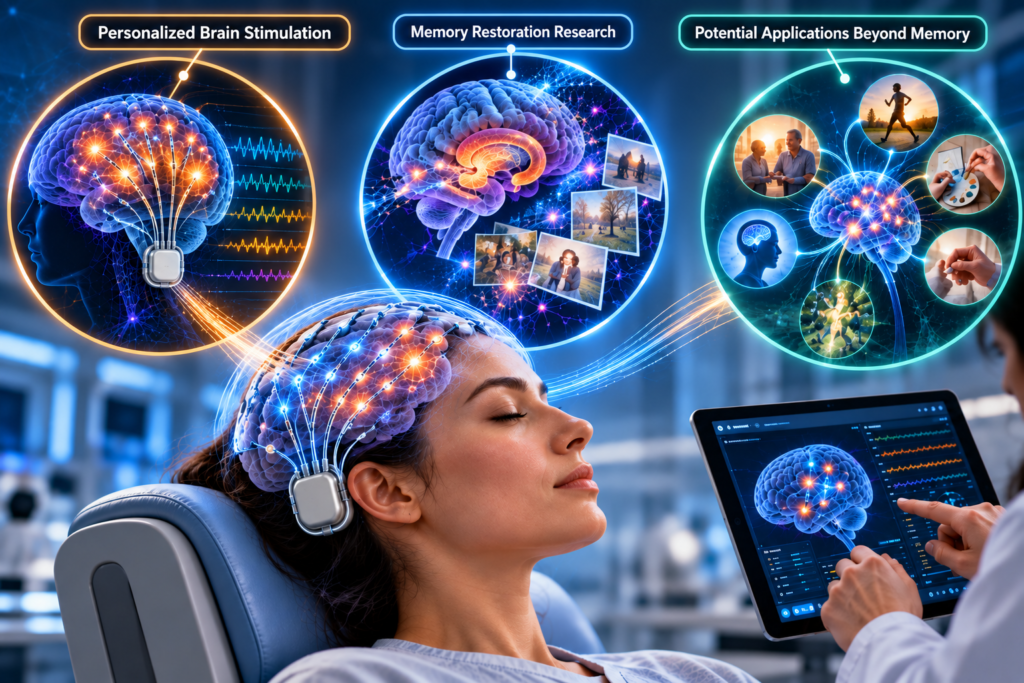
- Personalized Brain Stimulation
The platform could eventually enable clinicians to develop patient-specific stimulation protocols based on an individual’s neural activity.
Instead of applying identical stimulation continuously, a closed-loop system could identify a particular brain state and respond only when the relevant biomarker appears.
For memory applications, the proposed workflow involves using neural activity during memory tasks to train models that predict successful versus unsuccessful memory states. The system could then trigger stimulation during predicted memory lapses.
- Memory Restoration Research
The platform was specifically motivated by previous closed-loop research showing that stimulation delivered during predicted poor-memory states could improve memory performance in human research participants.
The SNS translates this experimental concept into an integrated implantable architecture capable of distributed sensing and onboard processing.
However, higher cognitive decoding and closed-loop memory stimulation as areas may require future research.
- Potential Applications Beyond Memory
The architecture may eventually have broader applications in conditions characterized by fluctuating brain states, such as depression, anxiety, chronic pain, attention disorders and other neurocognitive and affective conditions
The common principle is biomarker-guided stimulation: detect a relevant neural state and adapt stimulation accordingly.
Future Insights:
One of the most notable features of the SNS is the integration of high-density sensing, AI-based decoding and stimulation. The SNS provides 60 sensing channels and 60 stimulation channels across four leads, compared with substantially fewer sensing channels in some established adaptive systems.
The system also performs spectral processing and classification onboard rather than relying entirely on an external computer. This could be particularly valuable for chronic applications where portability, latency, power consumption and continuous operation matter.
These findings are promising from a technology-validation perspective, but they shouldn’t be interpreted as proof of clinical effectiveness. There is a need to test higher cognitive functions such as memory in the SNS study Future clinical studies will therefore be essential for determining whether the platform’s technical capabilities translate into meaningful therapeutic outcomes.
The practical opportunity is significant: future neurostimulation systems could potentially respond to an individual’s real-time neural state rather than relying exclusively on fixed stimulation schedules. The study establishes device functionality and a foundation for future biomarker-guided therapies, but it does not yet establish clinical effectiveness for memory restoration or other neurological disorders.