An AI-Discovered Alzheimer’s Drug Candidate Targets Galectin-3
- Dr. Diksha Varma
- October 4, 2026
- 5 mins
AI-Driven Discovery of Brain-Penetrant Galectin-3 Inhibitors: A New Therapeutic Pathway for Alzheimer’s Disease
Alzheimer’s disease (AD) remains one of the major challenges in neurodegenerative disease research, with progressive memory loss and cognitive impairment associated with pathological changes including amyloid-β (Aβ) accumulation and chronic neuroinflammation. While several therapeutic approaches target amyloid pathology, researchers are increasingly investigating biological pathways that regulate the brain’s inflammatory response.
Galectin-3 (Gal-3) has emerged as one such target because it is implicated in microglial activation, neuroinflammation and Aβ pathology. Galectin-3 is a carbohydrate-binding protein involved in immune regulation. In Alzheimer’s disease research, increased Gal-3 has been associated with microglial activation, neuroinflammation and Aβ pathology. Studies have described Gal-3 as a potential upstream regulator of inflammatory processes that can contribute to neuronal dysfunction and cognitive decline.
Although, Gal-3 is an interesting therapeutic target, there is a major drug-development challenge that lies ahead, i.e. crossing the blood brain barrier. Previously small-molecule Gal-3 inhibitors such as TD139 and GB1211 were developed primarily for non-CNS applications and have limitations in BBB penetration.
To address these challenges, scientists from Fujian Medical University, sought to combine target selectivity with brain permeability from the earliest stages of drug discovery.
That’s where artificial intelligence enters the workflow.
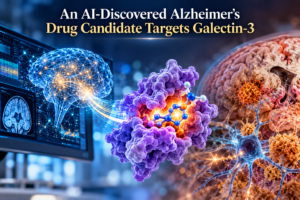
Artificial Intelligence was utilized to search for small molecules capable of inhibiting Gal-3 while also possessing properties needed to reach the brain. The research identified FJMU1887, as a novel small-molecule Gal-3 inhibitor, and evaluated it through computational, biochemical, cellular, pharmacokinetic and animal studies.
The findings of the study are notable because FJMU1887 not only interacted directly with Gal-3 but also crossed the blood-brain barrier (BBB), reduced inflammatory responses in microglia and improved cognitive performance in two mouse models of cognitive impairment.
How AI Identified FJMU1887?
Llama-Gram, a deep-learning platform, was employed that was trained using approximately 2.58 million protein-ligand interactions for virtual screening.
Rather than treating a drug molecule simply as a conventional numerical descriptor, the system incorporated:
- Protein structural representations from ESMFold
- Graph-based representations of chemical compounds
- Deep-learning prediction of protein–ligand interactions
- Binding-probability scoring
- Uncertainty estimation for candidate prioritization
The model ranked molecules according to their predicted ability to interact with Gal-3. Candidates were then prioritized according to drug-like and pharmacokinetic characteristics, including predicted BBB permeability.
Employing AI in drug discovery aided the design of computational models that can reduce the enormous chemical search space and help researchers identify molecules for experimental validation more efficiently.
The AI screen ultimately identified FJMU1887 as a lead candidate.
From Computer Prediction to Laboratory Validation
Post AI predictions, FJMU1887 underwent a sequence of experimental tests to determine whether its predicted properties translated into measurable biological activity.
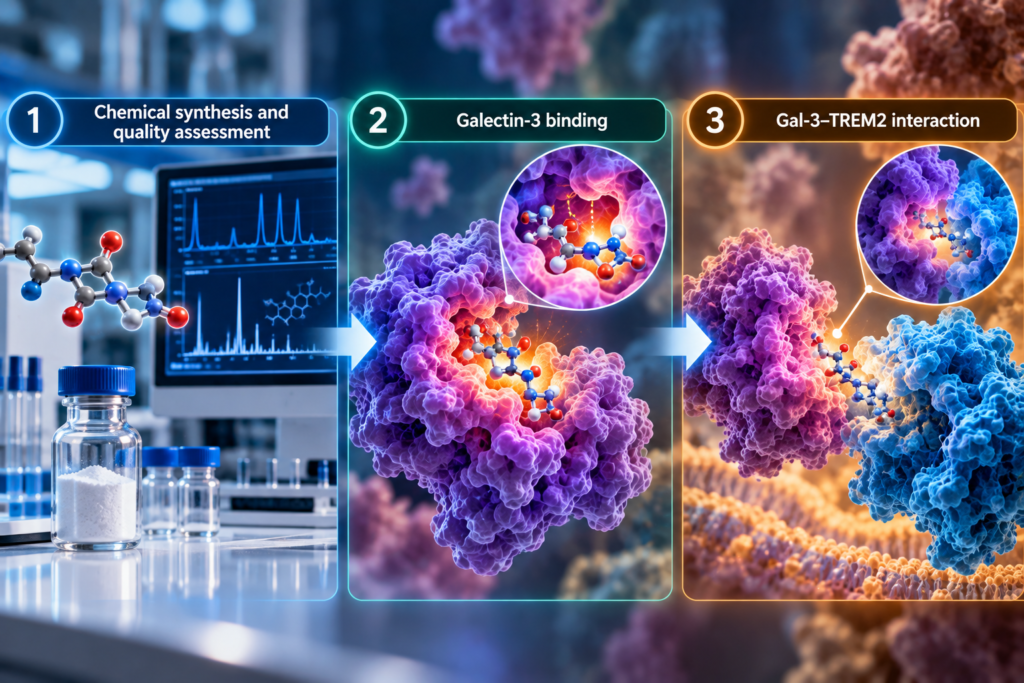
- Chemical synthesis and quality assessment
FJMU1887 was synthesized and isolated as a white solid with a reported yield of 38%. HPLC analysis showed 98.07% purity, supporting its use in subsequent biological experiments.
- Galectin-3 binding
Biolayer interferometry (BLI) and microscale thermophoresis (MST) was used to investigate direct interaction between FJMU1887 and Gal-3.
MST measured a dissociation constant (Kd) of 1.55 μM, confirming direct binding between the candidate molecule and Gal-3.
- Gal-3–TREM2 interaction
Later, investigations were performed to examine whether FJMU1887 could interfere with the interaction between Gal-3 and TREM2, a receptor involved in microglial regulation.
Using fluorescence resonance energy transfer (FRET) and fluorescence correlation spectroscopy, it was found that FJMU1887 disrupted the Gal-3–TREM2 interaction, providing a potential mechanistic link between Gal-3 inhibition and changes in inflammatory signaling.
FJMU1887 Reduced Neuroinflammation in Microglial Cells
When tested in BV-2 microglial cells, FJMU1887 reduced inflammatory responses, including inhibition of TNF-α, with an IC₅₀ of 2.36 ± 0.37 μM. Importantly, no significant cytotoxicity was observed under the tested conditions. CCK-8 testing showed minimal cytotoxic effects for most screened compounds, while additional analysis found that FJMU1887 did not significantly increase cleaved caspase-3, an apoptosis marker, at the tested concentration.
In Aβ-induced inflammatory model, FJMU1887 attenuated increases in inflammatory mediators including Gal-3, TREM2, TLR4 and IL-1β following fibrillar Aβ stimulation, suggesting that the compound’s effects weren’t limited to direct target binding but extended to cellular pathways relevant to Alzheimer’s-associated neuroinflammation.
One of the Biggest Challenges: Crossing the Blood-Brain Barrier
A promising Alzheimer’s drug needs to reach its target in the CNS.
So, the most important evaluation was using PAMPA-BBB, an artificial membrane model designed to estimate passive BBB permeability.
FJMU1887 showed a permeability coefficient of: 6.10 ± 0.45 × 10⁻⁶ cm/s
The researchers classified this as CNS+ under the study’s stated criteria. For comparison, TD139 showed a substantially lower value of 0.29 ± 0.05 × 10⁻⁶ cm/s.
The brain exposure in mice using LC-MS/MS was then confirmed.
Following oral administration, FJMU1887 was detected in both plasma and brain tissue, including the hippocampus and cortex. Hippocampal concentrations reached 108.40 ± 14.61 ng/mL at two hours, while cortical concentrations reached 144.2 ± 18.11 ng/mL at the same time point.
An insitu brain-perfusion experiment provided additional evidence of BBB penetration.
However, the compound showed partial P-glycoprotein-mediated efflux, an issue that future medicinal-chemistry optimization will need to address.
Effects of FJMU1887 in Alzheimer’s Disease Mouse Models
FJMU1887 was tested in two models of cognitive impairment.
In aged 5×FAD mice, animals received 20 mg/kg/day orally for 30 days. A separate oligomeric Aβ-induced model received FJMU1887 at 5, 10 or 20 mg/kg/day for 14 days, with behavioral assessments including fear conditioning, nest building and novel-object recognition.
In the 5×FAD model, FJMU1887 improved performance on a Y-maze measure of spatial working memory compared with untreated 5×FAD mice.
The treatment was also associated with biological changes relevant to Alzheimer’s pathology.
Reduced Microglial Activation and Amyloid Pathology
In the hippocampus of 14-month-old 5×FAD mice, FJMU1887 reduced markers of microglial activation, including IBA1 and CD68.
It also reduced inflammatory markers including:
- C1q
- iNOS
- IL-1β
- TLR4
- phosphorylated NF-κB
Alongside a shift toward a more homeostatic microglial morphology is also reported.
Immunofluorescence analysis further showed reduced Gal-3 and Aβ-related 6E10 staining in the hippocampus following treatment. The study found strong colocalization of these signals with activated microglia, supporting the proposed relationship between Gal-3, Aβ pathology and neuroinflammation.
Synaptic Protection and Neuronal Effects
Further, it was important to examine whether reducing inflammation was accompanied by changes in neuronal and synaptic integrity.
FJMU1887 treatment increased the levels of the synaptic proteins synaptophysin and PSD95 in hippocampal tissue. Dendritic spine density in CA1 pyramidal neurons was also preserved compared with untreated 5×FAD mice.
Additionally, reductions were found in GFAP and complement C3, markers associated with reactive astrocytes and complement activation, respectively.
These findings provide a potential biological explanation for the observed cognitive improvements: reducing inflammatory activity may help preserve components of neuronal connectivity.
Applicability of the AI-Drug Discovery Approach
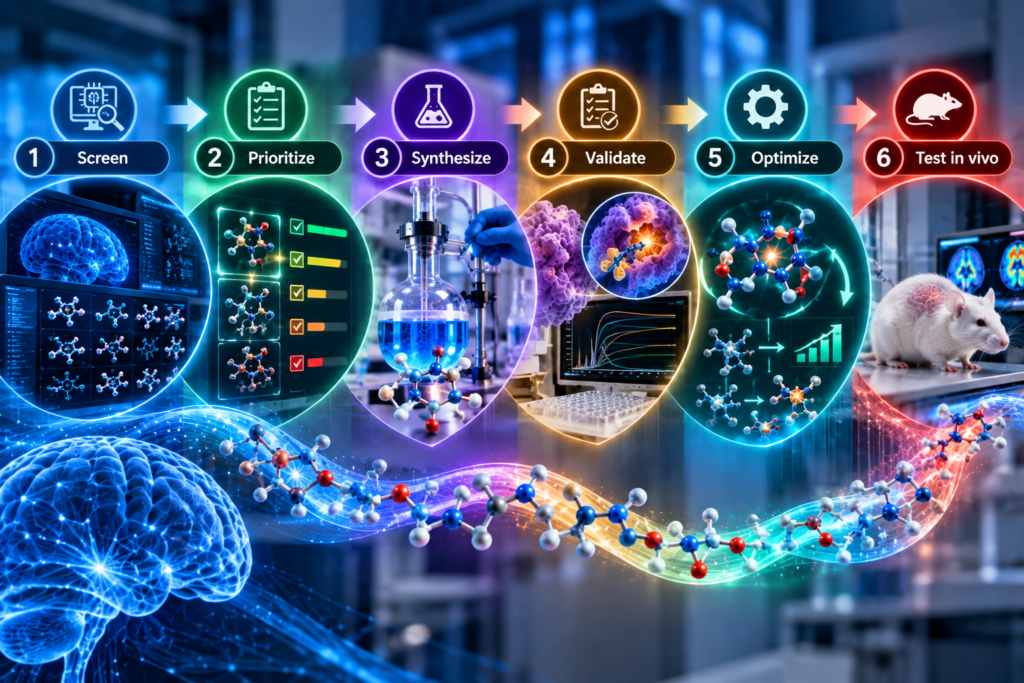
The most important technological lesson is the integrated discovery pipeline.
The study demonstrates a workflow in which AI can help researchers:
Screen → prioritize → synthesize → validate → optimize → test in vivo
This approach may reduce the number of compounds requiring extensive experimental screening and help incorporate CNS drug properties earlier in development.
For Alzheimer’s research, that could be especially useful because BBB penetration is one of the fundamental challenges in developing therapeutics for the brain.
AI-assisted, discovery of FJMU1887 therefore illustrates how AI-assisted molecular discovery can connect computational prediction with experimental pharmacology rather than treating AI as a replacement for laboratory science.
Future Insights
Through this study, FJMU1887 is found as a promising preclinical lead compound
Though the results are promising, but several challenges still remain.
1) The research with FJMU1887 was conducted in preclinical models, however, human clinical trials in both gender patients, will translate the benefit of therapy for cognitive improvements that are evident in mice.
2) Comprehensive selectivity testing needs to be done to confirm the selectivity of FJMU1887 with Galectin-3 inhibitor because related proteins share conserved carbohydrate-recognition domains.
3) Partial P-glycoprotein efflux could limit CNS exposure and this to be examined exhaustively.
4) Long-term efficacy and safety remain unknown. Longer studies lasting three to six months, together with electrophysiological assessments such as long-term potentiation experiments may evaluate these.
The clearly reflects that the practical significance lies in the combination of AI-powered molecular screening, BBB-focused drug design, experimental target validation and in vivo testing.