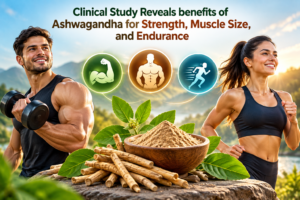
Clinical Study Reveals benefits of Ashwagandha for Strength, Muscle Size, and Endurance
- Dr. Diksha Varma
- October 6, 2026
- 5 mins
Ashwagandha as a gem of Indian Ayurvedic system
Ashwagandha (Withania somnifera) has been used for centuries in the Indian Ayurvedic system, where it is traditionally regarded as a Rasayana, a rejuvenating herb associated with vitality, strength, and general wellbeing. Scientists also have had increasing interest in Ashwagandha as a botanical supplement for physical performance and wellbeing.
Over several weeks of consistent use, Ashwagandha have been studied to:
- Reduce cortisol levels and regulates the body’s stress response system
- Support Sleep by interacting with the brain receptors to promote relaxation and aiding to fall asleep faster.
- Increases muscle strength by boosting muscle mass, physical power and exercise recovery.
- Improves focus by reducing mental fatigue and supporting memory and concentration.
To support these findings with clinical based evidences, researchers from King George’s Medical University, India conducted a prospective, randomized, double-blind, placebo-controlled clinical trial, investigating the effects of Ashwagandha root extract supplementation for 8 weeks in healthy adults who were already physically active and participating in resistance training.
The research provides clinical evidence that standardized Ashwagandha root extract, when combined with resistance training, may support improvements in strength, selected measures of muscle size, and cardiorespiratory endurance in healthy, physically active adults.
Clinical investigation of Ashwagandha root Extract
In the clinical study, both men and women aged 18–45 years were enrolled, addressing an evidence gap because previous research on Ashwagandha and muscle strength had focused predominantly on male participants. All the 80 participants were physically active and had participated in gymnasium or strength-training exercise for at least three months.
Participants were randomly allocated in a 1:1 ratio to receive either:
- Ashwagandha group: 300 mg standardized root extract twice daily, providing 600 mg/day.
- Placebo group: Identical placebo capsules.
The extract contained more than 5% total withanolides, standardized using high-performance liquid chromatography.

Resistance Training & Assessment of Cardiorespiratory endurance
Resistance training is widely used to increase muscular strength, improve physical fitness, and promote adaptations in skeletal muscle while cardiorespiratory endurance, is commonly assessed using VO₂max, is another important component of physical performance.
Three major outcomes were evaluated, including:
- Muscle strength was assessed using 1RM bench press and leg press
- Muscle size was assessed through measurements of arm, chest, and upper-thigh circumference
- Cardiorespiratory endurance was assessed using a treadmill test based on the Bruce protocol, with performance converted into an estimated VO₂max value.
Both groups followed the same resistance-training program for eight weeks, with participants training three days per week.
Safety was assessed through reported adverse events, vital signs, and laboratory tests covering hematological, renal, liver, and thyroid parameters.
Ashwagandha greatly improves Physical-Performance
- In Participants who were supplemented with Ashwagandha, 1RM bench press increased by approximately 5% in men and 22.8% in women, while 1RM leg press increased by approximately 15% in men and 9.9% in women over the eight-week period.
- Participants who consumed Ashwagandha displayed increase in arm and chest circumference.
- VO₂max increased significantly in both male and female participants receiving Ashwagandha. The Ashwagandha group showed approximately 5% improvement in men and 7% in women, with a reported adjusted effect size of 1.034 for VO₂max.
The findings, thus suggest that standardized Ashwagandha root extract may complement resistance training by supporting multiple dimensions of physical performance rather than affecting strength alone.
Consuming Ashwagandha as a daily supplement
The research is particularly relevant to people interested in natural sports nutrition, plant-based performance supplements, muscular strength, endurance training, and exercise-related supplementation.
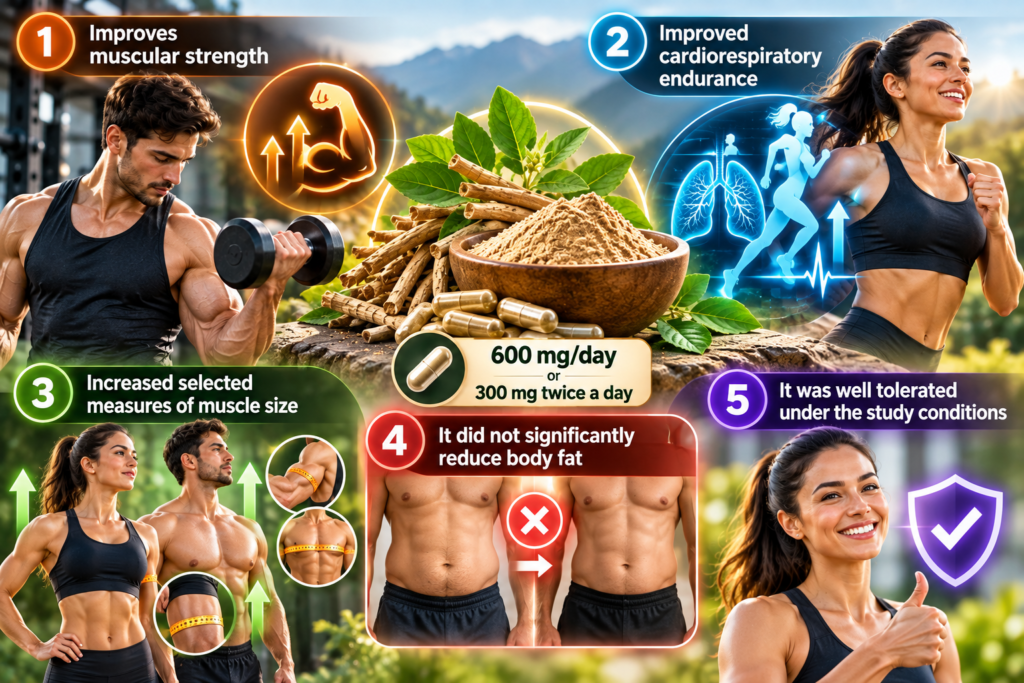
Ashwagandha at 600 mg/day or 300 mg twice a day-
- Improves muscular strength
- Improved cardiorespiratory endurance
- Increased selected measures of muscle size
- It did not significantly reduce body fat
- It was well tolerated under the study conditions
Is Ashwagandha as a supplement Safe?
The study clearly demonstrates the safety outcomes among the participants who were supplemented with Ashwagandha extract. Participants did not report any adverse events and no significant changes in hematology, renal function, liver function, thyroid function, or vital signs between baseline and week eight, throughout the study.
The findings concludes that the standardized Ashwagandha root extract was well tolerated under the conditions of this eight-week trial. In future, longer-term research and studies involving broader populations would help establish how consistently these findings apply beyond the investigated population.
It is thus suggested to choose a standardized Ashwagandha root extract with a defined withanolide content, as the study findings cannot be directly generalized to all Ashwagandha products.
Top 5 Ashwagandha Products you can consider
Here are five top products you can consider taking as supplement for increasing your muscle strength and endurance while you are exercising and training.
Product Name | Form | Recommended Dose | Company | Approx. Price |
Tata 1mg Tejasya KSM-66 | Capsule | 1 capsule daily with milk or water | ₹665 (60 capsules) | |
Carbamide Forte KSM-66 | Tablet | 1 tablet daily (600 mg) | ₹615 (60 tablets) | |
Organic India Pure Ashwagandha | Capsule | 1–2 capsules twice daily with food or water | ₹250 – ₹280 (60 capsules) | |
Baidyanath Asli Ayurved | Tablet | 1 tablet twice daily with water | ₹134 (60 tablets) | |
Kapiva Organic Ashwagandha Powder | Powder | 1/4 to 1/2 teaspoon daily with milk or honey | ₹175 (100g powder) |
Product Details:
- Tata 1mg Tejasya KSM-66 Capsules: The capsules are prepared from the KSM-66 extract which is a highly concentrated Ashwagandha root extract, containing at least 5% withanolides. It is recognized as the gold standard for quality, clinical backing, and purity in herbal supplements.
- Carbamide Forte KSM-66 Tablets: Each tablet contains a potent 600 mg extract formulation with standardized 5% withanolides active compound to support muscle recovery and stress management.
- Organic India Pure Ashwagandha Root Capsules: These are prepared using 100% organic raw root powder (400 mg per capsule). It is a great middle-ground supplement for those looking for whole-herb nutrition without chemical extraction procedures followed.
- Baidyanath Asli Ayurved Tablets: These tablets are highly economical, classic Ayurvedic remedy from Baidyanath.
- Kapiva Organic Ashwagandha Powder: It is recommended for users who prefer the traditional method of ingestion. You can easily dissolve this clean, organic root powder directly into smoothies, teas, or warm nighttime milk.
Future Insights
The presented clinical evidences demonstrate Ashwagandha as a powerful daily supplement that increase muscle strength, muscle size and improves cardiovascular endurance among physically active people who exercise and undergo strength trainings.
Future studies may consider quantitative measurement of participants’ daily calorie and protein intake for a longer duration.
By supporting improvements in muscle strength and endurance when combined with resistance training, standardized Ashwagandha root extract could be of interest to people looking to rebuild physical strength. However, because the available study involved healthy, physically active adults, dedicated clinical research is needed to establish its effectiveness in people who are physically weak, deconditioned, or recovering from a period of reduced activity.
The findings provide a useful basis for further research into standardized botanical supplements as potential components of sports nutrition and physical-performance strategies.