GOATOOLS Python Library: Transforming Gene Ontology Research
The challenge with traditional gene ontology analysis
As high-throughput sequencing technologies continue to generate enormous volumes of biological data, researchers need efficient tools to extract meaningful biological insights from gene expression datasets. Gene Ontology Enrichment Analysis (GOEA) has become one of the most widely used approaches for interpreting gene lists generated from RNA sequencing, microarray studies, and other genomic experiments.
Gene Ontology provides standardized descriptions of gene functions across three major categories:
- Biological Processes
- Molecular Functions
- Cellular Components
With more than 47,000 Gene Ontology terms available at the time of the study and annotations that are updated almost daily, researchers often struggle to keep analyses current. Traditional GO enrichment tools frequently return long, flat lists of statistically significant GO terms, making biological interpretation time-consuming and challenging.
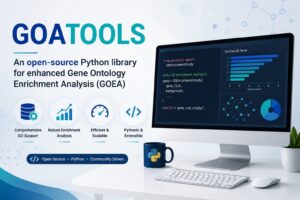
The researchers developed GOATOOLS to address these limitations while integrating seamlessly into Python-based bioinformatics workflows. Scientists at the Drexel University, Philadelphia, introduced GOATOOLS, an open-source Python library designed to make Gene Ontology analysis more flexible, reproducible, and easier to interpret. Beyond performing enrichment analysis, GOATOOLS introduces an innovative grouping method that helps researchers organize hundreds of Gene Ontology (GO) terms into meaningful biological categories, making interpretation significantly easier.
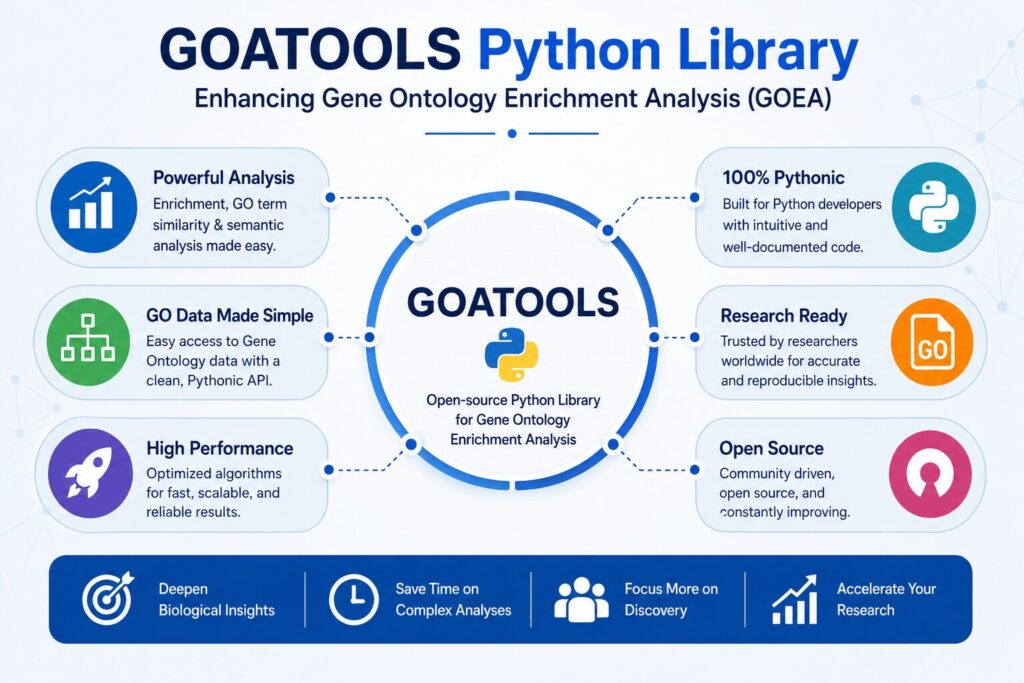
GOATOOLS: Python Library
GOATOOLS is a comprehensive Python library capable of handling every stage of Gene Ontology Enrichment Analysis (GOEA), from ontology parsing to visualization and reporting.
- Open-Source Python Framework
GOATOOLS is developed as an open-source project available through GitHub and installable via standard Python package managers such as pip, easy_install, and Bioconda. It includes tutorials and Jupyter Notebook examples that enable researchers to integrate GOEA directly into automated bioinformatics pipelines.
- Efficient Ontology Processing
The software supports multiple ontology and annotation formats, including:
- GO-basic
- GO-plus
- JSON ontology files
- Gene Annotation Format (GAF)
- gene2go
- GPAD
The study explains that GOATOOLS models Gene Ontology as a Directed Acyclic Graph (DAG), allowing efficient traversal of parent-child relationships and calculation of semantic similarity between GO terms.
- Statistical Analysis
To identify enriched biological functions, GOATOOLS uses Fisher’s Exact Test, one of the most widely accepted statistical methods for Gene Ontology enrichment analysis.
Recognizing that thousands of statistical tests are often performed simultaneously, the researchers incorporated 12 multiple-testing correction methods, including:
- Bonferroni correction
- Sidak
- Holm
- Benjamini-Hochberg False Discovery Rate (FDR)
- Resampling-based FDR
This flexibility allows researchers to choose the most appropriate statistical correction depending on the experimental design and acceptable false-positive rate.
- Novel GO Grouping Method
One of the study’s major innovations is GOATOOLS’ two-step grouping strategy.
Instead of presenting hundreds of GO terms in a single unorganized list, GOATOOLS:
- Groups related GO terms under broader GO headers.
- Organizes these headers into researcher-defined biological sections such as:
- Immune
- Neurological
- Cell death
- Viral/Bacterial response
This hierarchical organization dramatically improves readability and interpretation of enrichment results.
- Performance Evaluation
The researchers validated GOATOOLS using two complementary approaches:
Stochastic simulation datasets
Artificial datasets were generated to evaluate statistical performance under controlled conditions.
Real-world RNA-seq dataset
The team analyzed published RNA-seq data from the Gjoneska et al. Alzheimer’s disease study and compared GOATOOLS with two widely used enrichment tools:
- DAVID
- GOstats
This comparative evaluation allowed the authors to assess both statistical accuracy and usability.
GOATOOLS: A Powerful Python Library for Gene Ontology Analysis
GOATOOLS provides comparable or better enrichment results
GOATOOLS produced Gene Ontology enrichment results that were comparable to—and in some cases better than—those obtained using DAVID and GOstats.
Importantly, GOATOOLS offered greater flexibility through its Python API while maintaining statistical reliability.
Better Interpretation of Biological Results
One of the biggest advantages observed was GOATOOLS’ ability to reorganize hundreds of significant GO terms into biologically meaningful categories.
Rather than forcing researchers to manually interpret scattered GO terms, GOATOOLS grouped related functions together, making biological trends much easier to identify.
For example, immune-related GO terms could be displayed together under an “Immune” section instead of appearing randomly throughout a results table.
Greater Workflow Automation
Because GOATOOLS is written in Python, it can easily be integrated into automated genomic pipelines.
Researchers no longer need to rely solely on web-based interfaces, allowing reproducible analyses that can be rerun whenever Gene Ontology databases are updated.
Flexible Reporting
GOATOOLS exports results in multiple formats, including:
- Excel
- JSON
- Tab-separated files
- Python objects
This makes downstream analysis and visualization considerably easier for researchers and software developers alike.
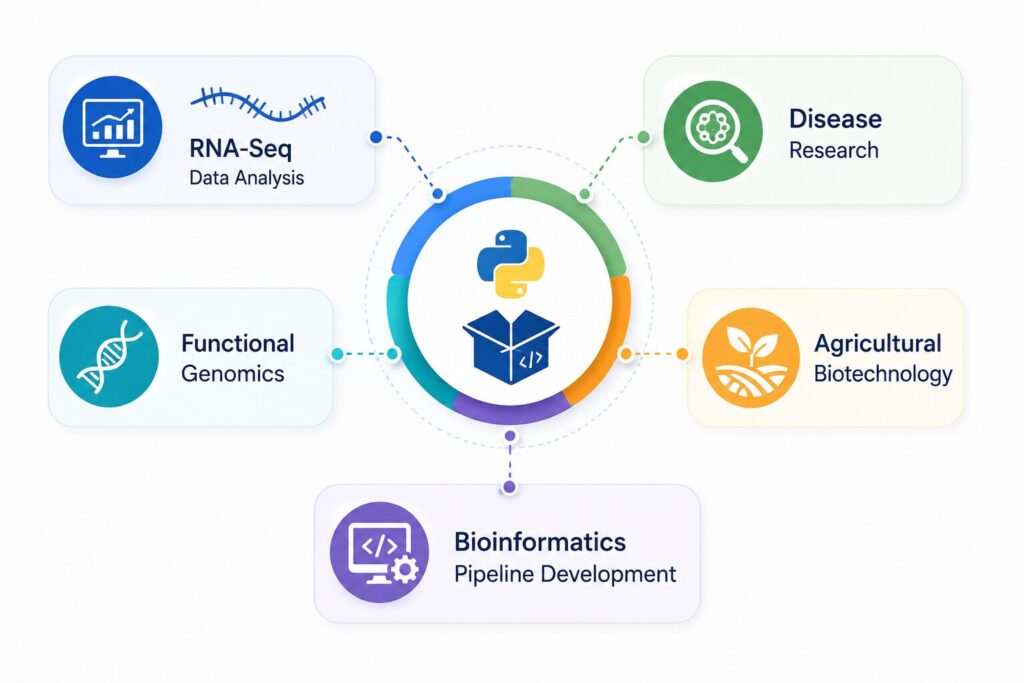
Applications of GOATOOLS
The study highlights several areas where GOATOOLS can make a significant impact.
RNA-Seq Data Analysis
Researchers studying differential gene expression can rapidly identify enriched biological pathways after sequencing experiments.
Disease Research
GOATOOLS supports investigations into diseases such as:
- Alzheimer’s disease
- Cancer
- Autoimmune disorders
- Infectious diseases
By identifying enriched immune, neurological, or metabolic pathways, researchers gain valuable biological insights that may guide therapeutic development.
Functional Genomics
Scientists studying gene function can quickly characterize newly identified genes by analyzing enriched biological processes and molecular functions.
Agricultural Biotechnology
The paper notes that GOATOOLS has already been applied to research involving numerous plant species, fish, fungi, bacteria, and microalgae. Applications include disease resistance studies in common carp and investigations of embryonic development, demonstrating its versatility across diverse organisms.
Bioinformatics Pipeline Development
Python has become one of the dominant programming languages in computational biology.
GOATOOLS enables developers to integrate Gene Ontology enrichment directly into larger automated workflows involving:
- RNA-seq processing
- Genome annotation
- Comparative genomics
- Functional pathway analysis
GOATOOLS in modern biological datasets
Modern biological datasets continue to grow exponentially.
Simply identifying statistically significant genes is no longer sufficient—researchers need tools that can efficiently transform those genes into biologically meaningful knowledge.
GOATOOLS addresses this challenge by combining:
- Robust statistical testing
- Flexible ontology handling
- Automated workflow integration
- Improved visualization
- Human-friendly grouping of GO terms
These features reduce manual interpretation while improving reproducibility and scalability in genomic research.
Thus, GOATOOLS is much more than another Gene Ontology enrichment tool. By integrating accurate statistical testing with an innovative GO grouping methodology and seamless Python integration, the software significantly improves how researchers analyze and interpret functional genomics data.
Its ability to organize complex enrichment results into intuitive biological categories makes it especially valuable for RNA-seq studies, disease research, systems biology, and large-scale bioinformatics workflows. As genomic datasets continue to expand, tools like GOATOOLS provide the automation, flexibility, and interpretability needed to accelerate biological discovery while maintaining scientific rigor.