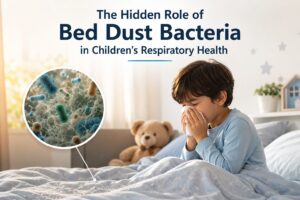
The Hidden Role of Bed Dust Bacteria in Children's Respiratory Health
Does home microbial environment affect our health?
Did you know that children spend most of their time indoors, surrounded by millions of invisible microorganisms? While many people associate indoor environments with safety, emerging scientific evidence suggests that the bacteria living in household dust may significantly influence children’s respiratory health. Research suggests that indoor bacteria can either protect against or contribute to allergic diseases such as asthma.
Modern lifestyles mean that people spend nearly 90% of their time indoors, making household microbial exposure an important determinant of health. However, some queries still arise like:
- Which household factors most strongly influence the indoor microbiome?
- Does the bacterial composition differ between homes of asthmatic and healthy children?
- Can household habits be modified to promote healthier microbial environments?
To answer these questions, researchers from institute for institute for Anthropological Research and university of Rijeka, Croatia conducted one of the first comprehensive indoor microbiome studies and investigated how environmental factors shape the bacterial communities found in bed dust and whether these microbial differences are associated with childhood asthma.
What our Home’s Microbiome tells us?
Dust samples were collected from the 90 beds from households with children aged 5–18 years, along with diagnosed cases of asthma in 59 children, while 31 children were taken as healthy control. Instead of analyzing airborne microbes alone, focus was concentrated on bed dust, as it is an ideal source because children spend many hours sleeping and are continuously exposed to microorganisms present in bedding.
Advanced DNA Sequencing
Bacterial communities were identified from extracted microbial DNA from each dust sample. Sequencing using Illumina MiSeq platform for 16S rRNA gene generated:
- Over 6.1 million sequencing reads
- More than 16,000 Amplicon Sequence Variants (ASVs)
- Identification of bacteria across 36 different bacterial phyla
Further, sophisticated bioinformatics software including QIIME2, DADA2, and R statistical packages enabled researchers to accurately profile bacterial diversity and compare microbial communities across households.
Study outcomes revealed that the overall balance of bacterial species (β-diversity) differed between households with asthmatic children and those without asthma and are associated with respiratory health.
Certain bacterial genera including Enhydrobacter, Micrococcus, and Paracoccusshowed statistically significant differences between the two groups.
Environmental Factors Examined
Environmental variables were also analysed such as:
- Urban vs. suburban living
- House versus apartment
- Presence of pets
- Furniture dusting frequency
- Mattress vacuuming frequency
These variables when statistically compared with bacterial diversity and asthma status to identify meaningful relationships. There are significant microbial differences among suburban homes, urban built environment and urban homes surrounded by green spaces. Nearby vegetation, urbanization, and surrounding ecosystems contribute to the bacterial communities that eventually enter homes.
Housing Type Influences Microbial Diversity
Whether children live in a house or an apartment also affects bacterial diversity.
Although dominant bacterial groups remains relatively stable, several less abundant bacterial taxa varies according to housing type, demonstrating that building characteristics can shape indoor microbial exposure.
Pets Contribute to a Richer Indoor Microbiome
Homes with dogs or cats shows measurable differences in bacterial composition compared to homes without pets. As found pet ownership significantly influenced bacterial diversity and is also associated with asthma-related microbial interactions. Some bacteria that are linked to pet ownership have also previously been associated with beneficial immune development.
Cleaning Habits Shape Indoor Bacteria
Cleaning practices greatly influence microbial diversity in homes. Dusting and vacuuming frequencies significantly influence bacterial community composition
While cleaning helps reduce dust accumulation, frequent cleaning may also reduce exposure to a broader range of microorganisms. These findings are discussed in relation to the hygiene hypothesis, which proposes that limited microbial exposure during childhood may contribute to increased allergy and asthma risk.
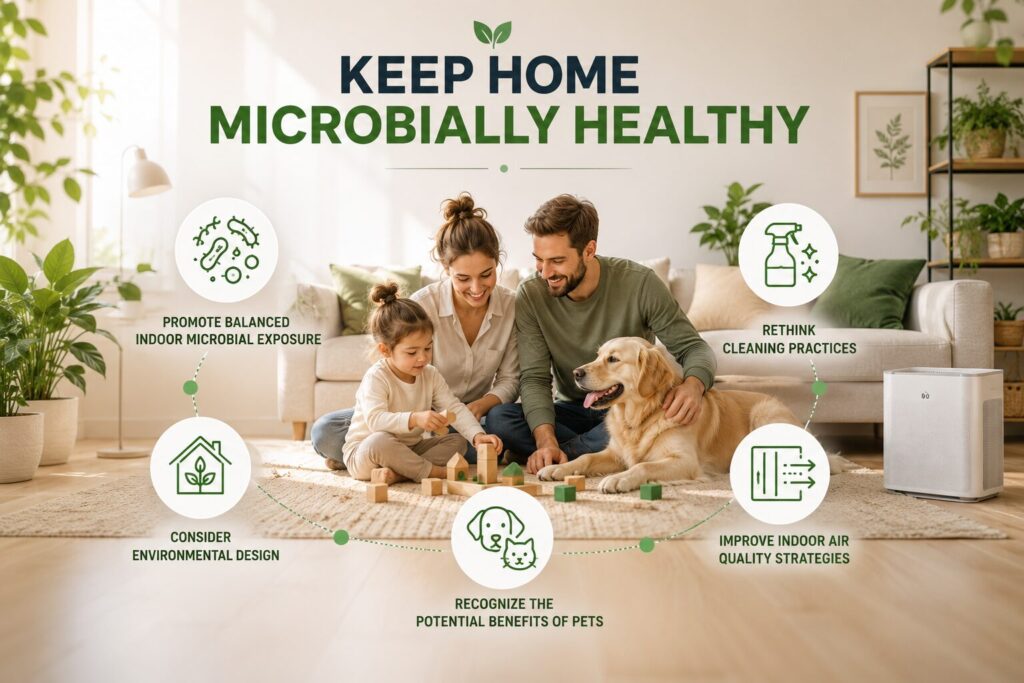
How to keep our home microbially healthy?
Promote Balanced Indoor Microbial Exposure
Rather than striving for completely sterile environments, maintaining balanced indoor microbial diversity may support healthy immune development.
Consider Environmental Design
Access to green spaces and thoughtful urban planning may influence healthier indoor microbial communities.
Recognize the Potential Benefits of Pets
Pet ownership may contribute positively to indoor microbial diversity, although decisions about pets should always consider individual allergies and medical advice.
Rethink Cleaning Practices
Routine cleaning remains essential, but excessive sterilization may not always be beneficial. Future recommendations may focus on balancing hygiene with maintaining healthy microbial ecosystems.
Improve Indoor Air Quality Strategies
The research supports integrating microbiome science into future indoor air quality guidelines, potentially moving beyond traditional concerns such as dust and pollutants alone.
Thus, creating healthier indoor environments may involve more than reducing pollutants, it may also require understanding and supporting beneficial microbial ecosystems. As microbiome research continues to evolve, these insights could help shape future public health recommendations aimed at reducing childhood asthma and improving indoor air quality.