
The benefits of Green Spaces on children’s Quality of Life
Why Nature Matters for Children’s Health
In an increasingly urbanized world, children spend less time outdoors than previous generations. Concerns about screen time, mental health challenges, and reduced physical activity have sparked growing interest in understanding how nature influences child development and well-being.
A remarkable study conducted by researchers of University of Western Ontario, London, as part of the Spatial Temporal Environment Activity Monitoring (STEAM) Project, an ongoing initiative examining environmental influences on children’s health behaviours and outcomes. The study investigated whether access to natural environments around children’s homes affects their overall well-being and quality of life. The research recognised that geographical locations such as parks, water bodies, and vegetation influence children’s physical, emotional, social, and school functioning.
The findings provide valuable insights for parents, educators, urban planners, public health professionals, and policymakers seeking evidence-based strategies to support healthier childhood development.
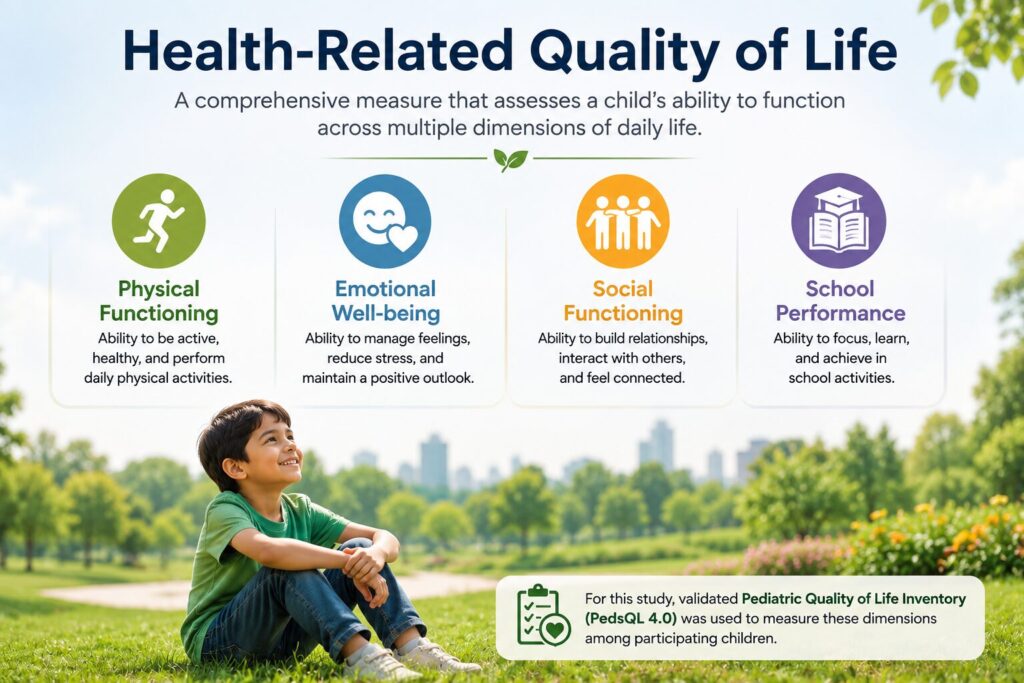
Understanding Health-Related Quality of Life (HRQOL)
Health-Related Quality of Life is a comprehensive measure that assesses a child’s ability to function across multiple dimensions of daily life. Rather than focusing solely on physical health, HRQOL evaluates:
- Physical functioning
- Emotional well-being
- Social functioning
- School performance
For this study, validated Pediatric Quality of Life Inventory (PedsQL 4.0) was used to measure these dimensions among participating children.
This broader approach provided a more complete understanding of children’s overall well-being and mental health.
Measuring Access to Nature
To compare the impact of natural environments across different geographical settings, study used an advanced Geographic Information System (GIS) technology. The study analysed the data of 851 children, aged between 8-14 years, across urban, suburban and rural communities, where each child’s exact home location was tracked by GPS and created a 500-meter buffer zone around the residence to measure nearby natural features.
Within these zones, following variables were assessed:
- Park Accessibility
The percentage of parkland within the buffer area around each child’s home.
- Water Accessibility
The percentage of water features such as rivers, lakes, and ponds within the surrounding area.
- Greenness Levels
Using satellite imagery and the Normalized Difference Vegetation Index (NDVI), researchers measured vegetation density and categorized greenery into:
- Grass and shrubbery
- Dense vegetation
Further, a step-wise linear regression models was used to identify relationships between environmental variables and HRQOL outcomes.
The analysis incorporated three levels of influence:
- Intrapersonal factors (age, gender, ethnicity)
- Interpersonal factors (family structure, parental education, household income)
- Physical environment factors (parks, water, vegetation, urbanicity)
This socio-ecological framework enabled a comprehensive evaluation of factors influencing children’s well-being.
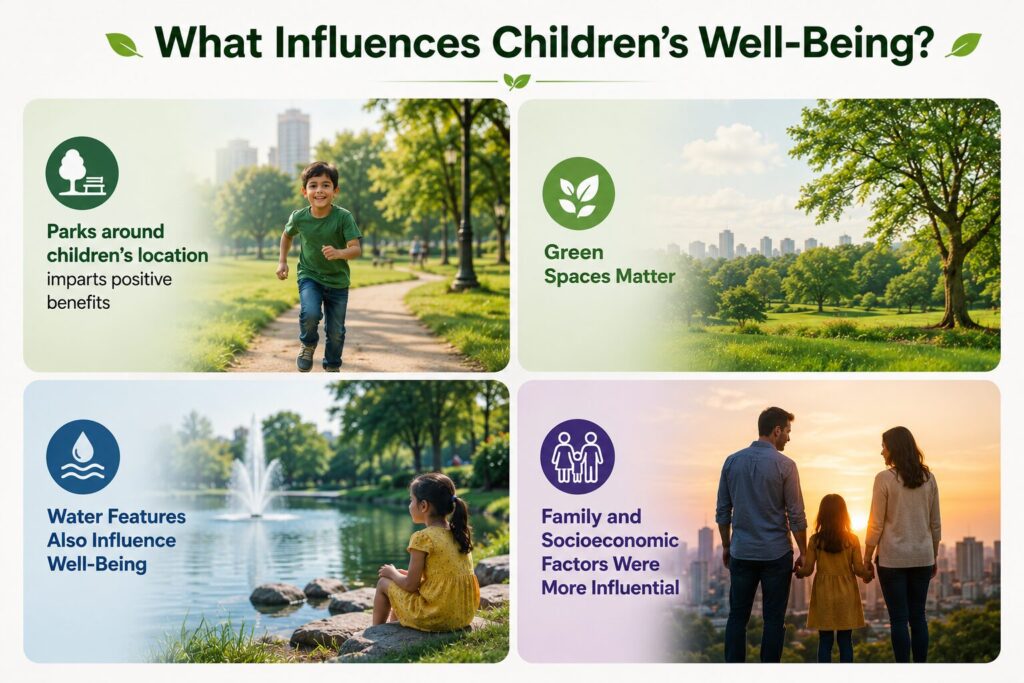
Influence of nature on children’s wellbeing
Findings for Urban and Suburban Children
Among urban and suburban participants, natural environmental features showed significant associations with multiple HRQOL outcomes.
Parks around children’s location imparts positive benefits
The presence of nearby parks was positively associated with:
- Overall quality of life scores
- Physical functioning
- Social functioning
Access to parks may support healthier lifestyles, social interaction, and better overall well-being among children living in more densely populated areas.
Green Spaces Matter
Vegetation levels were significantly associated with several HRQOL indicators. While some associations were complex, the results confirmed that natural environmental characteristics contribute meaningfully to children’s quality of life in urban and suburban settings.
Water Features Also Influence Well-Being
Water accessibility emerged as a significant predictor of several quality-of-life measures, highlighting the importance of considering all forms of natural environments rather than focusing solely on green spaces.
Findings for Rural Children
Interestingly, the results were quite different for children living in rural communities.
Family and Socioeconomic Factors Were More Influential
In rural populations, interpersonal factors had a stronger influence on quality of life than environmental variables.
As found:
- Household income significantly predicted multiple HRQOL outcomes.
- Age influenced psychosocial and social functioning.
- Gender affected emotional functioning.
Natural Environments Had Limited Impact
Unlike urban areas, natural environment measures showed fewer significant associations with overall HRQOL among rural children. This may be due to the abundance of natural environments in rural communities, resulting in less variation in access levels among participants.
Future Insights:
The study offers several actionable insights for stakeholders involved in child health and development.
- Urban Planning Should Prioritize Green Spaces
Cities and municipalities can use these findings to justify investments in:
- Public parks
- Community green spaces
- Urban forests
- Child-friendly outdoor environments
Increasing access to nature may contribute to improved physical and social well-being among urban children.
- Schools Can Integrate Outdoor Learning
The study recommends promoting programs that encourage children to spend more time outdoors.
Outdoor learning environments can support:
- Cognitive development
- Physical activity
- Mental well-being
- Social interaction
Educational institutions can incorporate nature-based activities into daily learning experiences.
- Public Health Programs Should Encourage Nature Exposure
Public health agencies can develop initiatives that:
- Promote outdoor recreation
- Reduce barriers to park access
- Encourage family engagement in nature-based activities
Such programs may help improve children’s overall quality of life and well-being.
- Parents Can Support Nature Engagement
Parents play a critical role in facilitating children’s interactions with nature. Simple strategies include:
- Regular visits to local parks
- Outdoor family activities
- Nature walks
- Encouraging unstructured outdoor play
Even modest increases in nature exposure may support healthier childhood development.
Also in future, study may be carried out to measure:
- Actual exposure to nature
- Time spent outdoors
- Frequency of nature interactions
- Nature-based activities and engagement
Understanding how children actively interact with natural environments may reveal even stronger links between nature and well-being.
The findings reinforce the importance of creating child-friendly communities that prioritize access to nature. For urban planners, educators, healthcare professionals, and parents, the message is clear: integrating nature into children’s daily lives can be an important component of supporting healthier, happier, and more resilient young people.