AI-HEALS: A New AI-Based Approach to Personalized Diabetes Care and Education
Artificial Intelligence in Diabetes Care: A New Era of Personalized Self-Management
Globally, Diabetes is responsible for an estimated 3.4 million deaths annually. About 589 million adults of the age (20-79) years are living with Type 2 Diabetes. Among them, nearly 252 million people are living undiagnosed, representing around 43% of all diabetes cases. Despite advances in diabetes treatment, maintaining long-term blood glucose control remains a challenge because successful diabetes management depends heavily on patients’ daily self-care behaviours.
Managing Type 2 diabetes involves much more than taking medication. Patients must consistently:
- Monitor blood glucose
- Follow healthy dietary habits
- Exercise regularly
- Take medications correctly
- Understand disease progression
- Maintain motivation for long-term lifestyle changes
Traditional diabetes education often occurs only during clinic visits, leaving patients without immediate access to reliable guidance when questions arise, causing:
- Limited consultation time
- Lack of personalized education
- Poor long-term engagement
- Difficulty maintaining healthy behaviours
- Limited accessibility outside healthcare facilities
These gaps build motivation for the development of an AI-driven education platform capable of providing real-time, personalized support.
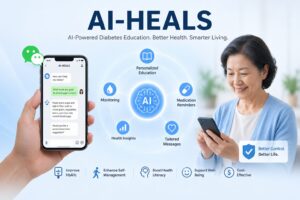
To address this challenge, researchers from Peking University, China, developed the Artificial Intelligence-based Health Education Accurately Linking System (AI-HEALS). AI-HEALS is an innovative AI-powered digital health platform designed to improve diabetes self-management through personalized education, intelligent question answering, lifestyle monitoring, and behavioral support, while reducing healthcare costs in primary care settings.
What is AI-HEALS?
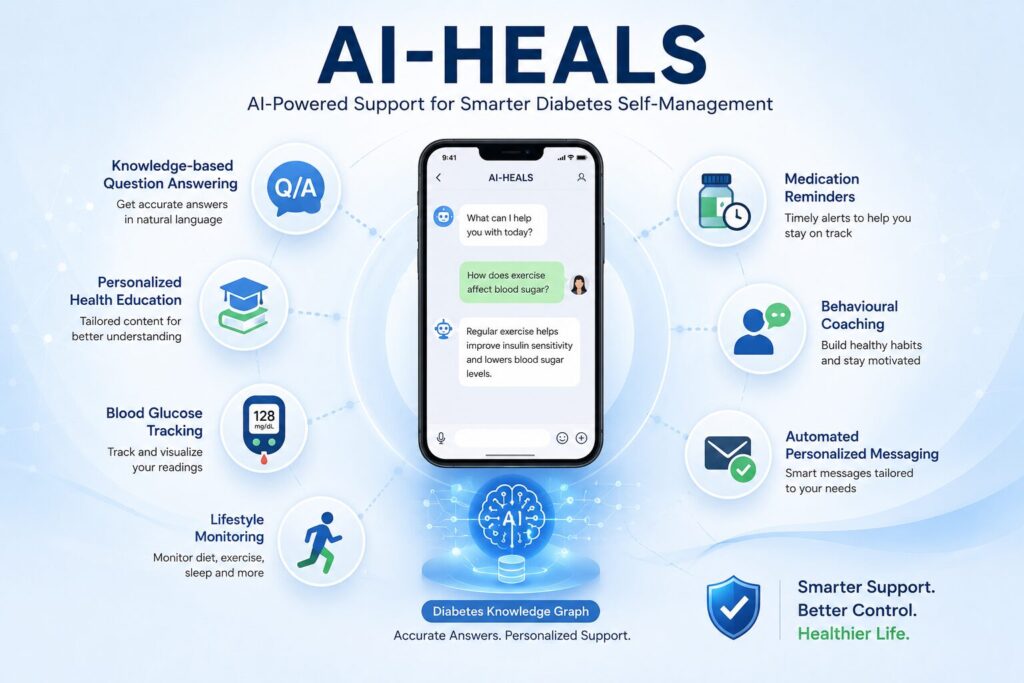
AI-HEALS (Artificial Intelligence-based Health Education Accurately Linking System) is an AI-powered mobile health intervention delivered through the WeChat platform.
Unlike conventional diabetes education apps, AI-HEALS combines several intelligent technologies into one integrated system:
- Knowledge-based Question Answering (KBQA)
- Personalized health education
- Blood glucose tracking
- Lifestyle monitoring
- Medication reminders
- Behavioural coaching
- Automated personalized messaging
The system uses a diabetes knowledge graph to accurately answer patient questions in natural language while continuously supporting self-management behaviours.
Design of AI-HEALS
For this nested mixed-methods approach was adopted that combines:
- Quantitative research
- Qualitative interviews
The quantitative component is a community-based cluster randomized controlled trial (RCT), considered the gold standard for evaluating healthcare interventions.
The qualitative component consists of in-depth interviews of 664 participants, diagnosed with Type 2 Diabetes, to understand patient experiences, usability, satisfaction, and engagement.
How AI-HEALS Works?
The intervention combines four major AI-powered functions.
Intelligent Question Answering (KBQA)
Participants can ask diabetes-related questions in natural language, such as:
- What foods should I avoid?
- Is this fruit safe for diabetes?
- Which exercises are recommended?
- How should I take my medication?
The AI retrieves accurate answers using a structured diabetes knowledge graph developed from clinical guidelines, expert consultation, and scientific literature. Unlike simple keyword searches, KBQA provides context-aware responses tailored to patient queries.
Lifestyle and Health Monitoring
Patient’s records are evaluated such as:
- Blood glucose
- Blood pressure
- Diet
- Physical activity
- Medication adherence
The platform stores these records electronically, allowing continuous monitoring of health behaviours over time. Usage patterns can also be analysed to refine the AI system further.
Smart Medication and Blood Glucose Reminders
Users can schedule reminders for:
- Medication intake
- Blood glucose testing
This feature aims to improve adherence by reducing missed medications and delayed glucose monitoring.
Personalized Health Education
Instead of sending generic educational content, AI-HEALS delivers personalized messages based on:
- User questions
- Reading behaviour
- Lifestyle records
- Behavioural change theory
Participants receive one to three tailored educational messages each week, encouraging healthier lifestyle choices and improving diabetes knowledge.
Benefits of AI-HEALS
Unlike many digital health studies that focus on app usage alone, both clinical and behavioural outcomes were evaluated
Primary Outcome
One of the most widely accepted indicators of long-term blood glucose control, HbA1c was assessed from baseline and at every quarter upto 1.5 years, as a primary outcome.
Secondary Outcomes
Diabetes Self-Management was also monitored, such as
- Healthy eating
- Physical activity
- Blood glucose monitoring
- Medication adherence
In addition, psychological health was monitored for the presence of any symptoms of anxiety, depression, stress and self-efficacy
Health Literacy
Evaluation was performed, if AI improves patients’ understanding of diabetes management and decision-making skills. In addition, clinical indicators were measured including:
- Blood pressure
- Body Mass Index (BMI)
- Blood lipids
- Medication dosage
Economic Evaluation
A cost-effectiveness analysis also compared AI-HEALS with standard diabetes care by examining healthcare utilization, quality of life, and incremental cost-effectiveness ratios (ICERs).
Strengths of AI-HEALS
Long-Term Follow-Up
Using AI-HEALS, participants are monitored for 18 months, allowing researchers to determine whether behavioural improvements are sustained over time rather than being short-lived.
Mixed-Methods Design
Combining quantitative outcomes with qualitative interviews enables researchers to understand:
- Why patients engage with AI
- What features they find useful
- Barriers to long-term adherence
- Opportunities for improving the platform
Real-World Primary Care Setting
The intervention has been implemented across 40–45 community health centers in Beijing, making the findings more applicable to everyday healthcare rather than highly controlled laboratory settings.
Advanced Statistical Analysis
Researchers plan to use robust analytical techniques, including:
- Generalized Linear Mixed Models (GLMM)
- Structural Equation Modeling (SEM)
- Logistic regression
- Linear regression
These methods may enable rigorous evaluation of behavioral changes and clinical outcomes over time.
How can we practically use AI-HEALS ?
For Patients
AI-powered education could provide:
- Immediate answers to diabetes-related questions
- Better medication adherence
- Improved dietary decisions
- Greater confidence in self-management
- Continuous support outside clinic visits
For Healthcare Providers
Clinicians may benefit from:
- Reduced educational workload
- Better patient engagement
- Remote monitoring of patient behaviors
- Data-driven clinical decision-making
- More efficient follow-up care
For Public Health Systems
If AI-HEALS proves effective, healthcare systems could:
- Reduce diabetes-related complications
- Lower hospitalization rates
- Improve chronic disease management
- Expand access to personalized care
- Deliver cost-effective interventions at scale
For Digital Health Innovation
The study demonstrates how artificial intelligence can move beyond disease prediction to actively support patient education and behavior change.
By integrating AI, mobile health (mHealth), and behavioral science, AI-HEALS offers a scalable model that could be adapted for other chronic conditions such as hypertension, obesity, and cardiovascular disease.
Future Insights
The AI-HEALS is designed totowards integrating artificial intelligence into routine diabetes care. By combining a knowledge-based question answering system, personalized health education, lifestyle tracking, automated reminders, and behavioural support within a single mobile platform, the researchers aim to empower patients with continuous, accessible, and individualized diabetes management.
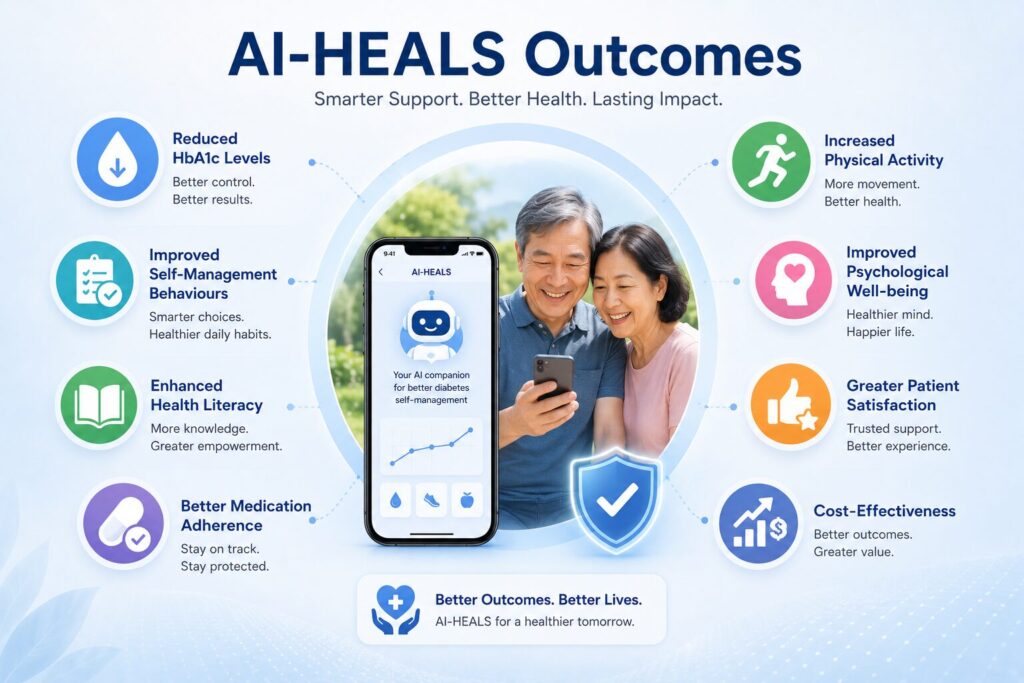
The intervention intends to evaluate the outcomes, such as:
- Reduced HbA1c levels
- Improved diabetes self-management behaviours
- Enhanced health literacy
- Better medication adherence
- Increased physical activity
- Improved psychological well-being
- Greater patient satisfaction with AI-assisted care
- Demonstrated cost-effectiveness compared with standard diabetes care
Further, patient’s trial will provide evidence on whether AI-driven personalized education can improve diabetes outcomes in primary healthcare settings. If the intervention achieves its intended objectives, AI-HEALS could become a scalable, cost-effective model for enhancing chronic disease management and improving the quality of life for millions of people living with Type 2 diabetes worldwide.