
Blood-Based Biomarkers Could Enable Early Alzheimer’s Diagnosis
Alzheimer’s Disease Diagnosis and Current Challenges
Alzheimer’s disease (AD) is a progressive neurodegenerative disorder and the most common cause of dementia. It gradually affects memory, thinking, learning, language and the ability to perform everyday activities. The disease is associated with biological changes in the brain, including the accumulation of amyloid-β plaques and abnormal tau proteins, alongside neuronal damage and neuroinflammation.
Diagnosis of Alzheimer’s typically begins when a person presents with memory or other cognitive complaints and involves assessing cognitive symptoms that determines whether the presence of Alzheimer’s disease. Traditionally, clinicians have relied on clinical assessments such as cerebrospinal fluid (CSF) analysis or sophisticated brain imaging such as amyloid and tau positron emission tomography (PET). These approaches have demonstrated strong value, but their use can be limited by the need for specialized facilities, advanced imaging infrastructure or lumbar puncture, making widespread implementation difficult. In addition, because symptoms of Alzheimer’s can overlap with other causes of cognitive impairment, misdiagnosis remains substantial even in specialist memory clinics, opening a way forward to solve the challenges for scalability, accessiblity and cost-effective diagnostic approaches, particularly as disease-modifying treatments increase the importance of accurate early diagnosis.
Scientists are now taking a glance at the potential of blood-based biomarkers (BBMs) testing that can be more precise and provide evidence of the underlying biological changes associated with Alzheimer’s disease. Biomarkers such as plasma p-tau217, p-tau181 and Aβ42/Aβ40 could provide information about Alzheimer’s pathology through a much simpler blood sample. Rapidly developing blood tests, particularly plasma phosphorylated tau (p-tau) could transform the assessment of Alzheimer’s disease.
In search of Alzheimer’s Biomarkers
Scientists have found that the biomarkers could be applied across several stages of the Alzheimer’s disease pathway, such as:
- Diagnosis of symptomatic Alzheimer’s disease
- Differential diagnosis of cognitive impairment
- Prognosis and prediction of cognitive decline
- Identification of preclinical Alzheimer’s pathology
- Clinical-trial recruitment
- Monitoring of treatment response
- Evaluation of disease-modifying therapies
The known biomarkers could be assessed for analytical performance, pre-analytical sample handling, biomarker robustness, standardization and clinical cutoff values, before they become reliable clinical laboratory tests.

Understanding the Main Alzheimer’s Blood Biomarkers
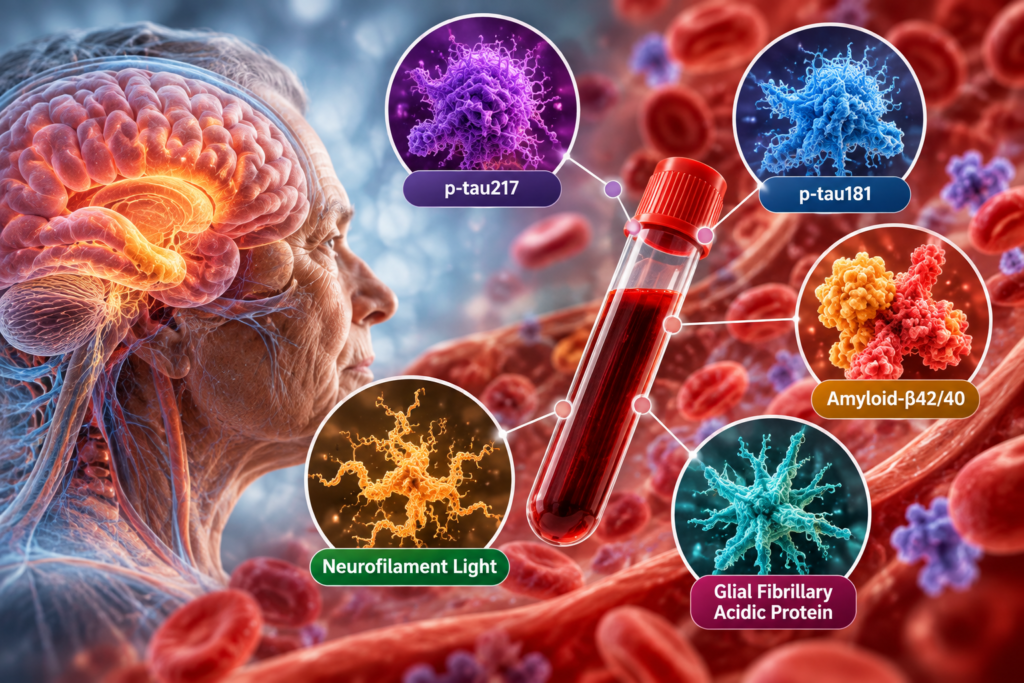
- Plasma p-tau217
The biomarker protein, plasma p-tau217 emerges as one of the most promising candidates for Alzheimer’s disease detection. This protein (p-tau217) can distinguish symptomatic Alzheimer’s disease from other neurodegenerative diseases with high diagnostic accuracy. Its relatively large change between disease and non-disease states also gives it an important advantage in routine testing.
Many evidences display increase in plasma p-tau217 by approximately 300–700% in symptomatic Alzheimer’s disease, providing a substantially larger biological signal than the relatively modest changes observed for some plasma amyloid measurements.
Longitudinal evidence is particularly interesting. Over 4-6 years, p-tau217 showed clearer increases in preclinical and prodromal Alzheimer’s disease than several other biomarkers, including Aβ42/40, p-tau181, p-tau231, GFAP and NfL. It also showed strong associations with brain atrophy and cognitive decline.
These findings make p-tau217 a promising candidate for both diagnostic testing and monitoring disease progression.
- Plasma p-tau181
Plasma p-tau181 is another important Alzheimer’s biomarker.
p-tau181 also performs well for identifying Alzheimer’s-related pathology. An additional practical advantage is that plasma p-tau181 concentrations are generally higher than p-tau217, which can make p-tau181 easier to measure on some fully automated laboratory platforms.
Therefore, technological performance isn’t determined solely by biological accuracy. A biomarker must also be measurable reliably on instruments available in everyday clinical laboratories.
- Amyloid-β42/40
The plasma Aβ42/Aβ40 ratio also play an important role, particularly in detecting amyloid pathology at very early stages.
However, the change in plasma Aβ42/Aβ40 in symptomatic Alzheimer’s disease is relatively small i.e. approximately 8–15%. This makes the measurement more vulnerable to analytical and pre-analytical variation.
The biomarker may therefore be particularly useful when combined with other markers rather than being interpreted independently.
For example, combinations of plasma p-tau and Aβ42/Aβ40 may improve identification of amyloid pathology, particularly in preclinical disease.
- Neurofilament Light
Neurofilament light (NfL) is a marker of neuronal injury and neurodegeneration, but it isn’t specific to Alzheimer’s disease.
This distinction is clinically important. Increased NfL may reflect neurodegeneration caused by several neurological disorders. It is therefore suggested that NfL could be particularly useful when clinicians suspect non-Alzheimer neurodegenerative disease, rather than relying on it as a standalone Alzheimer’s diagnostic marker.
- Glial Fibrillary Acidic Protein
GFAP is another biomarker associated with Alzheimer’s-related pathology and disease progression.
plasma GFAP levels increase over time in Alzheimer’s disease and that reductions have been observed after effective removal of amyloid plaques through anti-amyloid immunotherapy. This raises the possibility that GFAP could contribute to monitoring biological responses to treatment.
Application of Alzheimer’s Biomarkers in Clinical Diagnosis
Non-invasive and cost-effective investigations
One of the most important applications of Alzheimer’s blood biomarkers is potentially reducing the need for invasive or expensive confirmatory investigations.
A possible future clinical pathway may be in which a patient presenting to primary care with cognitive concerns first receives a standard clinical assessment, including medical history, neurological examination and cognitive testing.
Blood biomarkers could then provide additional biological information.
For example:
Elevated plasma p-tau → may supports the possibility that Alzheimer’s pathology is contributing to cognitive impairment.
Normal p-tau + elevated NfL → may suggest a non-Alzheimer neurodegenerative process.
However, the blood biomarkers should support rather than replace clinical assessment.
Prognosis: Predicting Future Cognitive Decline
Blood biomarkers could also provide information beyond diagnosis.
Higher baseline plasma p-tau217 and p-tau181 levels in people with mild cognitive complaints have been associated with subsequent progression to Alzheimer’s dementia.
Importantly, models combining plasma p-tau with a small number of brief cognitive tests have shown predictive performance comparable to CSF-based models for predicting the development of Alzheimer’s dementia over approximately 2–6 years in patients with mild cognitive complaints.
This could eventually support more individualized discussions between clinicians, patients and care partners about prognosis.
Blood Biomarkers could transform Alzheimer’s Clinical Trials?
The implications for clinical trials may be particularly significant.
It is worthy to note that approximately 40–60% of people with mild cognitive impairment and 20–30% of clinically diagnosed Alzheimer’s dementia patients do not have brain amyloid pathology. Consequently, clinical trials can spend substantial time and money identifying participants who actually meet biological eligibility criteria. Blood biomarkers could provide an efficient pre-screening step before expensive amyloid PET or CSF testing.
For example, as experienced in the A4 preclinical Alzheimer’s trial: identifying 1,169 eligible participants required more than 4,000 amyloid PET scans over 3.5 years. High-performing blood tests could substantially reduce this screening burden.
This could make trials more scalable, accelerate recruitment and reduce unnecessary PET or lumbar-puncture procedures.
Blood Biomarkers for Treatment Monitoring
Another promising application is monitoring biological response to therapy.
Reductions in plasma p-tau following anti-amyloid treatment have been associated with less clinical deterioration. Plasma GFAP has also shown reductions after effective amyloid removal.
This creates the possibility of repeatedly measuring blood biomarkers during treatment rather than depending exclusively on imaging or CSF assessments.
Longitudinal p-tau217 measurements may be particularly interesting as it may provide stronger longitudinal associations with brain atrophy and cognitive decline than several other plasma biomarkers.
Future Insights: What Still Needs to Be Solved?
Blood-based biomarkers like plasma p-tau217 and p-tau181 represent an important development in Alzheimer’s disease research and clinical practice and could contribute to prognosis, clinical-trial recruitment, preclinical disease identification and treatment monitoring.
Despite the promising applications possibilities of biomarker testing, clinicians could still not completely rely on blood biomarkers as universally ready to replace existing diagnostic tools.
Several challenges remain.
Standardization: Different assays can produce different results. For instance, there may be relatively poor correlations between some plasma Aβ42 assays, whereas high-performing plasma p-tau assays have shown tighter agreement.
Sample handling: Pre-analytical standardized blood collection is primarily important, where with EDTA plasma used across biomarkers. Aβ42 and Aβ40 are unstable in whole blood, making early centrifugation, within one hour, is important.
Clinical cutoffs: For prospective studies, cutoffs should be first established before testing and samples may then be analyzed under routine clinical conditions.
Real-world populations: Age, kidney disease, obesity and other factors can influence biomarker concentrations. These effects may not always be clinically large, but they need to be considered when interpreting individual results.





Your posts are like a breath of fresh air I appreciate how you tackle difficult topics with grace and empathy
Hi, Julia,
Heartfelt Thank you for your appreciation.
Subscribe and stay updated with us.