How Algae Could Transform the Future of Biofuel Production?
Global Concerns for Sustainable Fuel Production
Fossil fuels including coal, oil, and natural gas are the major sources of global energy, powering electricity generation, transportation, industry, and heating. However, their continued use has raised significant environmental, health, economic, and energy-security concerns. The combustion of fossil fuels is a major source of greenhouse-gas emissions, particularly carbon dioxide, which contributes to global warming and climate change. Rising temperatures are associated with more frequent and intense heatwaves, changing precipitation patterns, sea-level rise, and other environmental disruptions.
Fossil-fuel combustion also releases pollutants such as particulate matter, nitrogen oxides, and sulfur dioxide, which contribute to poor air quality and adverse health effects. In addition, extracting and transporting fossil fuels can cause habitat disruption, water contamination, and other environmental impacts.
Scientists are therefore investigating alternative and cleaner energy solutions that can reduce greenhouse-gas emissions while meeting growing global energy demand. However, the transition is technically and economically challenging because energy systems must remain reliable, affordable, scalable, and accessible while reducing environmental impacts. Among the emerging options, algae-based biofuels stand out because algae can produce biomass without relying heavily on conventional agricultural land and, in suitable systems, can grow using wastewater, carbon dioxide and sunlight. Unlike many first-generation biofuel feedstocks, algae need not directly compete with food crops, making them particularly attractive for the development of third-generation biofuels.
Researchers from Quaid-i-Azam University and REVA University performed a systematic study on how microalgae and macroalgae can be cultivated, harvested and converted into fuels such as biodiesel, bioethanol, biohydrogen and biobutanol. They highlight the potential of algae as a sustainable fuel feedstock, but improvements in cultivation, harvesting, processing, energy efficiency and economics are essential before widespread commercial deployment.
Their study focussed on:
- Types of algae and their biochemical potential
- Cultivation systems and photobioreactor technologies
- Biomass-to-biofuel conversion processes
- Sustainability, limitations, practical applications and future prospects
This systems-level approach is important because the feasibility of algal biofuel isn’t determined by lipid content alone. Productivity, light availability, temperature, pH, carbon dioxide, nutrients, harvesting efficiency, energy consumption and downstream processing all influence the final fuel yield and economics.
Importance of Microalgae and Macroalgae
Several unique characteristics of algae make them attractive renewable feedstocks. Microalgae exhibit rapid biomass growth and accumulate lipids, while macroalgae, including seaweeds, provide carbohydrate-rich biomass for fuel production.
Among algal species, there are substantial biochemical variation are found. For example, reported dry-weight lipid contents include approximately:
- 45–47% for Nitzschia sp.
- 28–32% for Chlorella sp.
- 25–33% for Isochrysis sp.
- 20–25% for Pavlova lutheri.
This variation demonstrates why species selection is a critical part of designing an algal biofuel process.
Importantly, algae can potentially be cultivated in environments unsuitable for conventional agriculture such as wastewater, brackish water and marine water, creating an opportunity to combine biomass production with nutrient removal and wastewater treatment.
That creates a compelling circular-bioeconomy model where, wastewater provides nutrients → algae produce biomass → biomass becomes fuel and other products → nutrients and resources can potentially be recycled.
Four Fuel Pathways from Algal Biomass
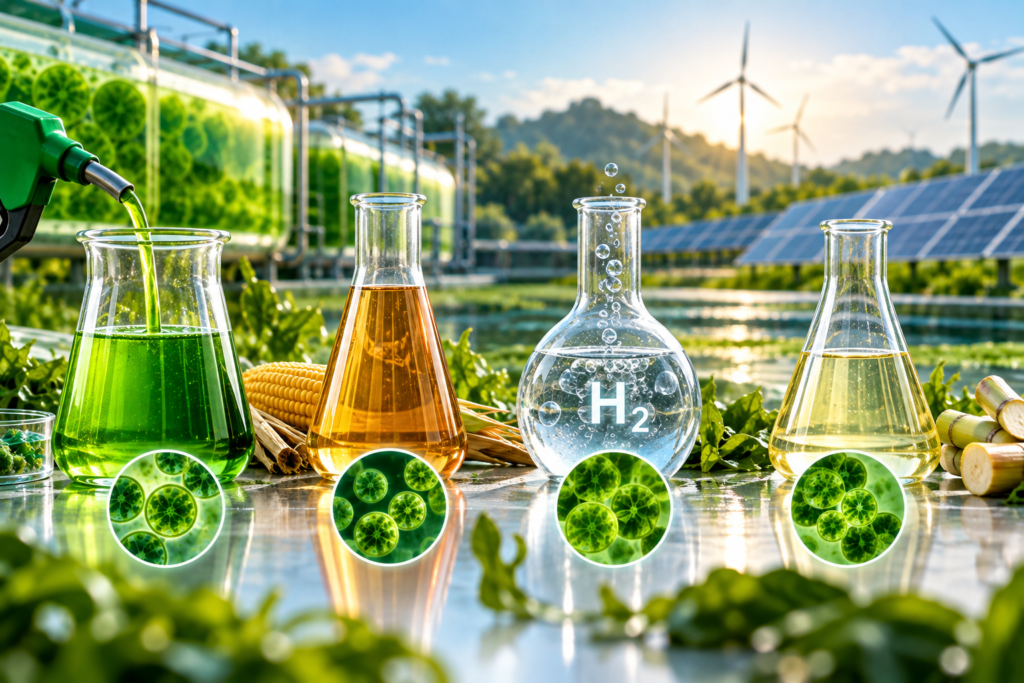
There are four major biofuels obtainable from algae:
- Algal Biodiesel
Biodiesel is produced from algal oils through processes such as transesterification. Microalgae are particularly attractive because some species can accumulate substantial quantities of lipids.
However, an important commercial challenge is producing sufficient low-cost biomass and extracting the oil economically. Harvesting, drying and extraction can consume significant energy, potentially reducing the overall sustainability advantage.
- Bioethanol
Algal carbohydrates, including starch and sugars, can be converted into ethanol through hydrolysis and fermentation. The process generally involves biomass preparation, carbohydrate conversion, fermentation and distillation.
The practical advantage is that algal biomass can provide carbohydrate feedstock without depending exclusively on conventional food crops.
- Biohydrogen
Algae can generate hydrogen through biological pathways such as direct and indirect photolysis, while carbohydrate-rich biomass can also support fermentation-based hydrogen production.
The major technical challenge is oxygen sensitivity. Hydrogenase activity can be inhibited by oxygen, creating an important engineering barrier while improved reactor designs, oxygen-management strategies and potentially genetically engineered strains can be some future solutions.
- Biobutanol
Algal carbohydrates can also serve as substrates for acetone–butanol–ethanol (ABE) fermentation. The use of algal biomass with Clostridium species notes the potential of both microalgae and macroalgae as feedstocks.
Photobioreactors: The Technology Behind Controlled Algal Cultivation
There are different technologies for algal cultivation, including open ponds, closed photobioreactors and hybrid systems, as well as tubular, vertical-column, bubble-column, helical, flat-panel and stirred-tank configurations.
Closed photobioreactors can provide better control of cultivation conditions and reduce contamination compared with open systems, although they generally involve higher capital and operating costs.
Open ponds, particularly raceway systems, are simpler and less expensive but are more vulnerable to contamination, weather fluctuations, water loss and uncontrolled temperature and light conditions.
Hybrid systems combine elements of both approaches. Algae can initially be cultivated in a controlled photobioreactor to generate high-density inoculum before transfer to a larger open system.
The practical lesson is that there is no universally optimal cultivation technology. Reactor selection needs to match the algal species, desired product, available resources, environmental conditions and economic model.
Factors Affecting Biofuel Productivity
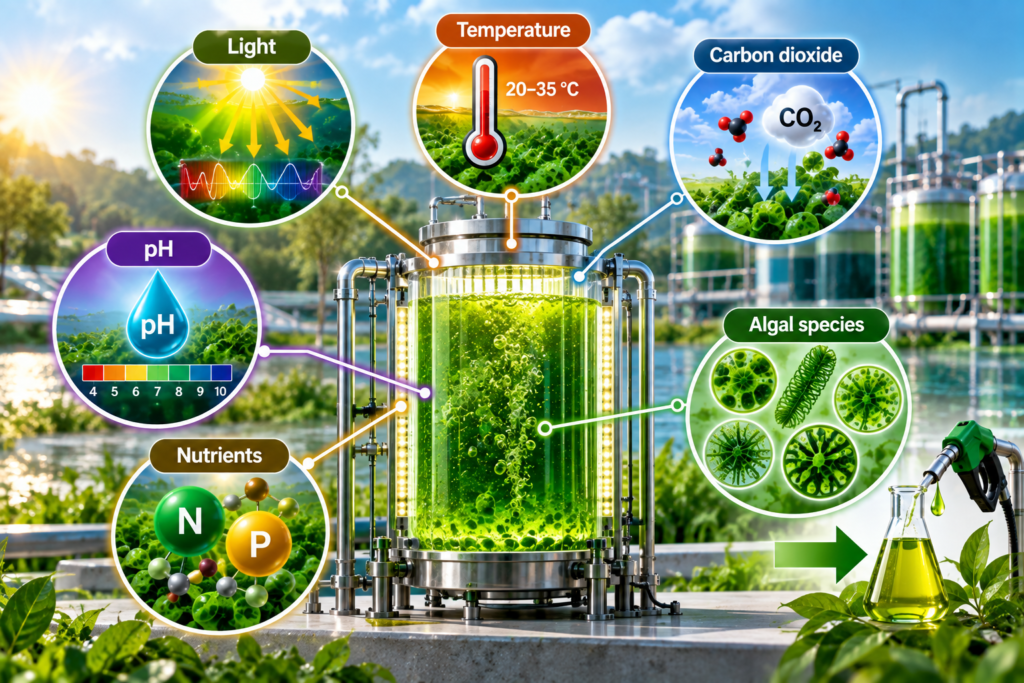
Several critical factors affects algal growth and fuel production:
- Light: wavelength and intensity influence photosynthesis, biomass accumulation and lipid production.
- Temperature: many algae grow optimally around 20–35 °C, although species-specific requirements vary.
- Carbon dioxide: CO₂ availability affects both biomass growth and lipid/fatty-acid production.
- pH: changes in pH can influence growth, enzymatic activity and lipid accumulation.
- Nutrients: nitrogen and phosphorus are particularly important for algal development.
- Algal species: biochemical composition and growth characteristics determine the suitability of biomass for particular fuels.
Monitoring and optimizing these parameters can improve biomass productivity and help operators select conditions appropriate for either maximum growth or targeted biochemical accumulation.
From Biomass to Fuel: Choosing the Right Conversion Route
Biomass conversion can be categorised into thermochemical, biochemical and chemical pathways, as well as direct combustion.
Thermochemical approaches
This includes pyrolysis, gasification and hydrothermal liquefaction. One major advantage of hydrothermal processing is that wet algal biomass can potentially be processed without the same degree of drying required by some conventional pathways.
Biochemical approach
This includes fermentation, anaerobic digestion and photobiological hydrogen production.
The practical choice depends on the composition and moisture content of the biomass. For example, lipid-rich biomass may be attractive for biodiesel, carbohydrate-rich biomass can support ethanol, butanol or hydrogen pathways, while wet residual biomass may be particularly suitable for anaerobic digestion.
This points toward an important concept of algal biorefineries. Instead of treating algae solely as a source of one fuel, multiple fractions and co-products could potentially be converted into commercially valuable products.
The Biggest Challenge: Economics and Energy Balance
The algae is not a ready-made replacement for petroleum. In fact, its utilization accompanies significant energy and economic challenges associated with cultivation, circulation, harvesting, drying and processing.
Photobioreactors can improve cultivation control but require considerable infrastructure and energy. Open ponds are less expensive but introduce contamination and environmental-control challenges. Harvesting and dewatering can also become major energy-intensive stages.
This means future commercialization depends on reducing capital costs, operating costs and energy consumption while increasing biomass productivity and improving downstream recovery.
Future Insights: Applications and the Road Ahead
Several promising strategies lie for making algae-based biofuels more practical.
1) Wastewater-based cultivation could combine nutrient removal with biomass production.
2) Recycling water, nutrients and CO₂ could reduce resource consumption.
3) Improved harvesting and extraction technologies could lower downstream costs.
Genetic engineering can be a potentially important long-term strategy for developing strains with enhanced lipid production, improved photosynthetic performance or easier oil recovery while co-cultivation of microalgae with bacteria, yeast, fungi or other microorganisms is another emerging approach.
Perhaps most importantly, a biorefinery approach could be revolutionary where fuels need not be the only products. Valuable biomolecules and other algal-derived products could improve the overall economic viability of the system.
The next breakthrough may therefore not come from a single “best” algal species or reactor. It may come from integrating cultivation, resource recycling, efficient harvesting, biomass conversion and high-value co-products into one economically viable algal biorefinery.