Scientists Develop Compact Gene-Silencing Technology for Alzheimer’s Research
- Dr. Diksha Varma
- October 8, 2026
- 5 mins
All-in-One AAV Epigenome Editing: A New Gene-Silencing Platform for Neurodegenerative Disease
Neurodegenerative disorders such as Alzheimer’s disease and Parkinson’s disease are associated with complex changes in gene expression and making precise control of related genes is critical to find effective solution for the underlying disease. Conventional gene-editing approaches can permanently alter DNA and may create unintended effects, while delivering sophisticated CRISPR systems into the brain remains technically challenging.
Researchers from Duke University School of Medicine, developed a compact CRISPR interference system based on catalytically inactive Staphylococcus aureus Cas9 (dSaCas9), fused to two transcriptional repression domains, KRAB and the transcriptional repression domain of MeCP2. Unlike conventional CRISPR/Cas9 gene editing, the system is designed to suppress gene expression without cutting DNA and most fascinating is that the complete editing machinery is engineered to fit within a single adeno-associated virus (AAV) vector.
Epigenome Editing using CRISPR Technology
CRISPR technology is best known for cutting DNA at specific locations. However, not every disease requires DNA to be permanently altered. In some disorders, a therapeutic strategy may instead involve reducing the activity of a disease-associated gene.
This is where epigenome editing becomes relevant.
For this a catalytically inactive Cas9, or dCas9, was used which retains its ability to recognize a specific DNA sequence but lacks the ability to cut DNA. By attaching transcriptional repressors to dCas9, a system capable of directing the cell’s own regulatory machinery toward a selected gene and suppressing its transcription was designed.
The major engineering challenge was delivery. AAV is an attractive gene-delivery platform, particularly for the central nervous system, but its packaging capacity is limited to approximately 4.7 kb. Conventional CRISPR systems can be too large to fit into a single AAV vector. The study therefore focused on developing a compact, all-in-one system containing the necessary components within one optimized AAV particle.
Optimization of AAV Vector System
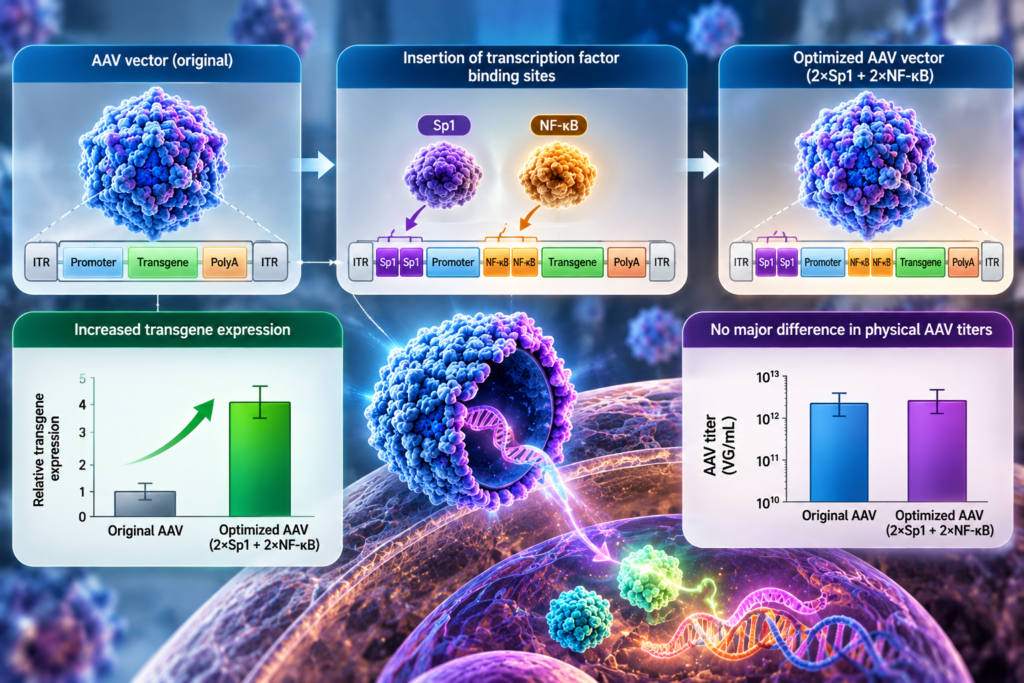
First the AAV vector itself was optimized. Binding sites were introduced for the transcription factors Sp1 and NF-κB into the expression cassette. These modifications substantially improved transgene expression without producing major differences in physical AAV titers. The optimized vector containing 2×Sp1 and 2×NF-κB sites was subsequently used throughout the study.
The next step identified the most effective transcriptional repression system.
Several combinations involving the smaller dCas9 proteins derived from Campylobacter jejuni and Staphylococcus aureus were screened. These were fused to different repression domains, including HP1, MBD proteins, NIPP1, KRAB, MeCP2, and DNA methyltransferases. A dual-reporter cell system containing destabilized GFP and Nano-Luciferase was used to measure gene repression. This screening identified dSaCas9-KRAB-MeCP2(TRD) as the most potent combination.
With a guide RNA targeting the promoter, the system reduced reporter expression by approximately 80% in vitro and the repression persisted through multiple rounds of cell division.
Later, Pcsk9 was targeted in human HEPG2 liver cells to investigate whether the system could regulate endogenous genes. With a sustained repression following a single treatment, results demonstrated that the technology was not limited to artificial reporter genes.
Evidence of Sustained Epigenetic Gene Silencing
When treated cells were followed for several weeks, it was found that the optimized AAV system-maintained gene silencing through multiple cell divisions. For example, reporter repression remained measurable several weeks after treatment.
Chromatin immunoprecipitation experiments provided mechanistic evidence for this sustained repression. The targeted promoter showed characteristics associated with transcriptionally inactive chromatin, including reduced H3 and H4 acetylation and increased H3K9 trimethylation.
Also, the AAV-CRISPR system remained predominantly episomal and that the persistent repression appeared to result from the established epigenetic state rather than permanent integration of the editing machinery.
This raises the possibility of a “hit-and-run” epigenome-editing strategy, in which a transient treatment establishes a longer-lasting change in gene expression. However, this concept remains preclinical research finding rather than a demonstrated human therapeutic outcome.
Epigenetic Gene Silencing in Animal models
Next the experiments then moved from cell culture to an animal model.
They delivered the all-in-one AAV system by stereotaxic injection into the dorsal hippocampus of mice, a brain region strongly associated with learning and memory and affected in several neurodegenerative disorders.
Using GFP as a reporter, approximately 45–60% reduction in reporter expression in the mouse hippocampus following treatment. The effect was observed in both young adult and middle-aged mice.
The researchers then tested a therapeutically relevant target: APOE.
APOE is the strongest and most reproducible genetic risk factor associated with late-onset Alzheimer’s disease, making it an important target for research into disease-modifying strategies. The investigators used two different guide RNAs directed against the mouse Apoe promoter.
After six weeks, the two guide RNAs reduced ApoE expression by approximately 71% and 53%, respectively. Both reductions were statistically significant.

How Gene-Silencing Technology can be used in Research?
The most important practical application of this research is the development of a flexible platform for targeted gene repression.
Rather than developing an entirely new delivery system for every gene, the same AAV-dSaCas9-KRAB-MeCP2(TRD) framework could potentially be adapted by changing the guide RNA to target a different gene.
This creates potential applications in research on diseases in which excessive or inappropriate gene expression contributes to pathology. For example, genes such as SNCA, which is associated with Parkinson’s disease, dementia with Lewy bodies, and multiple system atrophy.
The platform could therefore support:
- Targeted repression of disease-associated genes
- Functional investigation of genes involved in neurodegeneration
- Preclinical testing of gene-regulation strategies
- Development of potential disease-modifying approaches
- Investigation of epigenetic mechanisms underlying neurological disease
- Adaptation of one delivery platform to multiple genetic targets
The technology could also have broader research applications where precise and sustained gene repression is required.
Safety following Genetic Modifications
Preliminary safety assessments in mice following stereotaxic injection, displayed stable body weight and normal grooming and eating/drinking behaviours in animals and is important to note that the research was preclinical, and the brain experiments were conducted in mice using stereotaxic administration.
The findings of this study however, supports further preclinical investigation in Alzheimer’s disease models were evaluation of clinical outcomes such as memory improvement, prevention of Alzheimer’s disease, or slowing of neurodegeneration in human patients remains critical.
In addition, further research may establish long-term safety, delivery to relevant brain regions, target specificity, potential off-target effects, durability, immune responses, dose optimization, and therapeutic efficacy in disease models before clinical translation can be considered.
Future Insights
This study demonstrates an important shift from conventional gene editing toward programmable epigenome regulation. The ability to package the complete system into one vector is particularly relevant for CNS applications, where efficient delivery is a major challenge.
The all-in-one AAV-delivered dSaCas9-KRAB-MeCP2(TRD) epigenome-editing platform is capable of targeted and sustained gene repression. By overcoming the packaging limitations of AAV and avoiding DNA cleavage, the technology provides a promising research framework for manipulating disease-associated gene expression.
The results demonstrate the ability to regulate gene expression; they do not yet demonstrate prevention or treatment of Alzheimer’s disease in humans. Further disease-model studies will be required to determine whether this promising gene-regulation technology can ultimately translate into a clinically useful therapeutic strategy.