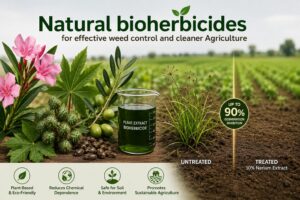
Natural bioherbicides for effective weed control and cleaner agriculture
Challenges of modern agricultural practices
Modern agriculture practices pose difficult challenges to control weeds effectively while minimizing environmental damage. For decades, synthetic herbicides have been the primary solution for weed management. However, their widespread use has contributed to soil and water contamination, biodiversity loss, herbicide resistance, and potential risks to human health.
Study conducted by the University of Samarra, Iraq, explored an eco-friendly alternative using natural plant extracts with allelopathic properties to control weeds. These findings offer promising insights for sustainable agriculture and environmental protection.
What Is Allelopathy and Why Does It Matter?
Allelopathy refers to the natural ability of certain plants to release biochemical compounds that influence the growth, germination, or survival of neighbouring plants. These naturally occurring compounds can suppress weed development without the environmental drawbacks associated with synthetic herbicides.
Cyperus rotundus (purple nutsedge) is one of the world’s most persistent and problematic weeds. It is particularly challenging because it reproduces rapidly through underground tubers and survives under harsh environmental conditions. Traditional herbicide-based control methods often prove ineffective, increasing the need for innovative and environmentally responsible weed management solutions.
How Plant Extracts Can Transform Sustainable Weed Management
Germination & Seedling Growth Inhibition Study
The evaluated the effectiveness of aqueous leaf extracts from three commonly available plants:
- Nerium (Nerium oleander)
- Olive (Olea europaea)
- Castor (Ricinus communis)
Grounded powders of the dried plants were soaked in water, refrigerated, filtered, and concentrated using a rotary evaporator, preparing extracts of concentrations: 5%, 7.5% and 10%.
The prepared extracts of Nerium, Olive and Castor were first used against the germination phase of the purple nutsedge. Four tubers were planted in prepared soil and irrigated regularly with the different extracts over two weeks.
In the second phase, the weed seedlings were allowed to grow to approximately 10–15 cm before applying the plant extracts every two days for one month.
Nerium Extract Demonstrated Exceptional Weed Suppression
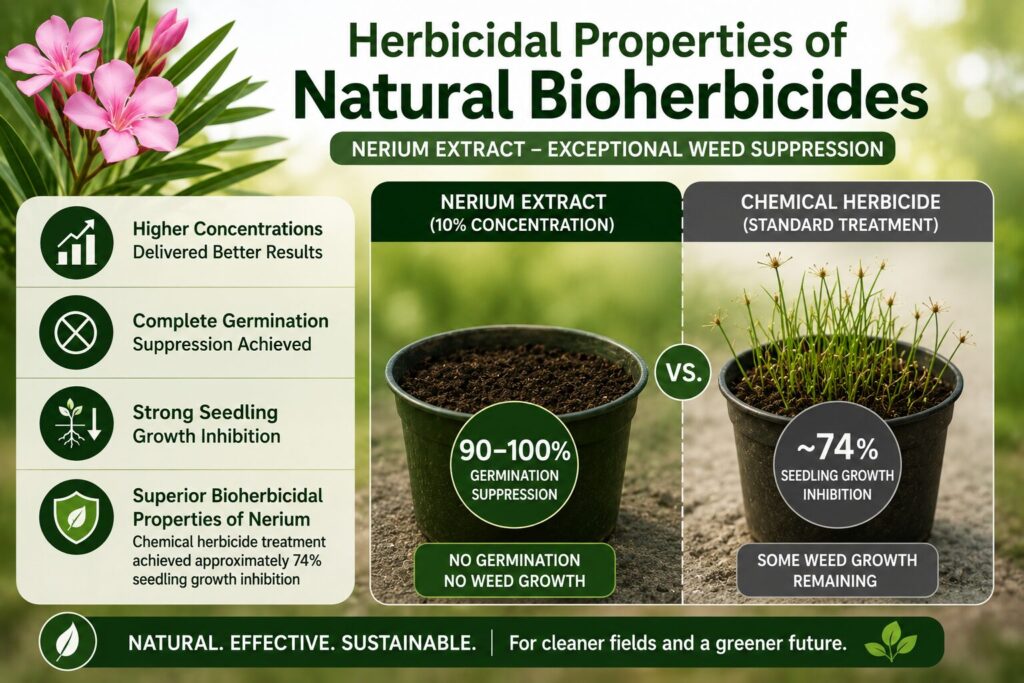
Nerium extract produced the strongest inhibitory effects on weed germination. The results showed:
- Nerium extract achieved approximately 80% inhibition of tuber germination.
- Castor extract achieved about 35% inhibition.
- Olive extract achieved about 23% inhibition.
The superior performance of Nerium suggests that it contains powerful allelopathic compounds capable of disrupting the germination process of purple nutsedge.
Higher Concentrations Delivered Better Results
A clear concentration-response relationship was demonstrated. As extract concentration increased, weed suppression improved significantly.
For Nerium extract:
- 10% concentration produced approximately 90% germination inhibition
- 5% concentration produced approximately 90% germination inhibition
- Lower concentrations were less effective but still showed substantial suppression
Notably, increasing concentrations improved inhibition rates across all three plant species.
Complete Germination Suppression Achieved
It was astonishing to see that 10% Nerium extract achieved 100% inhibition in a follow-up experiment, outperforming both the other plant extracts and the synthetic herbicide treatment, highlighting the remarkable potential of certain plant-derived compounds as natural herbicides.
Strong Seedling Growth Inhibition
Substantial suppression of seedling growth was observed:
- Nerium extract achieved 87% growth inhibition
- Castor extract achieved 5% growth inhibition
- Olive extract achieved approximately 55% growth inhibition
The extracts thus, not only prevent germination but also impair the development of existing weed seedlings.
Superior bioherbicidal properties of Nerium
The Tibenuron, a chemical weedicide treatment achieved approximately 74% seedling growth inhibition, while Nerium extract reached inhibition levels above 80% under certain concentrations, suggesting that natural plant extracts can, under specific conditions, compete with or even exceed the effectiveness of conventional herbicides.
Allelochemicals is naturally in plants
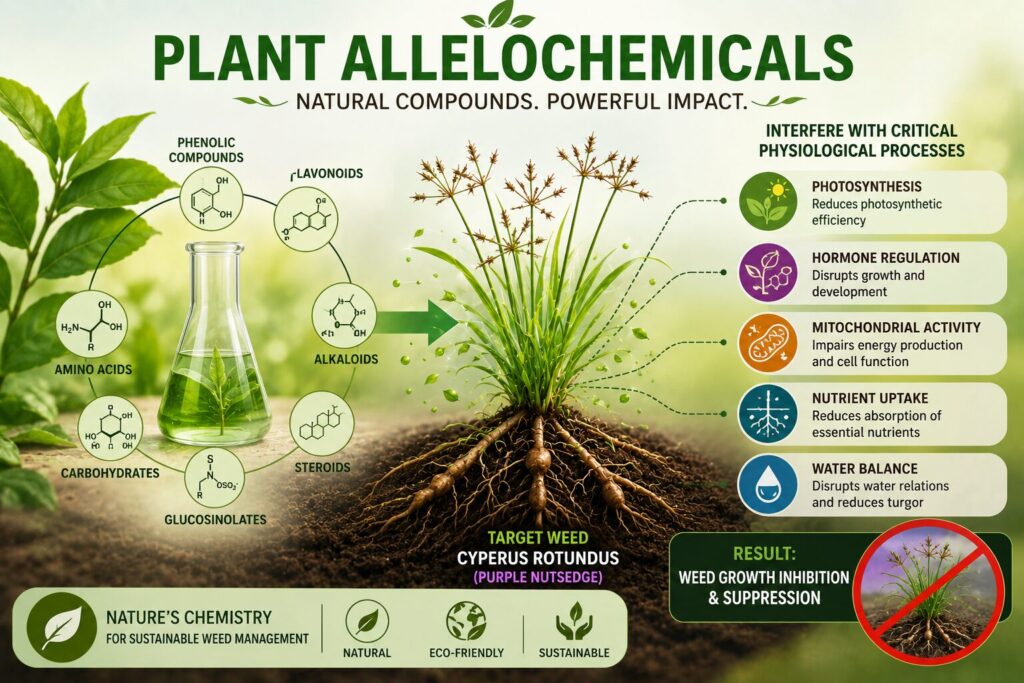
The inhibitory effects to various allelochemicals naturally present in plants, including:
- Phenolic compounds: They can inhibit seed germination and plant growth by interfering with enzyme activity and nutrient uptake.
- Flavonoids: They can suppress weed growth by affecting hormone regulation and cellular processes.
- Terpenoids: They often exhibit strong allelopathic and antimicrobial activities.
- Alkaloids: Many alkaloids are biologically active and can inhibit seed germination and plant development.
- Steroids: Some plant steroids possess allelopathic properties that can influence neighboring plant species.
- Amino acids: Organic molecules that serve as the building blocks of proteins and play essential roles in plant metabolism, growth, and stress responses.
- Carbohydrates: Certain carbohydrates and their derivatives can participate in plant signaling and allelopathic interactions.
These compounds interfere with critical physiological processes such as photosynthesis, hormone regulation, mitochondrial activity, nutrient uptake, and water balance in target weeds.
In particular, Nerium contains glucosinolates and other biologically active compounds that may contribute to its strong herbicidal activity.
Application of Bioherbicides for sustainable agriculture
- Sustainable Weed Management
Farmers can potentially integrate plant-derived herbicides into integrated weed management programs, reducing dependence on synthetic chemicals while maintaining effective weed control.
- Organic Farming Systems
As the extracts are obtained from natural plant materials, they may offer opportunities for weed management in organic and environmentally conscious farming operations, subject to local regulations and further validation.
- Reduced Environmental Pollution
Replacing or reducing synthetic herbicides can help minimize:
- Soil contamination
- Water pollution
- Chemical residue accumulation
- Biodiversity loss
This directly supports environmental sustainability goals.
- Managing Herbicide Resistance
Natural allelopathic compounds often contain multiple bioactive chemicals that affect weeds through different mechanisms. This diversity may help reduce the development of herbicide-resistant weed populations.
- Cost-Effective Local Solutions
Because Nerium, Castor, and Olive plants are widely available in many regions, farmers may be able to produce extracts locally, potentially lowering weed management costs while utilizing renewable biological resources.
Future Opportunities of Bioherbicides
The research highlights the tremendous insights over the use of natural plant extracts as bioherbicides, serving as a highly effective alternatives to synthetic herbicides. Especially, Nerium oleander that has been found to be 100% effective against the most world’s most persistent and problematic weed. These results demonstrated the strong potential of bioherbicide inclusion in environmentally friendly biological weed management programs.
Additional studies, may further validate these findings at field-scale level and optimize extract formulations. With the growing demand for organic food and sustainable farming, investigations in will focus on effects of bioherbicides on:
- Large-scale agricultural implementation of bioherbicides
- Long-term environmental impacts
- Effects on crop species
- Standardization of extract preparation
- Commercial bioherbicide development
As demand grows for eco-friendly farming solutions, natural bioherbicides may become an increasingly valuable tool for farmers worldwide.