
Epigenetic changes explain why we regain weight after weight loss
Why Does Weight Regain Happen So Often?
Millions of people successfully lose weight through dieting, exercise, medications, or bariatric surgery, yet many eventually regain much of it. While lifestyle factors certainly play an important role, scientists have long suspected that the body itself “remembers” obesity.
To prove this, scientists from Department of Health Sciences and Technology, Zurich have provided compelling evidence that fat tissue retains an epigenetic memory of obesity, even after substantial weight loss. The findings from their study help explain why maintaining weight loss is often much more difficult than losing it in the first place and may pave the way for future therapies that improve long-term obesity management.
How does Adipose tissue play role in weight regain?
Adipose (fat) tissue samples were collected from healthy-weight individuals and individuals with obesity before bariatric surgery and after two years of surgery.
Epigenetic memory persists
Single-nucleus RNA sequencing (snRNA-seq) was performed across cell types like adipocytes, endothelial cells, immune cells and macrophages, etc to investigate how individual cells behaved after weight loss.
In addition, one of the most detailed epigenetic investigations was conducted in adipocytes using techniques like ATAC-seq, CUT &Tag, TRAP-seq, Multi-Omics Factor Analysis (MOFA), also simultaneously examining the gene expression, chromatin accessibility, histone modifications and translational activity. These investigations helped to determine whether obesity leaves lasting molecular “marks” that persist even after weight normalization.
Strikingly it was found that many obesity-related gene expression changes remained active long after significant weight loss. It was observed that body weight improved dramatically and numerous adipocyte genes associated with obesity continued to behave differently from those of individuals who had never been obese.
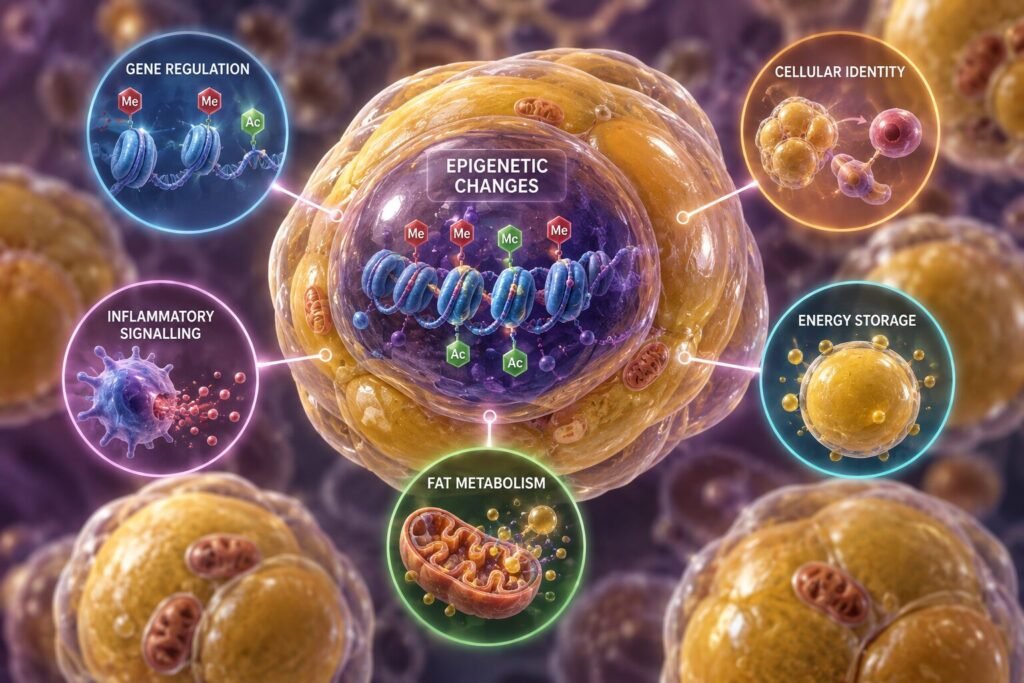
Stable epigenetic alterations were observed within adipocytes, affecting:
- Gene regulation
- Inflammatory signalling
- Fat metabolism
- Cellular identity
- Energy storage
Rather than disappearing after weight loss, many epigenetic marks remained, effectively creating a long-lasting biological memory of obesity.
Fat cells do not fully reset after weight loss
A controlled mouse model was designed to understand the mechanism of weight loss and regain, where mice were first fed with a high-fat diet to induce obesity and then switched back to a standard diet until body weight normalized and these mice were compared with lifelong healthy controls. This allowed scientists to observe biological changes before obesity, during obesity, after weight loss, and after weight regain under standardized conditions.
When mice that had previously been obese were re-exposed to a high-fat diet, they gained weight more rapidly than mice without prior obesity. Most importantly, this accelerated weight regain was associated with the persistent epigenetic changes observed in adipocytes, supporting the hypothesis that cellular memory contributes to rebound obesity
Metabolic function improved—but not completely
It was observed that weight loss restores many important metabolic indicators like:
- Blood glucose
- Insulin sensitivity
- Liver fat accumulation
- Body weight
However, adipose tissue still displayed persistent molecular abnormalities, suggesting that outward clinical recovery may not fully reflect underlying cellular recovery.

How can we maintain weight loss for the long term?
- Weight maintenance requires long-term support
Maintaining weight loss is not solely a matter of willpower. Persistent biological changes may continue to promote weight regain even after successful weight loss, highlighting the need for sustained medical, nutritional, and behavioural support.
- Obesity should be viewed as a chronic disease
Adipose tissue retains long-lasting molecular alterations and obesity appears to have enduring biological effects beyond visible body weight. This suggests viewing obesity as a chronic condition that requires ongoing care rather than a short-term problem that is permanently resolved once weight is lost.
- Future therapies could target epigenetic memory
Future obesity treatments may aim to erase or modify obesity-associated epigenetic changes.
Such therapies could potentially:
- Improve long-term weight maintenance
- Reduce rebound weight gain
- Restore healthier adipocyte function
- Complement lifestyle interventions and existing medications
While these approaches remain experimental, they represent an exciting direction for obesity research.
- Precision medicine for obesity
The identification of persistent molecular signatures raises the possibility of developing personalized obesity treatments based on an individual’s biological profile rather than relying solely on BMI or body weight measurements.
Future Insights
This landmark Nature study offers one of the strongest demonstrations to date that adipose tissue retains a long-lasting molecular memory of obesity. The research strongly suggests that significant weight loss does not completely erase obesity-induced changes in fat cells. Instead, persistent epigenetic alterations appear to prime adipose tissue for abnormal responses when exposed to an obesogenic environment again.
These findings provide a compelling biological explanation for why sustained weight maintenance is so challenging and underscore the importance of long-term obesity management. They also open the door to future therapies designed to target epigenetic memory, with the potential to improve the durability of weight-loss interventions and reduce the cycle of weight regain.