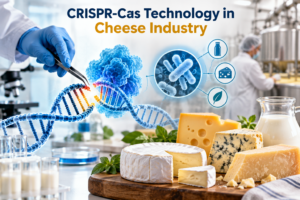
How CRISPR-Cas Technology Is Transforming the Cheese Industry?
How Bacterial Immunity Is Transforming Phage Resistance and Dairy Fermentation?
Cheese production depends on microorganisms that may be invisible to consumers but are fundamental to the final product. Lactic acid bacteria (LAB) such as Streptococcus thermophilus and Lactococcus species drive milk fermentation, contribute to acidification and influence the characteristics of many dairy products. Yet these valuable bacteria face a persistent biological threat from bacteriophages, or phages, viruses that infect bacteria.
Phage infections can disrupt starter cultures, interfere with fermentation and create serious challenges for cheese manufacturers. Starter cultures are essential for controlled dairy fermentation. If phages infect and destroy these bacterial populations, fermentation can become unreliable.
Why phages are such a problem for cheese production?
Traditional approaches to phage management include sanitation, rotation of starter cultures and the use of strains with different susceptibility profiles. However, complete elimination of phages cannot be completely eradicated from cheese-production environments.
This makes intrinsic bacterial resistance especially attractive and developing bacterial strains capable of resisting phage infection is an important industrial objective.
Researchers from Department of Biochemistry, Microbiology and Bioinformatics, Laval University, Canada, examined how CRISPR-Cas systems have become central to understanding and managing this problem and the industrial applications of CRISPR-Cas systems in cheese-related bacteria.
CRISPR-Cas and dairy microbiology
For cheese-related lactic acid bacteria (LAB), Type I, II, and III are the types of CRISPR-Cas systems are divided into two classes and seven major types:
Type I – Class 1 system
Type I CRISPR-Cas systems use a multi-protein complex called Cascade to recognize foreign DNA. After the target DNA is recognized, the Cas3 nuclease is recruited and degrades the DNA. In cheese-related LAB, Type I systems include I-C and I-E, and they are
particularly common in Lactobacillus helveticus and Lactobacillus delbrueckii.
Type II – Class 2 system
Type II systems use a single major effector protein, Cas9, together with crRNA and tracrRNA. Cas9 recognizes the target DNA and produces a double-stranded DNA break. Type II-A is the most important subtype in the cheese industry, particularly in Streptococcus thermophilus. The CR1 and CR3 loci of S. thermophilus contain Type II-A systems, which are highly active against bacteriophages.
Type III – Class 1 system
Type III systems are different because they mainly recognize RNA produced during viral transcription. Type III-A systems contain the Csm complex and Cas10, with Csm3 and Csm6
contributing to RNA degradation and antiviral defense. They occur in S. thermophilus, L. lactis, and several Lactobacillus species used in cheese production.
Other CRISPR-Cas types
CRISPR-Cas systems are currently grouped into Class 1 (Types I, III, IV and VII) and Class 2 (Types II, V and VI). Class 2 systems use a single large effector protein: Cas9 in Type II, Cas12 in Type V, and Cas13 in Type VI.
Streptococcus thermophilus is extensively applied in the cheese industry?
Type II-A CRISPR-Cas systems, especially the Cas9-based systems of Streptococcus thermophilus, are the most prominent and extensively used/researched in cheese production.
This is because:
- S. thermophilus is an important starter organism for Swiss and Italian cheeses such as Emmental and Mozzarella.
- All S. thermophilus strains possess at least one CRISPR-Cas system.
- The Type II-A systems associated with CR1 and CR3 are the most prominent in this species.
- They provide strong phage resistance, which is important because bacteriophages can severely disrupt starter cultures and cheese fermentation.
- CRISPR-Cas immunity has been used to develop phage-resistant industrial starter strains of S. thermophilus.
How CRISPR-Cas protects starter bacteria?
LAB possess numerous defense mechanisms against phages. Studies have found that lactococci, for example, have been found to possess more than 20 antiphage mechanisms known as abortive infection (Abi) systems.
CRISPR-Cas can be viewed as an adaptive immune system for bacteria as it provides robust resistance without adversely affecting important manufacturing properties such as bacterial growth and metabolism.
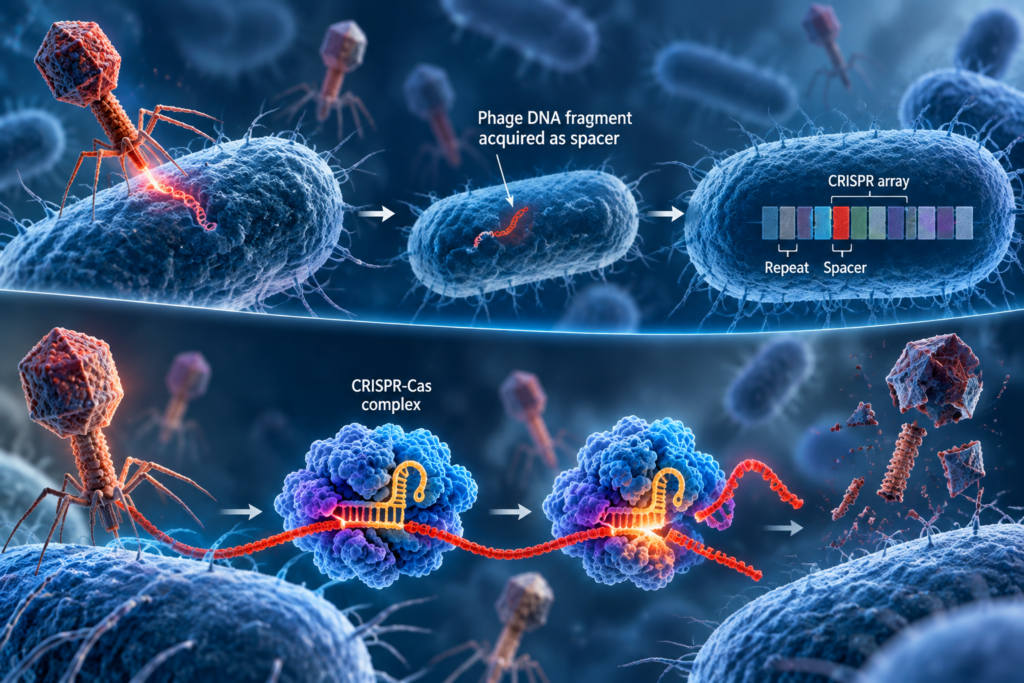
When a bacterium survives a phage attack, it acquires a short piece of phage DNA known as a spacer and incorporate it into its CRISPR array. The spacer subsequently provides sequence-specific information that allows the bacterial CRISPR-Cas machinery to recognize and attack the same or related phage during future infections.
This biological mechanism became particularly important in S. thermophilus. Research shows that phage exposure could generate CRISPR bacteriophage-insensitive mutants (BIMs) through spacer acquisition. These observations were instrumental in demonstrating that CRISPR arrays function as adaptive immune systems.
The industrial implication is straightforward: Rather than relying exclusively on environmental phage control, manufacturers can exploit the bacterium’s own defence mechanism.
Development of phage-resistant starter cultures
The most fascinating application of the CRISPR Technology is the CRISPR acquired immunity that can be readily used to strengthen industrial starter cultures.
In S. thermophilus, phage exposure can generate resistant mutants through acquisition of new spacers. Importantly, CRISPR immunization adds new spacers and repeats without adversely affecting the strain’s technological properties. This can generate strains with protection against multiple, distantly related phages.
For cheese manufacturers, this suggests a potentially valuable approach to starter-culture development by selection or generation of strains that retain their desirable fermentation characteristics while gaining broader phage resistance.
The strategy is however, not restricted to S. thermophilus. CRISPR systems can also be applied in other LAB and can also potentially be leveraged. In L. lactis, for example, a type III-A CRISPR-Cas system has shown to prevent phage replication by introducing a synthetic spacer to program the system against a particular phage.
CRISPR to identify bacterial strains: Using CRISPR-based genotyping
As spacers are acquired sequentially in response to previous phage exposure, the spacer composition of a CRISPR array can provide a kind of molecular history of bacterial-phage interactions.
PCR amplification and sequencing of CRISPR arrays can therefore help differentiate closely related bacterial strains.
This has practical value when companies are screening large collections of potential starter cultures. When new LAB strains are isolated from naturally fermented milk products, they need to be characterized for desirable technical properties and phage sensitivity. CRISPR typing can rapidly indicate whether newly isolated strains are genetically similar to strains already present in a collection.
CRISPR as a genome-editing tool
CRISPR-Cas can be repurposed for bacterial genome editing.
CRISPR arrays can be designed to contain a spacer targeting a specific chromosomal region. When combined with a suitable repair template, the bacterial repair machinery can introduce a desired genetic modification via mutations, gene knockouts or insertions, depending on design.
This is particularly relevant to dairy biotechnology because researchers can investigate how specific genes influence industrially important characteristics.
Endogenous CRISPR systems in lactobacilli and S. thermophilus have been successfully repurposed for genome editing. Using a bacterium’s own CRISPR machinery can have advantages over introducing heterologous systems, although the endogenous system must first be characterized, including its activity and PAM requirements.
Where endogenous systems are unavailable or unsuitable, researchers can introduce CRISPR components externally.
Engineering better cheese-making bacteria
Genome editing creates possibilities beyond phage resistance.
CRISPR/nCas9 has been successfully adopted for editing exopolysaccharide biosynthesis in S. thermophilus. Exopolysaccharides can influence characteristics relevant to fermented dairy products, making metabolic pathways associated with their production potentially useful targets for biotechnology.
The broader opportunity is to use CRISPR as a precision tool for investigating and modifying bacterial traits relevant to fermentation with the potential objectives including improving strain robustness, understanding metabolic pathways and developing starter cultures with desirable technological characteristics.
CRISPR-based resistance: Is it Permanent?
CRISPR-based resistance is not a permanent solution because phages are evolving too.
Phages can evolve mechanisms that bypass bacterial defenses.
CRISPR escape phage mutants (CEMs) acquire mutations in the protospacer or PAM sequences recognized by CRISPR-Cas systems. These mutations can prevent recognition and cleavage of phage DNA. However, escape can come with fitness costs, and increasing spacer diversity makes it harder for a phage to evade all targeted sequences.
An even more sophisticated threat comes from anti-CRISPR proteins (ACRs).
These proteins are produced by some phages to directly inhibit CRISPR-Cas machinery. Approximately 40% of phages infect S. thermophilus encode at least one known ACR, with AcrIIA6 being the most prevalent among the reported families.
This finding has major implications for industrial phage management.
Why continuous phage monitoring matters?
The emergence of anti-CRISPR phages demonstrates why relying on one defense mechanism may be insufficient.
The widespread use of CRISPR-based phage-resistant S. thermophilus strains may create selective pressure favouring phages capable of overcoming CRISPR immunity. This creates an ongoing evolutionary arms race between dairy bacteria and their phages.
Consequently, cheese manufacturers and researchers need to monitor the evolving dairy phage population and understand which phages are circulating in production environments.
The future may involve combining CRISPR-Cas with other bacterial defense systems rather than treating CRISPR as a standalone solution.
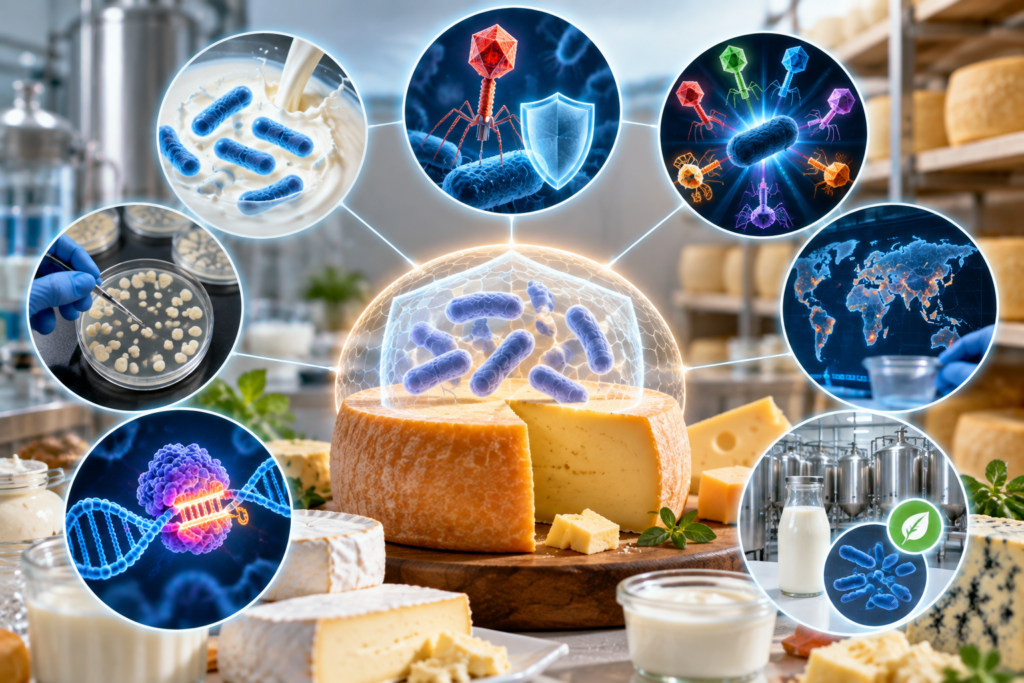
Applications of CRISPR Technology for the cheese industry
Phage-resistant starter cultures: CRISPR spacer acquisition can generate S. thermophilus strains resistant to specific phages.
Broad-spectrum protection: Sequential exposure to different phages can produce strains carrying multiple protective spacers.
Starter-culture screening: CRISPR array sequencing can help differentiate and classify closely related LAB strains.
Precision genome editing: CRISPR can modify bacterial genes associated with fermentation and technological properties.
Phage surveillance: CRISPR spacer profiles can provide information about historical phage exposure.
Food-grade strain development: CRISPR immunization can strengthen industrial strains while preserving important technological characteristics.
Future Insights: Combining multiple bacterial defences
CRISPR was discovered as an adaptive immune system, but CRISPR-Cas technology can now be uniquely be applied in the cheese industry for protecting dairy starter cultures.
There are growing number of newly characterized bacterial defense mechanisms. Some of these systems are abundant in S. thermophilus and may potentially be combined with CRISPR-Cas to strengthen industrial strains.
This multi-layered strategy could be particularly valuable because different defence systems may act at different stages of phage infection.
Instead of asking whether a bacterial strain has CRISPR, researchers may increasingly ask whether it possesses an optimized combination of complementary defence mechanisms.
However, despite these advantages, several challenges must be addressed.
Variability
CRISPR systems differ substantially between bacterial species and strains. Some bacteria lack suitable endogenous systems, while others require careful characterization before their CRISPR machinery can be repurposed.
Toxicity
Genome-editing systems can also create toxicity problems when Cas proteins are overexpressed. The low-copy or inducible Cas9 expression and modified Cas9 variants, including nickase forms, can help reduce toxicity.
Phage evolution
Escape mutations and anti-CRISPR proteins can compromise bacterial immunity, meaning that a strain that performs well against today’s phage population may not remain equally effective against tomorrow.
To challenge the evolutionary behaviour of viruses, the most promising future strategy may therefore be a combination of CRISPR-Cas immunity, complementary bacterial defence systems, precision genome editing and continuous phage surveillance.
CRISPR is not simply a gene-editing technology in the cheese industry. It is part of a broader strategy for making the microorganisms behind fermentation more resilient, predictable and technologically useful.