Moringa oleifera offers a cost-effective solution for microplastic removal from drinking water
Microplastic contamination in the environment
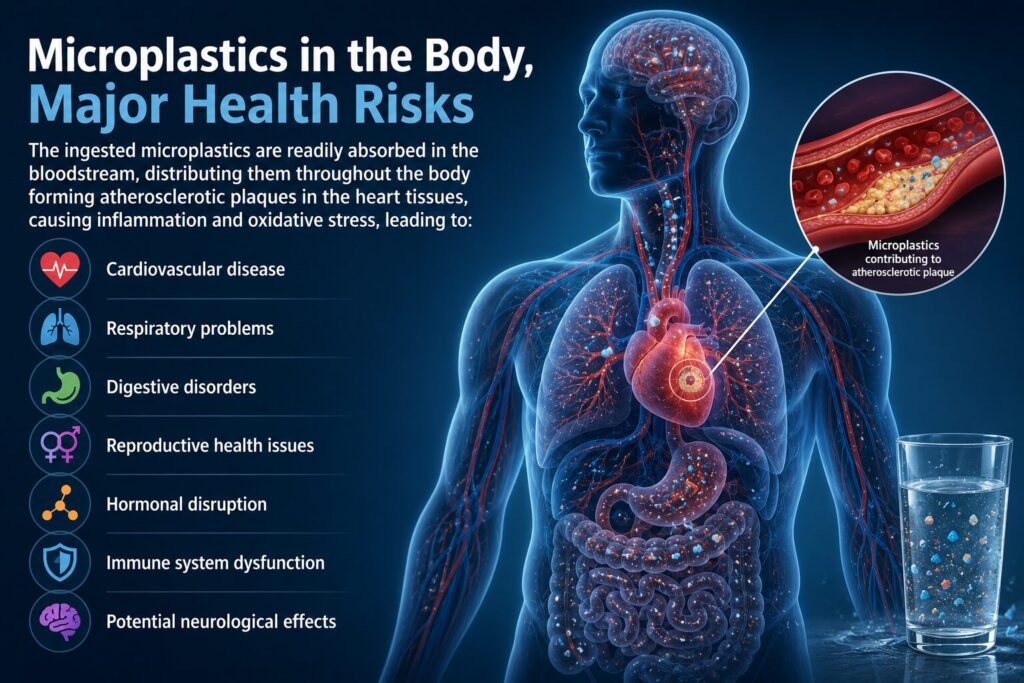
Microplastic contamination has emerged as one of the most pressing environmental and public health concerns worldwide. Microplastics, ranging from 0.1 μm to 5 mm in size, are now routinely detected in drinking water supplies. The ingested microplastics are readily absorbed in the bloodstream, distributing them throughout the body forming atherosclerotic plaques in the heart tissues, causing inflammation and oxidative stress, leading to:
- Cardiovascular disease
- Respiratory problems
- Digestive disorders
- Reproductive health issues
- Hormonal disruption
- Immune system dysfunction and
- Potential neurological effects
While conventional water treatment systems can remove a portion of these contaminants, sustainable and eco-friendly solutions and effective alternatives are being exhaustively explored by the researchers. One such studies has been carried out at São Paulo State University (UNESP), Brazil to investigate the potential of Moringa oleifera seed saline extract (MOS-SE) as a natural coagulant for removing microplastics from drinking water.
Need to find a sustainable solution for removing microplastics
For cleaning the contaminated water, traditionally, drinking water treatment plants often relied on aluminium or iron-based coagulants to facilitate particle removal. However, concerns regarding chemical residues, sludge management, and environmental sustainability have accelerated interest in natural coagulants. Recently, Moringa oleifera seeds have attracted considerable attention because they contain naturally occurring cationic proteins capable of destabilizing suspended particles and facilitating their removal from water.
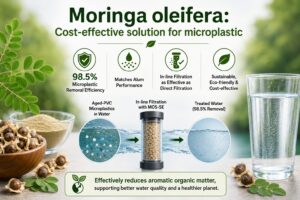
In this study effectivity of Moringa oleifera seed saline extract (MOS-SE) has been compared with the aluminium sulphate (alum) in removing aged polyvinyl chloride (PVC) microplastics from low-turbidity drinking water.
The study evaluated two treatment configurations:
- Direct Filtration (Coagulation → Flocculation → Filtration)
- In-Line Filtration (Coagulation → Filtration)
In addition, influence of pH, coagulant dosage, natural organic matter removal, filtration performance, and floc formation behaviour has also been assessed.
Moringa oleifera Seeds: A Sustainable Solution for Removing Microplastics from Drinking Water
- Exceptional microplastic removal efficiency
When coagulants of 30 mg/L MOS-SE and 9 mg/L alum at pH 6.0 was used to treat the water containing 15 mg/L of Aged-PVC MPs, 10 mg/L humic acid (representing natural organic matter) with an initial turbidity of approximately 15 NTU, remarkably high removal efficiencies were observed. When tested MOS-SE was found to remove about 98.5% of Aged-PVC MPs while alum removed 98.7% of Aged-PVC MPs.
Thus, Moringa seed extract performs virtually as well as traditional alum in removing microplastics from drinking water.
- In-line filtration is as effective as direct filtration
One of the most practical findings of the study was that in-line filtration achieved the same removal efficiency as direct filtration, despite eliminating the flocculation step.
It was observed that:
- Coagulated particle aggregates measured approximately 43–46 μm.
- Flocculated aggregates increased to 61–66 μm.
However, the larger flocs did not significantly improve microplastic removal performance.
This means water treatment facilities could potentially eliminate flocculation tanks, reducing:
- Capital investment costs
- Energy consumption
- Operational complexity
- Treatment footprint
Such simplification could be especially valuable for small and medium-sized drinking water plants.
- Moringa performs across a wider pH range
The most important advantage of MOS-SE is its operational flexibility.
- MOS-SE could maintain greater than 99% microplastic removal across pH 5–8 when used in sufficient dosage. On the other hand, alum which is highly effective works within a narrower pH range of 5–7.
- Also, alum performance deteriorates significantly at pH 8 because negatively charged aluminium hydroxide species become dominant and can no longer neutralize suspended particles effectively.
For treatment plants handling variable raw water quality, this broader pH tolerance can reduce chemical adjustment requirements and operating costs.
- Strong natural organic matter removal
When examined for the removal of natural organic matter (NOM), represented by humic acid, results shows that MOS-SE can:
- Remove over 92% of true color.
- Reduce UV254 absorbance significantly.
- Lowers SUVA values by approximately 88%.
This is important because high SUVA values indicate the presence of aromatic organic compounds that can form harmful disinfection by-products, such as trihalomethanes, during chlorination.
By reducing SUVA, Moringa treatment may contribute to safer drinking water beyond microplastic removal alone.
Can Moringa oleifera be used as an effective solution for microplastic removal from drinking water
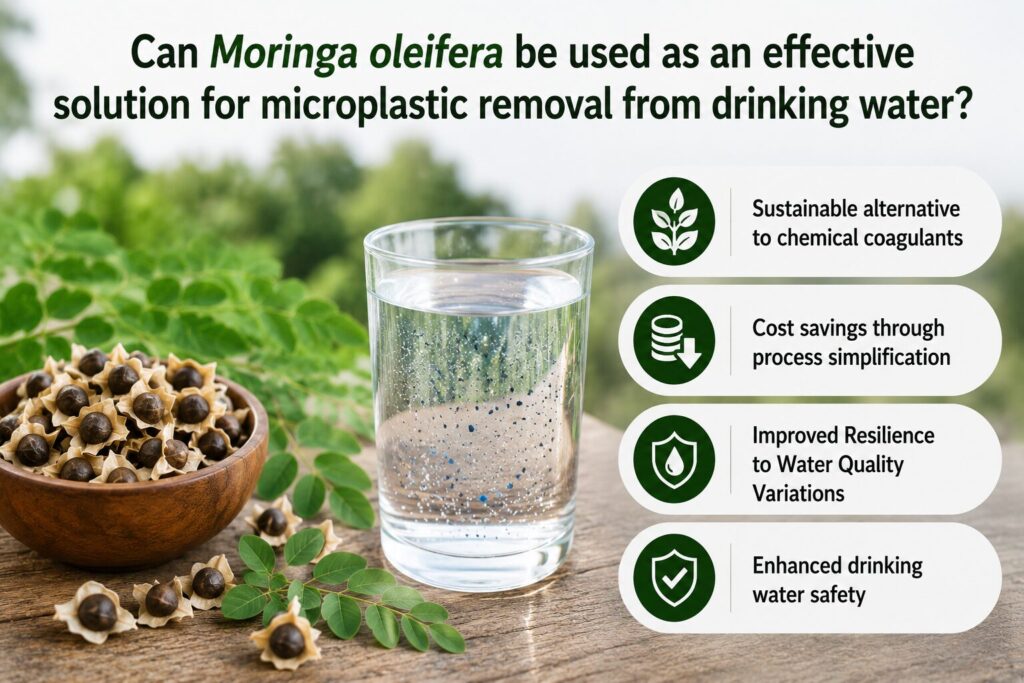
Sustainable alternative to chemical coagulants
Moringa seeds are renewable, biodegradable, and widely available in many tropical and subtropical regions. Their use could reduce dependence on synthetic chemicals and support greener water treatment practices.
Cost savings through process simplification
The demonstrated success of in-line filtration eliminates the need for energy-intensive flocculation processes, potentially lowering infrastructure and operational expenses.
Improved Resilience to Water Quality Variations
As MOS-SE performs effectively across a broader pH range, treatment plants may require fewer pH adjustment chemicals, simplified operations and improved resilience during seasonal water quality fluctuations.
Enhanced drinking water safety
Beyond microplastic removal, the significant reduction in aromatic organic matter and SUVA values may help reduce the formation of harmful chlorination by-products during disinfection.
Future Insights
Moringa oleifera seed saline extract presents a highly effective, sustainable alternative to alum for microplastic removal in drinking water treatment. The MOS-SE achieved removal efficiencies exceeding 98%, successful operation across a wider pH range, simpler in-line filtration systems that can perform just as effectively as conventional direct filtration.
As water utilities worldwide seek environmentally responsible solutions to address emerging contaminants such as microplastics, Moringa-based treatment offers a promising pathway toward safer, greener, and more cost-effective drinking water systems. The findings establish a strong foundation for future implementation of natural coagulants in modern water treatment infrastructure.