PEtracer Technology: Revolutionizing Cell Lineage Mapping in Cancer Research
High-Resolution Cell Lineage Mapping: A New Era in Biomedical Research
Understanding how cells grow, divide, migrate, and evolve has long been one of biology’s greatest challenges. Cells continuously divide, differentiate, and migrate throughout development and disease progression. Existing lineage tracing methods generally suffer from limitations including:
- Limited temporal resolution
- Poor spatial information
- Inability to simultaneously analyze gene expression
- Difficulty reconstructing complete cellular family trees
Traditional lineage tracing methods have provided valuable insights into cell development but often lack either spatial resolution or the ability to capture dynamic changes over time. Although CRISPR-based lineage tracing has significantly improved lineage reconstruction, integrating lineage history with spatial transcriptomics has remained technically challenging.
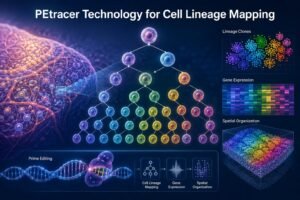
PEtracer Technology is specifically engineered by scientists from Harvard and Cambridge to bridge this gap. PEtracer, is an innovative prime editing-based lineage tracing technology that overcomes these limitations. By combining prime editing, single-cell RNA sequencing (scRNA-seq), and MERFISH spatial transcriptomics, PEtracer has enabled researchers to simultaneously monitor cellular lineage, gene expression, and spatial organization at single-cell resolution in living tissues.
The technology represents a major advancement for developmental biology, regenerative medicine, and cancer research, particularly in understanding how tumors evolve within their native microenvironment.
High-Resolution Cell Lineage Mapping with PEtracer
PEtracer is developed using prime editing, a genome-editing technology capable of introducing precise DNA modifications without creating double-stranded DNA breaks.
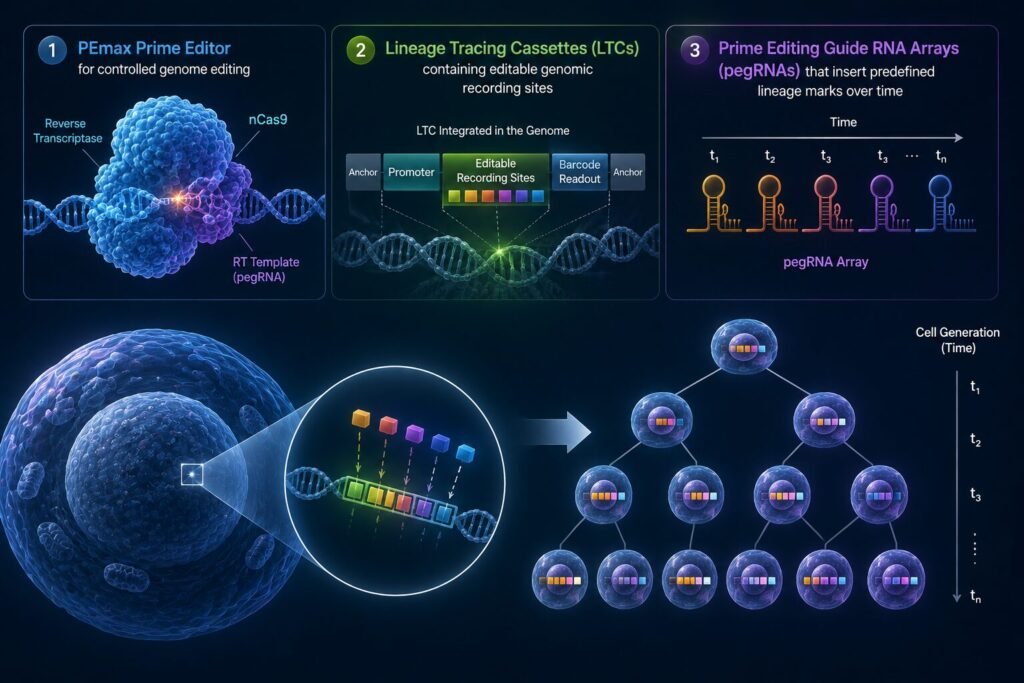
The system consists of three major components:
- PEmax prime editor for controlled genome editing
- Lineage tracing cassettes (LTCs) containing editable genomic recording sites
- Prime editing guide RNA arrays (pegRNAs) that insert predefined lineage marks over time
Instead of generating random mutations, PEtracer installs carefully designed five-nucleotide lineage marks at multiple genomic edit sites. These heritable marks accumulate throughout cell divisions, creating an evolving molecular record of each cell’s ancestry.
Unlike previous technologies, these lineage marks can be detected using either:
- Single-cell RNA sequencing
- MERFISH imaging for spatial transcriptomics
This dual-readout capability allows to correlate lineage history with gene expression while preserving tissue architecture.
Computational Design Optimized System Performance
Before laboratory experiments, extensive computational simulations were performed to optimize the PEtracer system.
The simulations evaluated variables including:
- Number of lineage marks
- Detection efficiency
- Editing rates
- Reconstruction accuracy
- Number of editable genomic sites
The models demonstrated that eight well-balanced lineage marks per editing site provided an optimal balance between reconstruction accuracy and compatibility with fluorescence imaging technologies, also optimizing the editing kinetics, ensuring lineage marks accumulation over weeks or months without saturating the recording system too early.
Single-cell RNA sequencing
PEtracer uses both sequencing-based and imaging-based experiments.
Upon single-cell sequencing validation across nearly 6,900 cells, the system achieved:
- 5% true-positive integration barcode detection
- 9% lineage mark calling accuracy
MERFISH imaging validation
Using high-resolution MERFISH imaging, over 5,600 cells were analysed, achieving:
- Approximately 82% integration barcode detection
- 4% lineage mark classification accuracy
These findings confirmed that PEtracer performs reliably using both molecular sequencing and spatial imaging approaches.
Mapping Tumor Evolution in Metastatic Breast Cancer
To demonstrate practical utility, PEtracer was applied to a mouse model of metastatic breast cancer using the aggressive 4T1 tumor model.
Engineered tumor cells were implanted into mice and allowed to establish lung metastases.
After tumor growth, PEtracer was combined with MERFISH to profile:
- Cell lineage
- Gene expression
- Spatial organization
- Tumor microenvironment
In total, the study analysed more than 368,000 individual cells across multiple tumours, generating one of the most comprehensive spatial lineage datasets reported to date.
PEtracer Technology is a breakthrough in cell lineage mapping
- Reconstruction of Three-Dimensional Tumor Growth
PEtracer enables reconstruction of how individual metastatic tumor cells expand into complex tumours over time.
Distinct phylogenetic branches occupy specific spatial regions within tumours, allowing researchers to visualize tumor evolution in three dimensions which was previously unattainable using conventional lineage tracing technologies.
- Discovery of Distinct Tumor Cell Modules
The technology enables to identify several spatially organized cancer cell populations, including:
- Leading-edge cells
- Hypoxic cells
- Tumor core cells
- Lung-adjacent cells
Each population exhibits unique transcriptional signatures and growth behaviours, demonstrating that tumor progression depends not only on genetic lineage but also on local environmental conditions.
- Spatial Organization Influences Cancer Fitness
One of the most important discoveries is that cancer cell fitness strongly depended on spatial location. High-fitness cancer cells are enriched near tumor boundaries adjacent to healthy lung tissue.
This suggests that favourable microenvironmental conditions significantly influence long-term tumor expansion.
- Identification of Heritable Growth Programs
Certain epithelial-associated genes, including Cldn4, Fgf1, and Fgfbp1 are consistently associated with highly fit cancer cell populations.
These genes may represent promising therapeutic targets because they appear to contribute to sustained tumor growth rather than transient cellular states.
Applications of PEtracer Technology
Although demonstrated in metastatic breast cancer, PEtracer has broad applications across biomedical research.
Cancer Research
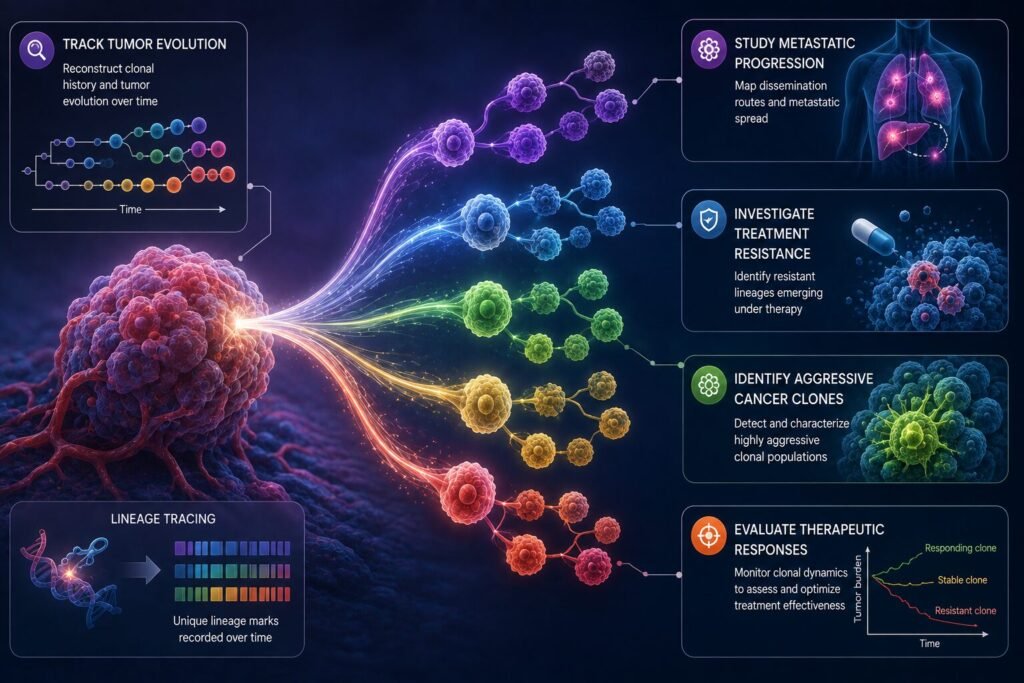
Researchers can now:
- Track tumor evolution
- Study metastatic progression
- Investigate treatment resistance
- Identify aggressive cancer clones
- Evaluate therapeutic responses
Developmental Biology
PEtracer enables scientists to follow cellular differentiation throughout embryonic development while preserving spatial tissue organization.
Regenerative Medicine
The technology can monitor stem cell differentiation and tissue regeneration, helping improve regenerative therapies.
Immunology
Researchers can investigate immune cell migration, activation, and differentiation during infection, inflammation, and immunotherapy.
Precision Medicine
Understanding how cellular lineage influences disease progression may ultimately support more personalized therapeutic strategies by identifying high-risk cell populations before they dominate tissue growth.
Why PEtracer Represents a Significant Advancement
Several features distinguish PEtracer from previous lineage tracing systems:
- Simultaneous lineage and gene expression profiling
- Compatibility with both sequencing and imaging
- Preservation of spatial tissue architecture
- High editing precision with minimal unwanted mutations
- Tunable recording rates for experiments lasting days to months
- Accurate reconstruction of complex phylogenetic trees
Together, these innovations enable researchers to study biological systems with an unprecedented combination of temporal, spatial, and molecular resolution.
Future Directions
Several exciting opportunities lies, expanding the PEtracer Technology, including:
- Applying the platform to additional cancer models
- Integrating whole-transcriptome spatial sequencing
- Improving three-dimensional tissue reconstruction
- Developing more advanced lineage reconstruction algorithms
- Combining lineage tracing with genetic perturbation studies
- Recording signaling events alongside lineage history
These developments could further enhance our understanding of development, tissue regeneration, and disease progression.
As spatial omics technologies continue to evolve, PEtracer is poised to become a foundational platform for studying complex biological systems with unprecedented resolution.