Carcimun® Blood Test shows 95.4% accuracy in identifying cancer
Why Early Cancer Detection Matters
Early cancer detection is one of the most important challenges in modern oncology. Detecting cancer before it enters the advanced stages can create more opportunities for timely treatment and potentially improve patient outcomes. However, conventional diagnostic approaches often depend on imaging, tissue biopsy, or screening methods designed for individual cancer types. These approaches can be invasive, costly, or less effective when cancers are asymptomatic or difficult to access.
Blood-based multi-cancer early detection (MCED) tests are being investigated as a less invasive way to identify signals associated with malignancy. Currently, diagnosis of cancer from the blood samples primarily focuses on detection of circulating tumor DNA (ctDNA), released by tumor cells into the bloodstream. The isolated ctDNA is then analysed for associated mutations, methylation patterns, or other molecular alterations. Because ctDNA levels can be very low, especially in early-stage cancer, highly sensitive analytical methods are required to distinguish tumor-derived DNA from normal cell-free DNA.
The Carcimun® test, developed by scientist of University Hospital Regensburg, Germany, uses optical extinction measurements to detect conformational changes in plasma proteins, offering a sensitive and universal marker for minimally invasive testing approach for early cancer detection and screening.

Evaluation Carcimun® Test
A prospective, single-blinded study was designed, enrolling 172 participants, divided into three groups:
- 80 healthy volunteers
- 64 patients with confirmed cancer
- 28 participants with inflammatory conditions or benign tumors
The cancer group included several malignancies, including pancreatic cancer, bile duct cancer, liver metastasis, esophageal cancer, stomach cancer, gastrointestinal stromal tumors, peritoneal cancer, colorectal cancer, and lung cancer. The cancer cases were classified as stages I to III.
The inflammatory and benign-condition group included patients with fibrosis, sarcoidosis, pneumonia, and benign tumors, to clearly distinguish participants with inflammatory conditions from malignant cases.
A Standardized Blood-Based Measurement
Carcimun® test used blood plasma for analysis, involving controlled sample preparation, incubation at 37°C, and optical measurements at 340 nm using an Indiko™ Clinical Chemistry Analyzer.
Previously established extinction-value threshold of 120 was applied to differentiate cancer from non-cancer samples while statistical analysis reported the diagnostic performance of the test.
Performance of Carcimun® Blood Test
Optical measurements of the blood plasma samples found a substantial difference of optical values was observed between cancer and healthy participants, as well as between cancer and inflammatory conditions with mean extinction value of 315.1, 23.9 and 62.7 respectively.
Although the difference between healthy participants and those with inflammatory conditions was not statistically significant.
Using the predefined threshold of 120, the Carcimun® test achieved:
- 4% overall accuracy
- 6% sensitivity
- 2% specificity
- 7% positive predictive value
- 6% negative predictive value
The primary merit of the test lies in its effectivity to distinguish many inflammatory conditions from cancer. This is important because inflammation can produce systemic biological changes that may resemble cancer-associated signals. The study showed that most inflammatory cases remained below the cancer threshold, although false-positive results occurred in acute pneumonia and severe sarcoidosis.
Practical Applications for Cancer Screening
One of the most important implications of the research is the potential role of a blood-based MCED test as an initial screening or triage tool.
Less invasive early cancer detection
The Carcimun® test requires a blood sample rather than an invasive tissue procedure, and could potentially be incorporated into routine health assessments or cancer screening pathways.
It may be particularly useful for people with mild or non-specific symptoms, such as persistent fatigue, unexplained weight loss, or ongoing inflammation.
A sensitive 2-step diagnostic pathway
The Carcimun® test providing an optical reading below the predefined threshold could help identify individuals with a lower likelihood of malignancy, while an elevated result could indicate the need for additional diagnostic evaluation.
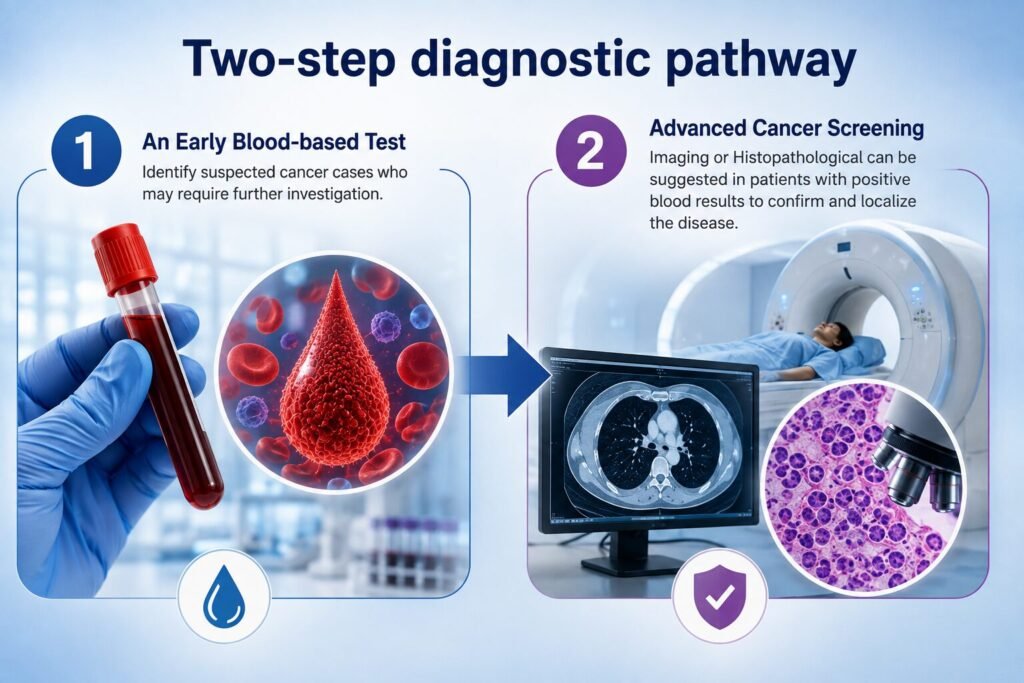
This creates a potential two-step diagnostic pathway:
- An Early Blood-based Test could help identify individuals who may require further investigation.
- Advanced Cancer Screening such as imaging or histopathological evaluation can be suggested in patients with positive blood results to confirm and localize the disease.
Such an approach could potentially help healthcare providers prioritize diagnostic resources. It may also reduce unnecessary imaging or invasive procedures among individuals considered to have a lower likelihood of cancer and also reduce the diagnosis cost and time.
Future Insights
Carcimun® Blood Test is a promising tool for early cancer screening in suspected patients presenting mild or non-specific symptoms. With 95.4% accuracy, 90.6% sensitivity, and 98.2% specificity, it is a potential tool diagnostic triage technology.
However, further studies may warrant the clinical applicability of the test:
- Including larger numbers of individual cancer types, stage-stratified analysis, a broader range of inflammatory and benign diseases, and longitudinal follow-up may determine the test performance for monitoring disease progression or detecting recurrence.
- In future, technological interventions may allow to localize of the tumor and identify the specific cancer type. However, additional diagnostic procedures, such as imaging or biopsy may still be required.
Thus, the Carcimun® test is a broader, multimodal screening strategy rather than as a standalone diagnostic method. It may eventually help clinicians identify patients who need further investigation earlier and more efficiently, but its ultimate clinical value will depend on validation in larger real-world populations and integration with established diagnostic methods.