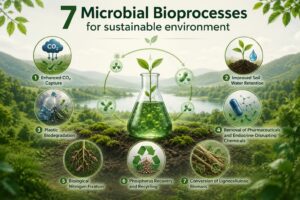
Seven microbial solutions revolutionizing environmental biotechnology
Key Environmental Challenges we face today
Many of the environmental problems we are facing today are now global rather than local. Unlike isolated chemical spills, challenges such as climate change, plastic pollution, and nutrient depletion require scalable, sustainable, and biologically driven solutions. As the world faces increasingly complex environmental challenges, scientists are turning to one of Earth’s oldest life forms for innovative solutions.
A decade of microbiological, environmental, and synthetic biology findings identifies the future directions where microbial biotechnology can make the greatest impact. These findings bridge existing scientific knowledge with practical environmental applications, offering a roadmap for researchers, policymakers, and biotechnology industries. Researcher Víctor de Lorenzo has presented a visionary framework describing seven microbial bioprocesses that could significantly contribute to solving global environmental problems.
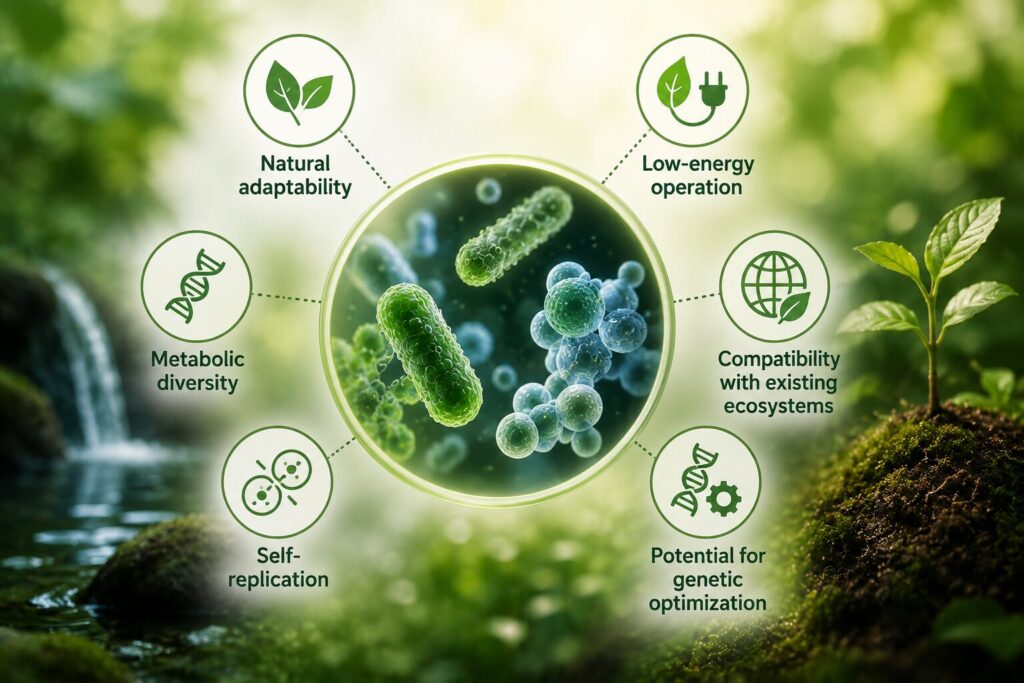
Microorganisms offer several advantages:
- Natural adaptability
- Metabolic diversity
- Self-replication
- Low-energy operation
- Compatibility with existing ecosystems
- Potential for genetic optimization
These characteristics make microbial biotechnology a promising component of future environmental management strategies.
In this decade, innovative biological solutions are required as we are already facing some of the major impacts of environmental problems, such as:
- Rising atmospheric CO₂ and greenhouse gases
- Expansion of arid ecosystems
- Marine plastic pollution
- Pharmaceutical and endocrine-disrupting contaminants
- Unsustainable nitrogen fertilizer production
- Global phosphorus depletion
- Poor utilization of lignocellulosic agricultural waste
These issues are interconnected and require biological approaches capable of operating on global scales.
Seven Microbial Bioprocesses Proposed
- Enhanced Microbial Carbon Capture
Climate change remains one of humanity’s greatest challenges. While reducing emissions is essential, active carbon removal technologies are equally important.
To solve this, microorganisms can be engineered that will be capable of capturing atmospheric CO₂ through non-photosynthetic pathways.
This technology can be readily used in:
- Carbon capture facilities
- Industrial emission treatment
- Bio-based carbon sequestration
- Climate change mitigation technologies
- Increasing Soil Moisture in Dry Ecosystems
Desertification threatens agriculture across many regions. Enrichment of soil drought-resistant soil microorganisms would improve water retention through specialized water-binding proteins. This will aid:
- Sustainable agriculture
- Restoration of degraded land
- Improved crop resilience
- Climate adaptation strategies
- Microbial Cleanup of Plastic Pollution
Plastic waste has become a global environmental crisis. Engineering the microbial pathways will completely degrade common plastics such as PET, polyethylene, polypropylene, and PVC, without generating harmful microplastics. These engineered microbial strains may find their applications in:
- Ocean cleanup technologies
- Plastic waste treatment plants
- Circular bioeconomy initiatives
- Biodegradable waste management
- Removal of Pharmaceuticals and Endocrine Disruptors
Many pharmaceuticals and hormone-disrupting chemicals persist in freshwater and marine ecosystems. Microbial metabolic pathways can be designed to fully degrade these contaminants before they accumulate in food chains. These engineered microbes can be used in:
- Wastewater treatment
- Drinking water purification
- Environmental remediation
- Public health protection
- Biological Nitrogen Fixation
Modern agriculture depends heavily on synthetic nitrogen fertilizers produced through the energy-intensive Haber-Bosch process.
Improving microbial nitrogen fixation by:
- Engineering oxygen-insensitive nitrogen-fixing pathways
- Transferring microbial nitrogen-fixing capabilities into plants will
- Reduce fertilizer use
- Lower greenhouse gas emissions
- Sustainable farming
- Increased food security
- Recovery of Phosphorus
Phosphorus is a finite resource critical for agriculture. Large amounts are lost into aquatic ecosystems where recovery remains difficult. Engineering phosphate-hyperaccumulating microorganisms are capable of recovering diluted phosphorus from marine environments and sediments. These can be applied in:
- Nutrient recycling
- Sustainable fertilizer production
- Reduced eutrophication
- Circular resource management
- Improved Utilization of Lignocellulosic Biomass
Agricultural activities generate enormous quantities of lignocellulosic waste. Current degradation technologies remain inefficient, particularly for lignin.
Micro-organisms can be designed that may be useful for:
- Efficient lignin depolymerization
- Converting biomass into valuable chemical building blocks
- Producing more durable lignin polymers where carbon storage is desirable
These can be applied in:
- Biofuel production
- Green chemical manufacturing
- Agricultural waste valorization
- Sustainable biorefineries
Future Insights
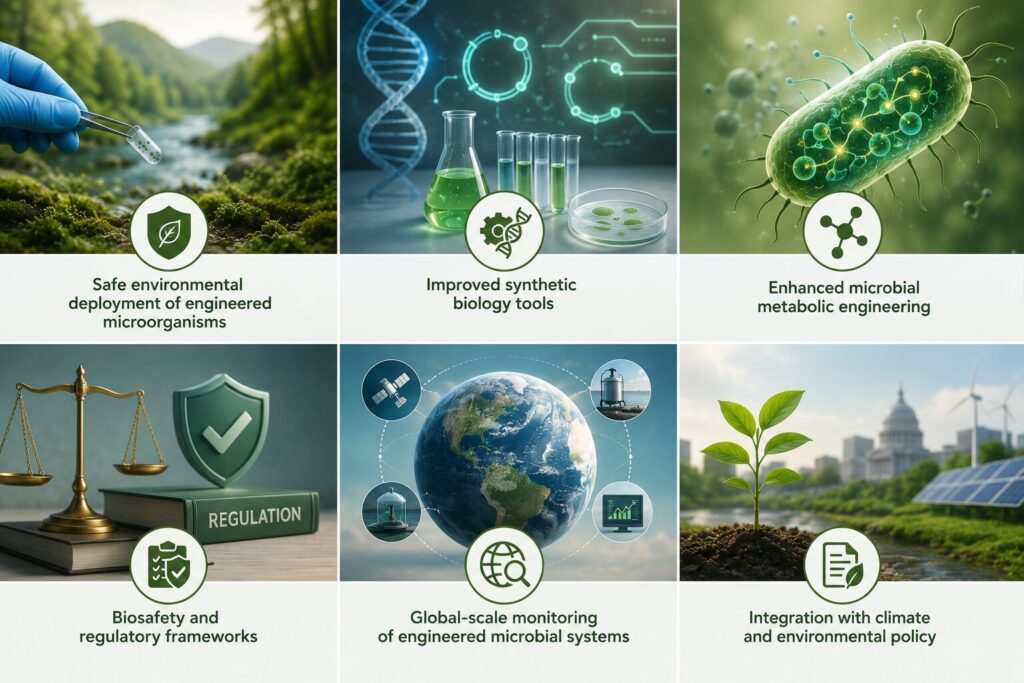
In addition to developing microbial technologies, many other areas require further investigations, such as:
- Safe environmental deployment of engineered microorganisms
- Improved synthetic biology tools
- Enhanced microbial metabolic engineering
- Biosafety and regulatory frameworks
- Global-scale monitoring of engineered microbial systems
- Integration with climate and environmental policy
Continued interdisciplinary collaboration will be essential to translate these concepts into practical environmental technologies. As synthetic biology continues to advance, many of these visionary ideas are steadily moving from theoretical concepts to real-world applications, positioning microbial biotechnology as a key driver of global environmental sustainability.