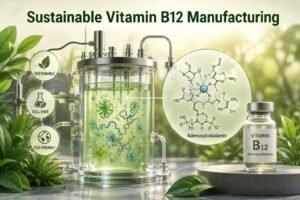
A New Cell-Free Technology for Sustainable Vitamin B12 Manufacturing
A Sustainable method Vitamin B12 Production
Vitamin B12 is an essential nutrient with a remarkably complex molecular structure. It plays critical roles in DNA synthesis, methylation, and cellular metabolism, yet its natural biosynthesis is limited to prokaryotic organisms. For decades, industrial vitamin B12 production has therefore depended primarily on microbial fermentation. While fermentation can achieve substantial production levels, the long and complex biosynthetic pathway of vitamin B12 makes further metabolic engineering challenging.
Traditional microbial fermentation requires maintaining living cells under conditions that support both growth and product synthesis. In contrast, cell-free systems eliminate the need to sustain cellular growth and provide greater control over enzyme concentrations, substrates, cofactors, and reaction conditions. This flexibility is valuable for producing complex natural compounds that are difficult to manufacture through conventional metabolic engineering.
A platform developed by the scientists of University of Chinese Academy of Sciences, China, presents an alternative strategy of Vitamin B12 production. The developed platform offers a complete cell-free synthesis of adenosylcobalamin, or AdoCbl, one of the biologically active forms of vitamin B12. Rather than relying on living cells to perform the entire process, a vitamin B12 biosynthetic pathway is designed outside the cell using a coordinated network of enzymes and cofactor regeneration systems.
This synthetic reaction platform involves 36 enzymes and more than 30 biocatalytic reactions. Importantly, the research also demonstrates not only that complex natural compounds can be synthesized in a cell-free environment, but also that systematic pathway design and optimization can overcome several major biochemical bottlenecks.
Rebuilding Vitamin B12 Biosynthesis Outside the Cell
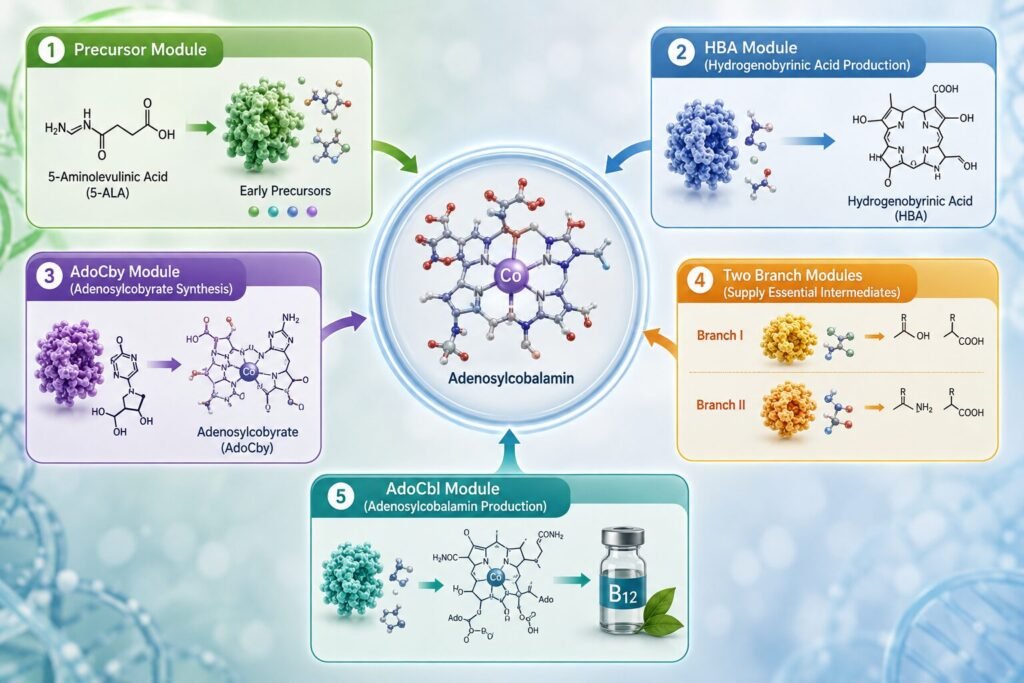
The central challenge of Vitamin B12 production is the complexity of biosynthetic pathway. The aerobic biosynthetic route is selected and divided the overall pathway into five interconnected synthetic modules.
These included
- Precursor module
- HBA module for hydrogenobyrinic acid production
- AdoCby module for adenosylcobyrate synthesis
- 2 branch modules supplying essential intermediates
- A final AdoCbl module for producing adenosylcobalamin.
Instead of attempting to optimize the entire pathway at once, A design-test-optimize strategy is adopted for each individual modules. This modular methodology is particularly important because multienzyme systems can suffer from competing reactions, unstable intermediates, cofactor depletion, and differences in optimal reaction conditions between enzymes.
The overall system incorporates enzymes originating from ten different microorganisms. In total, the synthetic pathway involves 32 reaction steps catalyzed by 36 enzymes, including additional enzymes dedicated to cofactor regeneration.
Identification of Bottlenecks to Improve Reactions
The modular approach adopted in this study provides an important methodological lesson for synthetic biology and biomanufacturing. When a biosynthetic pathway is too complicated to optimize as a single unit, separating it into functional modules, allowing identification of bottlenecks to improve individual reactions before reconstructing the complete system.
First Challenge: Solving the Problem of Unstable Intermediates
In living-cell systems, factors such as oxidation, reduction, metabolite concentrations, and cofactor depletion are regulated through the cell’s biochemical feedback mechanisms. However, in cell-free systems, controlling these factors presents a major challenge.
While engineering the cell free platform, it was identified that uroporphyrinogen III, an intermediate in the precursor module, was highly sensitive to oxygen. After exposure to air for several hours, a substantial proportion was converted into uroporphyrin III, an oxidized dead-end product that could not continue through the desired vitamin B12 pathway.
To address this problem, addition of 2% beta-mercaptoethanol effectively reduced the oxidation of uroporphyrinogen III and substantially improved downstream product formation, demonstrating the importance of controlling the reaction environment in cell-free biotechnology
Unlike living cells, which naturally regulate their internal chemical conditions, cell-free systems, active management of factors such as oxidation, pH, substrate concentrations, and cofactor availability remains crucial.
Second Challenge: Engineering Cofactor Regeneration for Higher Productivity
Another major bottleneck identified is feedback inhibition caused by the accumulation of a reaction by-product. As the inhibitory compound increases, it reduces enzyme activity and limit the pathway ‘s productivity.
It was identified that the methyl donor S-adenosylmethionine, commonly known as SAM is an intermediate byproduct required in several reactions in the vitamin B12 pathway. But its use creates S-adenosylhomocysteine, or SAH, which can strongly inhibit methyltransferase enzymes.
So instead of increasing the amount of SAM, researchers designed a cofactor regeneration strategy. For this, Methionine adenosyltransferase, MetK, was introduced to regenerate SAM from L-methionine, while MtnN was used to reduce the accumulation of the inhibitory by-product SAH.
This modification improved precursor synthesis and reduced the accumulation of unwanted intermediates. Further optimization of the reaction buffer and pH increased the production of hydrogenobyrinic acid, or HBA.
So, the optimized system produced approximately 10.23 mg/L of HBA in 12 hours, with further experiments reaching about 10.95 mg/L under strengthened reaction conditions.
This strategy implies that cofactors such as ATP, NADH, SAM, and glutamine are often expensive and can become limiting factors in cell-free production. Regenerating these molecules within the reaction system could reduce material requirements and improve process efficiency.
Third Challenge: Coordinating Enzymes to Drive the Reaction Forward
It is immensely important to coordinate multiple enzymes to maintain an efficient reaction sequence. Some reactions reach equilibrium or may cause intermediate accumulation, limiting overall productivity.
Through this study it is successfully demonstrated that downstream reactions can help overcome limitations in upstream steps.
During the conversion of HBA into later intermediates, the reaction catalyzed by the enzyme CobB approached an equilibrium that resulted in the accumulation of intermediate compounds. Rather than treating this reaction as an isolated problem, it was coupled with downstream cobalt chelation catalyzed by the CobNST enzyme complex.
This coupling redirected metabolic flux toward the desired product. The highest reported conversion yield of the downstream product CBAD from HBA reached 92.40%.
ATP and cobalt concentrations were also optimized because both insufficient and excessive levels of these molecules may reduce system performance.
These findings highlight another important principle of multienzyme engineering: increasing the concentration of a substrate or cofactor does not necessarily improve productivity. Instead, efficient cell-free biosynthesis requires careful balancing of all reaction components.
Fourth Challenge: From 5-ALA to Active Vitamin B12
The major driver of the cell free-systems is the integration of all the optimized reactions into a complete system to convert a simple starting material into active vitamin B12.
Using 5-aminolevulinic acid, or 5-ALA, as the starting substrate, the full cell-free system produced 417.42 micrograms per liter of adenosylcobalamin.
Next major step was to investigate the system’s practical production potential by using hydrogenobyrinic acid, an intermediate closer to the final product, as the starting substrate. Under optimized conditions, the system produced 5.78 mg/L of AdoCbl within 14 hours.
The results are significant because they demonstrate the feasibility of producing one of the most structurally complex natural compounds through a fully reconstructed cell-free enzymatic system.
Complex cell-free biosynthesis depends on successfully integrating and balancing all reaction modules. Even when individual steps are optimized, overall productivity requires coordinated enzyme activity, efficient cofactor management, and controlled metabolic flow to achieve successful conversion from a simple substrate to the final product.
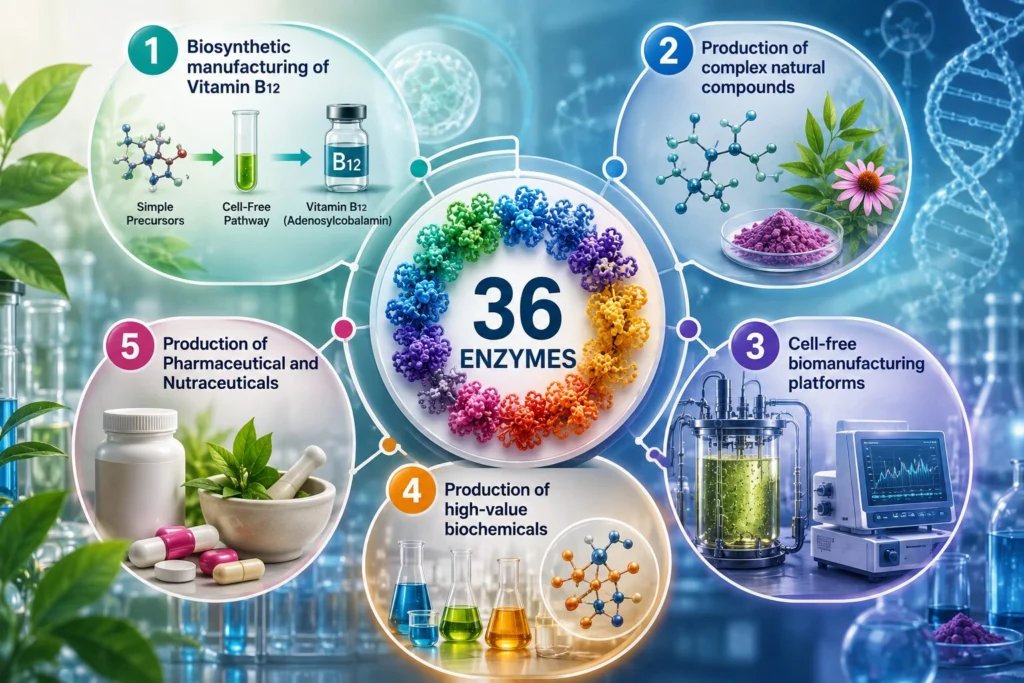
A 36-Enzyme Breakthrough: Practical Applications for Biotechnology and Biomanufacturing
- Biosynthetic manufacturing of Vitamin B12
Provides a potential alternative to conventional microbial fermentation for producing active vitamin B12.
- Production of complex natural compounds
Demonstrates that long and complex biosynthetic pathways can be reconstructed outside living cells.
- Cell-free biomanufacturing platforms
Provides a framework for developing flexible enzyme-based production systems with greater control over reaction conditions.
- Production of high-value biochemicals
The modular approach could support the synthesis of valuable natural products with complicated biosynthetic pathways.
- Production of Pharmaceutical and Nutraceuticals
The modular strategy is applicable to pharmaceuticals, nutraceuticals, specialty chemicals, and other high-value biomolecules with long biosynthetic pathways. Researchers can potentially optimize individual pathway segments, identify unstable intermediates, manage inhibitory by-products, and introduce customized cofactor regeneration modules.
Future Insights
A New Direction for Complex Natural Product Manufacturing
The 36-enzyme vitamin B12 system thus demonstrates that cell-free biotechnology can coordinate a remarkably complex network of biochemical reactions.
The technology provides:
- Flexible framework
- Cofactor regeneration
- Removal of inhibitory by-products
- Optimization of individual reaction modules
- Providing greater control over enzyme concentrations, substrates, intermediates, and reaction conditions.
Together, these capabilities demonstrate that the future of sustainable biomanufacturing may extend beyond engineered microorganisms. The potential of cell-free systems represents a way for sustainable production of complex and high-value molecules without relying entirely on living microorganisms.
Although further improvements will be necessary before this technology can be considered for large-scale commercial manufacturing, carefully designed cell-free systems could provide a powerful alternative for producing complex natural compounds, including active vitamin B12, with greater flexibility and control.