CRISPR-GPT Is Changing AI-Powered Gene Editing
CRISPR-GPT: How AI Is Transforming Gene-Editing Research and Experimental Design
CRISPR guided gene editing has become one of the most powerful technologies in modern biomedical research. CRISPR systems have enabled scientists to modify DNA with increasing precision, supporting research into cancer, genetic disease, immunology and therapeutic development. Yet designing a CRISPR experiment remains complicated. Researchers must select an appropriate editing system, choose a delivery strategy, design guide RNAs, assess potential off-target effects, develop validation approaches and interpret experimental data.
This is where Artificial intelligence (AI) is accelerating the research and aiding it to move beyond conventional data analysis and entering the laboratory as a potential research co-pilot to support researchers across these complex workflows.
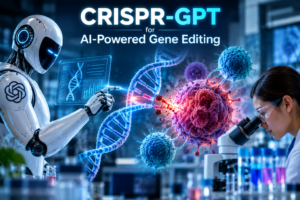
Researchers at Department of Pathology & Genetics, Stanford University School of Medicine developed CRISPR-GPT, an AI-powered system designed to help researchers plan, execute and analyze gene-editing experiments.
The significance of this work lies in its end-to-end approach. Rather than using an AI model simply to answer questions, the researchers developed a multi-agent system that can coordinate experimental planning, CRISPR system selection, delivery-method recommendations, guide RNA (gRNA) design, off-target prediction, validation planning and data analysis.
The research demonstrates how large language models (LLMs), domain-specific knowledge, retrieval systems and computational tools can be combined to assist with gene-editing experiment design and analysis.
What is CRISPR-GPT?
CRISPR-GPT is not simply a chatbot answering questions about CRISPR. It is developed as a multi-agent AI system capable of coordinating different stages of gene-editing research.
The system supports four major gene-editing modalities:
- Knockout
- Base editing
- Prime editing
- Epigenetic editing through CRISPR activation or interference.
It encompasses 22 gene-editing tasks and provides three interaction modes: Meta, Auto and Q&A.
Meta mode
It is designed to guide less-experienced researchers through predefined workflows.
Auto mode
It allows more advanced users to submit a broader research request, after which the AI planner breaks the request into appropriate tasks and constructs a customized workflow.
Q&A mode
It provides targeted assistance with gene-editing questions and troubleshooting.
The system uses a multi-agent architecture consisting of an LLM Planner, Task Executors, Tool Providers and an LLM User-proxy agent.
- LLM Planner breaks a research request into appropriate tasks.
- Task Executors manage individual stages using structured state machines
- Tool Providers connect the system with external databases, search engines and computational software
- User-proxy agent interacts with the researcher and incorporates user feedback into the workflow
Together, these components allow the system to coordinate information, external tools and user interactions throughout an experimental workflow.

From benchmark testing of CRISPR-GPT to real laboratory experiments
CRISPR-GPT was not solely evaluated through theoretical questions. Instead, several complementary approaches were used to assess whether the AI system could actually support gene-editing research.
First,
Gene-editing bench was developed. It contained 288 test cases. And benchmark covered gene-editing planning, guide-RNA design, delivery-method selection and gene-editing Q&A. The planning and guide-RNA sections each contained 50 cases, delivery selection included 50 biological systems, and Q&A included 138 questions. Human experts provided reference answers or consensus rankings for comparison.
Then,
Individual CRISPR-GPT functions were evaluated against baseline large language models. Planning performance was assessed using accuracy, precision, recall and F1 scores, while task-order similarity was assessed using normalized Levenshtein distance. Delivery recommendations were compared against expert rankings, while guide-RNA design was evaluated against expert-defined ground truth.
For Q&A performance,
Three human experts independently evaluated responses in a blinded setting while eight independent CRISPR experts assessed the overall user experience across accuracy, reasoning and action, completeness and conciseness.
Finally,
The research moved beyond computational evaluation into real-world laboratory demonstrations. Two researchers with limited CRISPR expertise used CRISPR-GPT as an AI co-pilot for independent gene-editing projects.
Strong performance in experimental planning
Rather than treating every CRISPR question as a generic information-retrieval problem, CRISPR-GPT attempts to identify the biological system and integrate relevant knowledge before generating its recommendation.
Surprisingly, when powered by GPT, CRISPR-GPT outperformed baseline GPT-4 and GPT-3.5-turbo models, with a particularly noticeable advantage for challenging systems such as difficult-to-transfect cell lines and primary cell types. CRISPR-GPT achieved scores above 0.99 for accuracy, precision, recall and F1 on the planning evaluation while the normalized Levenshtein distance between AI-generated plans and expert-generated plans was below 0.05.
This finding has practical significance because gene-editing experiments often involve dependent decisions. The correct order of activities matters because a researcher cannot meaningfully complete downstream stages before resolving certain upstream choices. CRISPR-GPT’s ability to decompose a broad research request into connected tasks could therefore help researchers organize complex projects more efficiently.
The practical lesson is that domain-specific AI can be more useful than general-purpose AI when biological context matters.
Context-aware guide-RNA design
Guide-RNA design provided another important demonstration.
Existing tools can generate highly ranked guide RNAs, but a guide with strong predicted editing performance does not necessarily produce the desired biological phenotype. CRISPR-GPT was further tested for its ability to incorporate biological context into guide selection.
In a BRD4 cancer-biology example, CRISPR-GPT uniquely identified key functional exons—Exons 3–4—whereas seven of eight guide designs from CRISPick and CHOPCHOP targeted non-essential exons.
This highlights an important practical concept that successful gene editing is not always equivalent to high editing efficiency. Selecting a biologically meaningful target region can be just as important as maximizing predicted editing performance.
However, the study highlights an important distinction that the guide with the highest predicted editing efficiency is not necessarily the guide that produces the desired biological outcome.
AI-assisted scientific problem solving
A common weakness of general-purpose LLMs is their tendency to produce inaccurate, outdated or overly broad answers to specialized biological questions.
To improve CRISPR-GPT’s Q&A capability, approximately 4,000 discussion threads were assembled from 11 years of CRISPR-focused scientific discussions and curated more than 3,000 question-and-answer pairs. These were used to fine-tune an 8-billion-parameter Llama3-based model.
The resulting specialized model improved performance over the baseline by approximately 8% on basic gene-editing questions and around 20% on real-world research questions.
When the complete Q&A system was evaluated against GPT-4o, it demonstrated improvements of 12% in accuracy, 15% in reasoning and 32% in conciseness.
At this point, it becomes important to note the fundamental limitation of general-purpose AI: broad knowledge does not necessarily translate into reliable specialized scientific reasoning.

Real-world laboratory applicability of CRISPR-GPT
Demonstration of the technology is important because although AI can potentially lower the technical barrier for researchers entering gene-editing research, however, it does not eliminate the need for expert oversight, laboratory training or appropriate safety procedures.
Similarly, to test the applicability of CRISPR-GPT, a junior researcher unfamiliar with CRISPR was made to use the CRISPR-GPT to design and conduct a multigene knockout project in A549 lung adenocarcinoma cells. The system supported the overall workflow, including experimental planning, guide selection, validation planning and data interpretation.
The resulting experiments targeted four genes and achieved approximately 80% editing efficiency across the target genes, based on next-generation sequencing analysis. Functional assays also supported the biological effects of selected knockouts.
Moving ahead to test the efficiency of CRISPR-GPT,
A second beginner researcher used CRISPR-GPT for an epigenetic gene-activation experiment involving NCR3LG1 and CEACAM1. Protein-expression measurements demonstrated activation efficiencies of up to 56.5% for NCR3LG1 and 90.2% for CEACAM1 compared with negative-control guide groups.
These results provide practical evidence that AI can support researchers through complex gene-editing workflows rather than merely generating theoretical recommendations.
How CRISPR-GPT can accelerate biomedical research?
The practical applicability of CRISPR-GPT extends beyond saving researcher’s time.
AI systems like this could help:
- Standardize complex workflows
- Improve accessibility & reproducibility
- Reduce errors in experimental planning
- Make specialized knowledge easier to access.
- Researchers connect computational design with experimental validation and data analysis.
The modular architecture of CRISPR-GPT could allow additional scientific tools to be integrated without rebuilding the entire system. It is rightly envisioned that future connections between AI agents, genome and protein foundation models, laboratory robotics and automated experimentation.
CRISPR-GPT, for example, integrates tools such as Primer3, CRISPRitz and CRISPResso2 for primer design, off-target prediction and sequencing analysis.
Using AI Responsibly: A must remember
The findings of this research do not suggest that AI can replace scientists.
While building, researchers have shared the struggle of CRISPR-GPT with complex requests and rare biological situations. Its performance also depends on high-quality expert knowledge and training data, which can be difficult to obtain at scale.
Gene-editing technologies are considered as dual edge swords.
While genomic information can contain sensitive personal data. To maintain stringent safety and privacy ethic, safeguards designs were incorporated to detect potentially dangerous requests and prevent identifiable genetic sequences from being transmitted to external LLMs. The system incorporates safeguards for potentially dangerous gene-editing requests and attempts to prevent identifiable human genetic sequences from being transmitted to external models.
These safeguards reinforce an important principle: AI-assisted gene editing should remain a human-AI collaboration, with researchers retaining responsibility for experimental judgment, validation, ethics and laboratory safety.
The future of AI-powered gene editing
The present CRISPR-GPT platform thus, provides an important glimpse into how AI-powered gene editing, CRISPR automation and human-AI collaboration could influence biomedical research.
Its strongest connects with the fact that future of scientific AI may lie in human–AI collaboration, not human replacement. Researchers will always remain primely responsible for scientific judgment, laboratory execution, validation and ethical decisions, while AI can potentially handle increasingly complex information-management and workflow-support tasks. It may be scientists equipped with increasingly capable AI research partners.
As gene editing becomes more sophisticated, systems that can connect scientific reasoning with validated computational tools could help accelerate research while improving consistency and accessibility.
CRISPR-GPT is an early example of that emerging model: an AI co-pilot designed not merely to explain science, but to help researchers navigate the increasingly complex process of turning biological questions into experimentally testable ideas.
In future integration with genome and protein foundation models, plasmid-design systems, laboratory robotics and automated experimentation are envisioned by the scientists.