High-Efficiency Microalgae Cultivation Meets Urban Design: The Promise of Carbon-Capturing Fountains
Need for Eco-friendly Technologies
As cities expand, the challenge of achieving carbon neutrality is becoming increasingly urgent. Urban areas occupy only a small share of the world’s land but are responsible for a disproportionately large share of greenhouse gas emissions. At the same time, rapid urbanization is placing pressure on air quality, water resources, green infrastructure, and overall urban environmental quality. Meeting ambitious climate targets therefore requires solutions that can integrate carbon reduction with the infrastructure, economic realities, and social needs of modern cities.
One promising technology is microalgae-based carbon capture. Microalgae are photosynthetic microorganisms with the ability to rapidly grow, efficiently utilize light, and convert carbon dioxide (CO₂) into organic biomass. Their environmental potential extends beyond carbon fixation. Microalgae can assimilate nutrients such as nitrogen and phosphorus, support wastewater remediation, and generate biomass containing potentially valuable proteins, lipids, pigments, and other compounds. This creates an opportunity to link carbon capture with resource recovery and circular-economy applications.
Despite these advantages, conventional microalgae cultivation systems face significant barriers to widespread urban deployment. Open ponds require considerable land and can experience contamination and water-loss problems, while enclosed photobioreactors can provide better control but often involve high capital costs, complex operation, and substantial energy requirements. Light attenuation in deeper cultivation systems can also cause mutual shading between cells, limiting photosynthetic efficiency and biomass productivity. These challenges have made it difficult to scale microalgae-based carbon capture economically across cities.
A recent study by the researchers of Technology Innovation Centre for Exploitation of Marine Biological Resources, China proposes an intriguing solution: retrofitting existing urban fountains with microalgae cultivation technology.
The concept, described as microalgae-enhanced fountain landscapes, combines carbon capture, biomass production, sustainable landscaping and public environmental education in a single system. Rather than constructing entirely new photobioreactors (PBRs), cities could repurpose fountain infrastructure while incorporating shallow-layer cultivation technology designed for high-density microalgal growth.
How Microalgae can be used for Urban Carbon Capture?
Microalgae are photosynthetic microorganisms capable of rapidly converting carbon dioxide into biomass. Their potential extends beyond CO₂ fixation. Their ability to assimilate nitrogen and phosphorus during wastewater treatment, capture carbon from gaseous sources, and produce biomass containing potentially valuable compounds such as proteins, lipids and pigments.
That multifunctionality is particularly relevant to cities. Conventional urban infrastructure often consumes resources without producing environmental value. A fountain equipped with a microalgae cultivation system could instead become a living carbon-capture installation.
However, there is a major obstacle to implement the microalgae-enhanced fountain landscapes.
Some of them are:
- Conventional microalgae production can be expensive and energy intensive.
- Open ponds require substantial land and can suffer from contamination and evaporation
- Enclosed photobioreactors offer better environmental control
- They also require greater capital investment and operational complexity.
- Harvesting can also represent more than 30% of total production expense.
The Key Technical Outcome: Shallow-Layer Cultivation
One of the most significant findings concerns cultivation depth.
Conventional microalgae systems often operate at culture depths of approximately 5–30 cm. At these depths, light rapidly attenuates through the culture, causing cells to shade one another and limiting photosynthetic efficiency. The conventional systems therefore often have cell densities below 2.0 g/L and relatively modest areal productivity.
Thin-layer cascade systems address this problem by reducing culture depth to < 1 cm. They can achieve cell densities as high as 50 g/L and biomass productivity of approximately 15–50 g/m²/day. However, their disadvantage is that rigid construction can make them expensive.
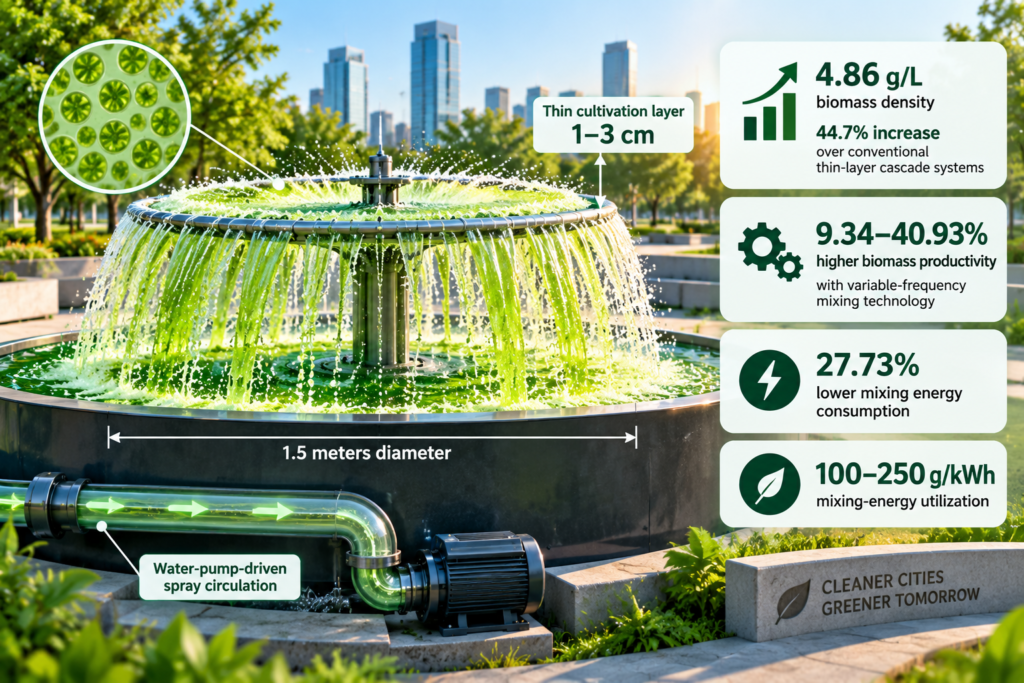
The thin-layer fountain photobioreactor (TLF-PBR) offers a different approach. Using water-pump-driven spray circulation, the system maintains a cultivation layer of approximately 1–3 cm.
A 1.5-meter-diameter TLF-PBR achieved 4.86 g/L biomass density, representing a 44.7% increase over conventional thin-layer cascade systems. Further optimization using variable-frequency mixing technology increased biomass productivity by 9.34–40.93% while reducing mixing energy consumption by 27.73%. Mixing-energy utilization reached 100–250 g/kWh.
These figures provide an important practical foundation for adapting fountain infrastructure to microalgal cultivation.
From Fountain to Carbon-Capture Infrastructure
The proposed application is relatively straightforward conceptually: instead of treating a fountain solely as decorative infrastructure, its circulation system and physical footprint can become part of a microalgal cultivation platform.
This could reduce the need for entirely new structures and potentially lower deployment barriers. The study proposes that high-density cultivation exceeding 5 g/L could be combined with existing fountain assets to create multifunctional urban installations.
Potential application of Microalgae for CO2 capture
The benefits could extend beyond CO₂ capture.
On of the practical recommendation is to avoid energy-intensive harvesting, dewatering and drying wherever possible. Instead, unharvested microalgal culture broth could potentially be used directly as liquid biofertilizer. The proposed model would allow nutrient-rich broth to support urban vertical farms or urban landscaping, creating a local resource loop between microalgae cultivation, agriculture and green infrastructure.
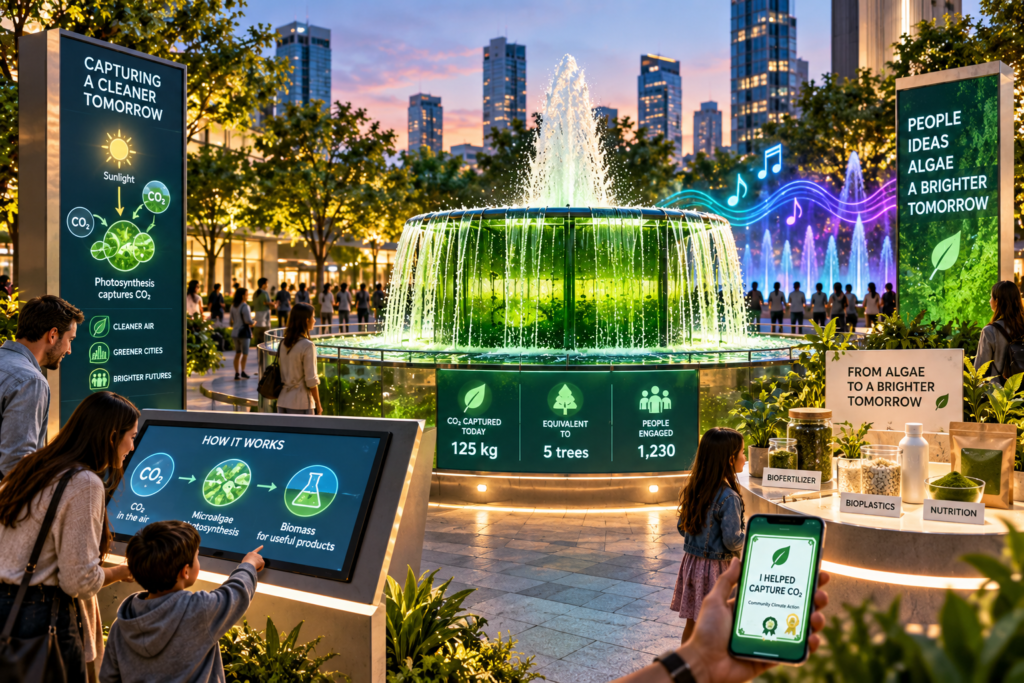
Turning Climate Technology into Public Infrastructure
Perhaps the most distinctive findings is that the fountain is not envisioned merely as a carbon-capture machine.
- As fountains are commonly located in visible, high-footfall areas, they could also become public carbon-literacy platforms.
- Carbon information stations, interactive displays and demonstrations could explain how photosynthesis captures CO₂ and how biomass can be converted into useful products.
- More immersive approaches, including synchronized light and music performances, voice-responsive controls and participation certificates linked to measurable carbon-sequestration metrics.
- Demonstrating microalgae-derived products such as biofertilizers could further connect an abstract climate concept with everyday consumption.
This matters because the authors argue that urban climate action depends not only on technological carbon capture but also on changes in public behaviour.
Practical Challenges with microalgae-enhanced fountain landscapes: Still Need Solving
Studies does not present fountain-based carbon capture as a finished commercial technology. Several challenges remain:
- The most important is the net carbon balance: Mixing can account for 22–79% of energy consumption during microalgae cultivation. It is recommended to mix renewable-energy-powered, computational fluid dynamics modelling and life-cycle assessment to establish genuine carbon breakeven points.
- Other concerns are decentralized biomass processing, cultivation efficiency and maintaining sustained public participation.
What This Research Means for Future Cities
The practical message is compelling: urban carbon capture does not necessarily require entirely new infrastructure.
- Existing fountains could potentially be redesigned as visible, productive biological systems.
- With shallow-layer cultivation, optimized mixing and renewable energy, they could simultaneously support microalgal biomass production and CO₂ fixation.
- Their location could make them unusually effective tools for environmental education, while biomass utilization could connect carbon capture with urban agriculture and circular resource management.
It is proposed that ultimately a model could be developed in which a familiar piece of public infrastructure becomes a photosynthetic, educational and potentially economically productive urban asset.
The next step is not simply to build more fountains. It is to demonstrate whether these systems can achieve positive net carbon removal under real urban conditions, operate economically, and maintain biological performance over long periods.
If those questions can be answered, the humble city fountain could acquire a surprising new role with not just a decorative feature, but a highly visible component of the infrastructure for urban carbon neutrality and climate-resilient cities.