IMOP-Cancer Predicts Tumor Behaviour Through Mutation Order
Why Mutation Order Matters
Cancer develops through the accumulation of genetic mutations. These sequential genetic alterations over time triggers development of tumours. Even though identical mutations may occur, their phenotypic outcomes vary greatly among patients. Traditionally, researchers have focused on identifying which mutations occur in tumours. However, emerging evidence suggests that the order in which these mutations appear can be equally important. Studies have shown the importance of mutation order in blood cancers, but its role in solid tumors remained poorly understood.
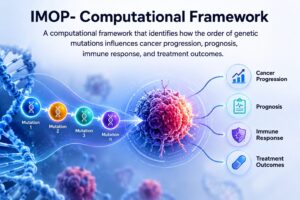
In a groundbreaking study conducted by the scientists at the College of Bioinformatics Science and Technology, Harbin Medical University, China, a computational framework-IMOP-Cancer (Identifying Mutation Order Pairs in Cancer), is designed to determine how the temporal sequence of mutations influences cancer behavior. This research represents an important step toward more personalized cancer diagnosis and treatment by incorporating the evolutionary timeline of tumor mutations.
How IMOP-Cancer Works
Rather than simply identifying co-occurring mutations, the framework reveals how mutation order affects tumor growth, immune response, prognosis, and therapeutic sensitivity across multiple cancer types. The IMOP-Cancer study addresses the knowledge gap of progressing disease by investigating whether different mutation sequences alter cancer phenotypes in solid tumors such as lung, bladder, and colorectal cancers.
The findings demonstrate that mutation order significantly influences:
- Tumor proliferation
- Immune microenvironment
- Drug sensitivity
- Patient prognosis
- Functional pathway activation
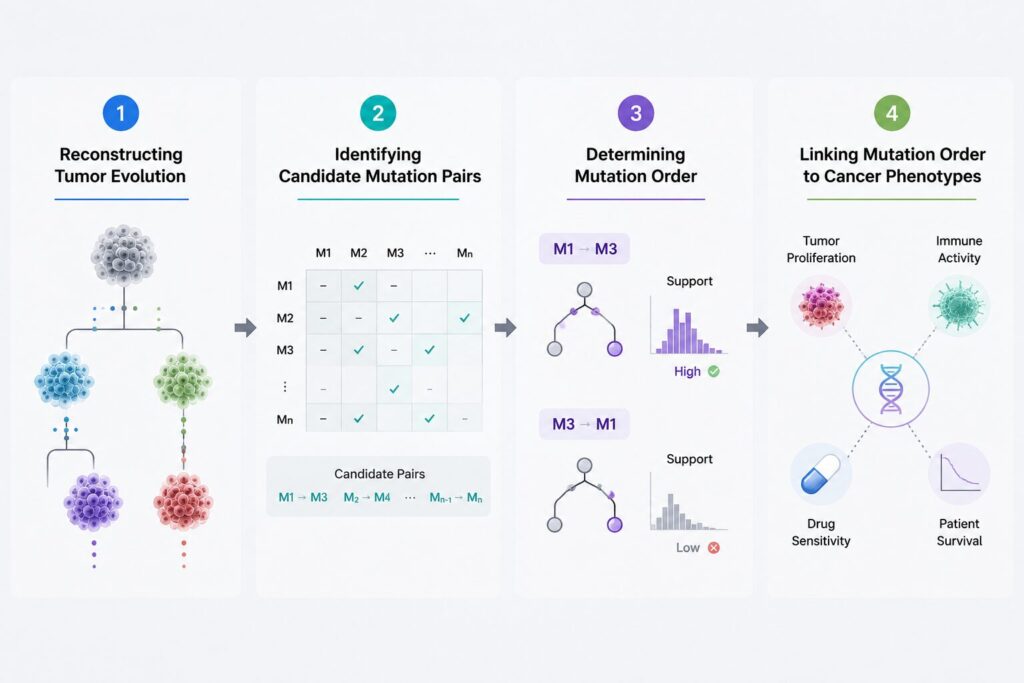
Workflow of IMOP-Cancer
A four-step computational workflow has been developed that is capable of identifying mutation pairs whose sequence changes cancer behavior.
Step 1: Reconstructing Tumor Evolution
Analysis of genomic and transcriptomic data from 9,290 tumor samples was performed across 33 cancer types, obtained from The Cancer Genome Atlas (TCGA). Additional validation datasets included:
- TRACERx
- SU2CLC
- ONCOSG
- DepMap cancer cell lines
To estimate mutation timing, the framework integrated:
- Somatic mutation profiles
- Copy number variation (CNV)
- Allele-specific CNVs
- Tumor purity
Using the PhylogicNDT algorithm, following were calculated:
- Cancer Cell Fraction (CCF)
- Mutation timing
- Tumor phylogenetic trees
These measurements allowed to determine which mutation occurred first within individual tumors.
Step 2: Identifying Candidate Mutation Pairs
Genes mutated in more than 5% of samples were selected.
Candidate mutation pairs were retained only if:
- Both mutations co-occurred in at least 30 samples
- Adequate numbers of patients existed for meaningful comparison
Patients were grouped into:
- Mutation A only
- Mutation B only
- Both mutations
- Neither mutation
Step 3: Determining Mutation Order
Mutations were classified asco-mutated tumors into:
- A-first
- B-first
This classification relied on:
- Cancer Cell Fraction
- Mutation timing
- Phylogenetic relationships
Only mutation pairs with sufficient numbers in both order groups were advanced for downstream analysis.
Step 4: Linking Mutation Order to Cancer Phenotypes
Gene expression data were integrated using single-sample Gene Set Enrichment Analysis (ssGSEA).
The team evaluated thousands of biological functions from:
- Hallmark pathways
- KEGG pathways
- Gene Ontology (GO)
Mutation pairs were considered biologically significant when different mutation orders produced statistically significant functional differences.
Outcomes of IMOP-Cancer framework
- Identification of 106,034 Mutation Order Pairs
One of the study’s most significant achievements was identifying:
- 106,034 mutation order pairs
- Across 17 different cancer types
Among these:
- 3,036 mutation pairs were shared across multiple cancers
- Most mutation-order effects were cancer-specific
This demonstrates the remarkable diversity of tumor evolution.
- Lung Adenocarcinoma Findings
Applying IMOP-Cancer to TCGA lung adenocarcinoma (LUAD) revealed:
- 446 key mutation-order pairs
- 34 pairs associated with patient prognosis
- 22 independent prognostic markers after multivariate analysis
These results indicate that mutation sequence provides clinically meaningful information beyond the presence of mutations alone.
- Mutation Order Influences Tumor Proliferation
A compelling example involved the CSMD3 and PTPRD mutation pair.
Researchers observed that:
- Tumors where PTPRD mutated before CSMD3 showed significantly greater activation of cell-cycle and proliferation pathways.
- Patients with this mutation sequence had poorer survival.
- These tumors also demonstrated reduced sensitivity to chemotherapy agents such as Docetaxel.
Importantly, these findings were validated across four independent datasets and supported by cancer cell-line experiments, strengthening confidence in the biological relevance of the results.
- Mutation Order Alters the Tumor Immune Environment
Another notable finding involved TP53 and NAV3.
When NAV3 mutations occurred before TP53, tumors exhibited:
- Higher immune pathway activity
- Increased immune-cell infiltration
- Higher immune and stromal scores
- Greater expression of major histocompatibility complex (MHC) genes
These observations suggests that mutation order can shape the immune landscape of tumors and may influence responses to immunotherapy. The study validated these immune-related findings across multiple independent datasets.
- Colorectal Cancer Evolution
The framework also examined mutation order among three well-known colorectal cancer drivers:
- APC
- KRAS
- TP53
Although the classic sequence (APC → KRAS → TP53) was common, alternative mutation orders produced distinct biological effects.
For example:
- KRAS mutations occurring before APC enhanced cell-cycle activity.
- KRAS mutations before TP53 reduced metabolic pathway activity.
These findings illustrate how different evolutionary trajectories may produce tumors with unique biological characteristics despite involving the same genes.

Applications of IMOP-Cancer
IMOP-Cancer integrates genomic, transcriptomic, and evolutionary data to examine mutation timing rather than mutation presence alone. Validation across independent clinical datasets and cancer cell lines further supports the robustness of the IMOP-Cancer, giving way to several potential applications in precision oncology.
Improved Prognostic Prediction
Mutation order provided stronger prognostic stratification than mutation status alone in several cancers, suggesting that evolutionary sequencing may become a valuable biomarker for predicting patient outcomes.
Personalized Treatment Planning
As mutation order influenced drug sensitivity, clinicians may eventually use this information to tailor therapies based on a tumour’s evolutionary history rather than solely on its genetic profile.
Enhanced Immunotherapy Selection
The discovery that mutation order affects immune activation raises the possibility of identifying patients who are more likely to respond to immunotherapies.
Better Understanding of Tumor Evolution
IMOP-Cancer provides researchers with a systematic framework for studying how cancers evolve over time, helping uncover mechanisms that drive tumor progression and treatment resistance.
Drug Discovery Opportunities
By identifying mutation sequences associated with aggressive disease, the framework may support the development of therapies targeting specific evolutionary stages of cancer.
Future Insights
As precision oncology continues to evolve, additional driver mutations or rarer evolutionary patterns with larger data set may improve the practical functionalities of IMOP-Cancer. Incorporating the temporal sequence of genetic alterations could improve risk prediction, guide treatment decisions, and support the development of more personalized cancer therapies. Rather than asking only which mutations are present, future cancer care may increasingly ask an equally important question: Which mutation came first?