Green Nanotechnology using plants for Cancer and Inflammation treatment
Green Nanotechnology Meets Herbal Medicine
In search for safer, more effective therapies, researchers are now combining knowledge of the traditional plants with cutting edge nanotechnology. The conventional plant-based therapeutics have minimal applications owing to their poor bioavailability, limited extraction yield, slow growing plant sources, reduced therapeutics efficiency.
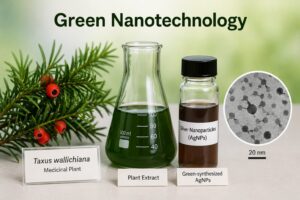
Scientists at the Department of Pharmacy and Department of Chemistry, University of Swabi, have adopted an innovative approach to address these challenges. They have synthesized silver nanoparticles (AgNPs) from Taxus wallichiana (Himalayan yew), a medicinal plant well known for producing taxanes, the compounds behind widely used chemotherapy drugs such as paclitaxel.
How Taxus wallichiana is used to synthesize Silver Nanoparticles could transform future therapeutics
Taxus wallichiana has long been recognized as one of the world’s most valuable medicinal plants because it contains taxanes, diterpenoid compounds used in clinically approved anticancer drugs. Besides taxanes, the plant also contains flavonoids, phenolic acids, terpenes, alkaloids, and other phytochemicals with antioxidant and anti-inflammatory properties.
The researchers hypothesized if these phytochemicals could be used to synthesize AgNPs through green synthesis, several limitations of plant extracts as therapeutics could be overcome while enhancing biological activity.
- Plant Collection and Extraction
Researchers collected aerial parts of Taxus wallichiana (leaves, bark, and branches) and their extraction was prepared using 70:30 hydroethanolic solvent, preserving the plant’s bioactive compounds.
- Green Synthesis of Silver Nanoparticles
Instead of using hazardous chemical reducing agents, researchers employed the plant extract itself to convert silver ions into metallic silver nanoparticles.
This eco-friendly “green synthesis” method relies on naturally occurring phytochemicals that act as both:
- reducing agents
- stabilizing (capping) agents
The approach minimizes environmental impact while integrating bioactive plant molecules onto the nanoparticle surface, potentially enhancing therapeutic activity.
- Nanoparticle Characterization
Several analytical techniques confirmed successful nanoparticle formation.
UV-Visible Spectroscopy: Identified a characteristic surface plasmon resonance peak around 430 nm, confirming successful synthesis of silver nanoparticles. A sharp absorption peak also suggested good nanoparticle stability.
Scanning Electron Microscopy (SEM): SEM imaging showed that the nanoparticles were spherical and oval-shaped, relatively uniform, approximately 10–20 nm in diameter.
Such nanoscale dimensions are advantageous because smaller particles generally exhibit greater biological interactions and improved cellular uptake. The SEM images on page 6 visually confirm these morphologies.
FTIR Spectroscopy: Identified multiple functional groups including hydroxyl, aromatic, and carbon-carbon stretching bands, demonstrating that plant phytochemicals participated in nanoparticle formation and stabilization.
- Phytochemical Profiling
Gas Chromatography-Mass Spectrometry (GC-MS) revealed numerous bioactive constituents within the extract.
Major compounds included:
- Betuligenol (51.42%)
- 3-(p-Hydroxyphenyl)-1-propanol
- n-Hexadecanoic acid
- Phenolic derivatives
- Fatty acid esters
These compounds likely contributed to both nanoparticle synthesis and biological activity.
Green Silver Nanoparticles could transform future therapeutics
Researchers evaluated the therapeutic potential of the green silver nanoparticles
Anti-Cancer Activity
When tested against U87 glioblastoma cells, AgNPs demonstrated greater cytotoxic efficacy, achieved 85.45% cytotoxicity, outperforming the crude plant extract.
These nanoscale particles possess:
- larger surface area
- improved cellular penetration
- enhanced delivery of bioactive phytochemicals
These characteristics likely explain the improved anticancer performance of the AgNPs.
Anti-Inflammatory Activity
When compared against diclofenac, a standard anti-inflammatory drug, extract and nanoparticles reduced inflammation in a dose-dependent manner. However, silver nanoparticles produced more pronounced anti-inflammatory responses than the crude extract.
At 120 minutes:
- plant extract significantly reduced paw edema
- nanoparticle formulations demonstrated even greater reductions
- diclofenac remained the most effective reference treatment
These findings indicate that nanoparticle formulation substantially improves anti-inflammatory performance while maintaining biological compatibility.
Analgesic Activity
The AgNPs have shown no significant central analgesic effects for either the crude extract or nanoparticle formulation. This suggests that the therapeutic benefits are likely mediated through anti-inflammatory and cytotoxic pathways rather than opioid-like pain modulation.
Acute Toxicity Study
When BALB/c mice received oral doses up to 2000 mg/kg to assess short-term toxicity and safety, no mortality, no behavioural abnormalities and no visible toxicity was observed, supporting further investigation of these nanoparticles for pharmaceutical development.
Future of Green Silver Nanoparticles and Precision Medicine
Although the study remains at the preclinical stage, several practical applications emerge. With further validation, biosynthesized nanoparticles could support personalized therapies by enabling targeted delivery of bioactive compounds while minimizing systemic toxicity.
Cancer Drug Development: The enhanced cytotoxicity against glioblastoma cells suggests that Taxus wallichiana silver nanoparticles could become promising candidates for targeted anticancer drug delivery systems.
Natural Anti-Inflammatory Therapeutics: The improved anti-inflammatory activity indicates potential applications in developing plant-based treatments for chronic inflammatory diseases.
Green Pharmaceutical Manufacturing: Using plant extracts instead of toxic chemicals provides a more sustainable approach to nanoparticle production, reducing environmental impact while preserving therapeutic phytochemicals.
Advanced Drug Delivery: Nanoparticle formulations may improve the bioavailability of naturally occurring compounds that traditionally suffer from poor absorption.
Thus, Taxus wallichiana silver nanoparticles may represent an important step toward next-generation plant-based therapeutics for cancer and inflammatory disorders.