A new Diagnostic Score offers faster diagnosis of primary Polydipsia and AVP deficiency
What is Arginine Vasopressin Deficiency?
Diagnosing arginine vasopressin deficiency (AVP deficiency), formerly known as central diabetes insipidus, has long been a challenge for clinicians. Although it is a rare endocrine disorder, it is often diagnosed late where patients wait for six to twelve months for a definitive diagnosis. This is due to the overlapping hallmark symptoms such as excessive thirst (polydipsia) and excessive urination (polyuria), which closely resemble those of primary polydipsia but require entirely different treatment approaches. During this period, patients remain symptomatic and may face dehydration, repeated hospital visits, and time-consuming diagnostic procedures.
Why Improving Diagnosis Matters?
Traditional diagnostic approaches, such as the water deprivation test and hypertonic saline stimulation test, require specialist expertise, prolonged monitoring, and can cause significant discomfort for patients. These limitations have created an urgent need for a simpler, more accessible diagnostic approach that can be used during the initial clinical assessment.
A recent multicentre study conducted by scientists at University of Basel and University of Wuerzburg, have introduced a practical diagnostic scoring system that may significantly simplify the diagnostic pathway. Developed and validated using routine laboratory tests, patient symptoms, and medical history, the score offers clinicians an evidence-based method for identifying patients who require immediate treatment while reducing reliance on specialised stimulation tests.
A Robust International Validation Study
The investigators combined data from two large international multicentre prospective diagnostic studies:
- CODDI Study (Development Cohort): A non-randomised, controlled diagnostic study conducted across 11 tertiary centres in Switzerland, Germany, and Brazil between 2013 and 2017.
- CARGOx Study (Validation Cohort): A randomised, controlled crossover diagnostic study involving seven tertiary centres across Switzerland, Germany, the Netherlands, Italy, the United Kingdom, and Brazil between 2018 and 2022.
Together, the studies included 299 adult patients who presented with hypotonic polyuria and polydipsia or had an existing diagnosis of AVP deficiency.
Importantly, the researchers separated the participants into:
- Development cohort: 141 patients used to create the diagnostic score.
- Validation cohort: 158 independent patients used to confirm the score’s accuracy.
Using separate patient populations for development and validation strengthens the reliability and generalisability of the findings.
How the Diagnostic Score was developed?
Rather than relying on a single laboratory measurement, a hybrid approach was adopted that combined statistical modelling, machine learning, and expert clinical judgement.
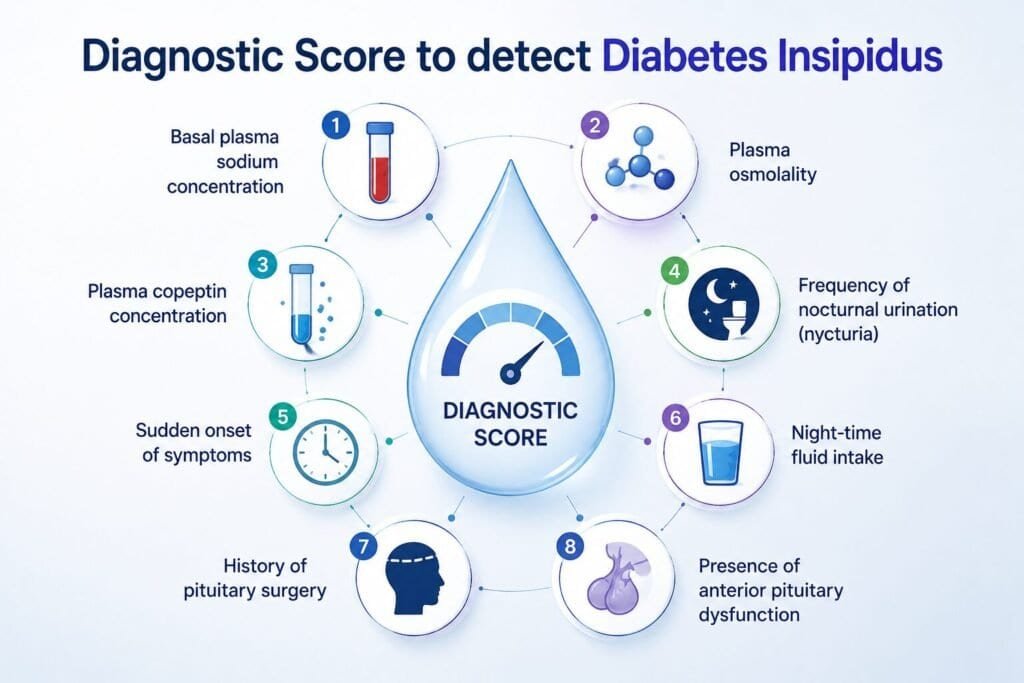
Initially, machine learning techniques evaluated 56 laboratory and clinical variables to identify the strongest diagnostic predictors. After further refinement and clinical review, the final scoring system incorporated readily available information collected during an initial patient consultation.
The score includes:
- Basal plasma sodium concentration
- Plasma osmolality
- Plasma copeptin concentration
- Frequency of nocturnal urination (nycturia)
- Sudden onset of symptoms
- Night-time fluid intake
- History of pituitary surgery
- Presence of anterior pituitary dysfunction
How can a Diagnosis Score improves diagnosis?
Several clinically important findings from the study could immediately influence diagnostic practice.
- Routine laboratory tests can identify clear cases
It was found that certain basal laboratory measurements alone could confidently diagnose or exclude AVP deficiency.
Specifically:
- Plasma sodium greater than 145 mmol/L strongly identified AVP deficiency with 100% specificity.
- Plasma sodium below 135 mmol/L effectively ruled out AVP deficiency.
- Basal plasma copeptin greater than 5.6 pmol/L reliably identified patients with primary polydipsia rather than AVP deficiency.
These findings suggest that many patients can receive an accurate diagnosis without undergoing invasive stimulation testing.
- The Clinical Score demonstrate a high diagnostic accuracy
When laboratory values were combined with clinical history and symptoms, the new diagnostic score achieved impressive performance.
In the independent validation cohort:
- Area Under the ROC Curve (AUC): 91%
- Overall diagnostic accuracy: 86%
- High-specificity threshold: 93% specificity
- High-sensitivity threshold: 93% sensitivity
These results indicate excellent discrimination between AVP deficiency and primary polydipsia.
- Most patients can avoid dynamic testing
The diagnosis score can significantly reduce the options of invasive diagnostic procedures.
By applying a stepwise diagnostic algorithm combining laboratory cut-offs with the clinical score, clinicians could accurately diagnose 75% of patients without requiring hypertonic saline stimulation testing.
Even when copeptin measurements were unavailable, the simplified clinical score could maintain a strong diagnostic performance, successfully identifying 83% of patients.
The simplified Diagnosis Score for Arginine Vasopressin deficiency
The diagnostic score developed in this study can be readily integrated into clinical practice, enabling healthcare professionals to diagnose patients more quickly and accurately using routine clinical and laboratory data.
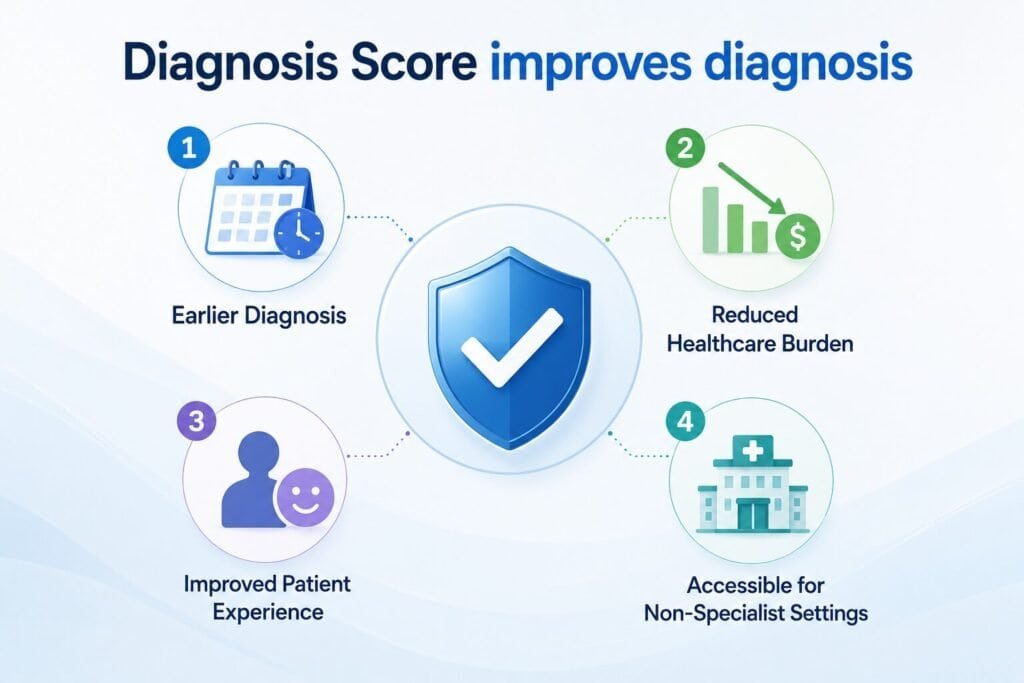
Earlier Diagnosis
Instead of automatically referring every patient for specialised stimulation testing, clinicians can begin with routine laboratory investigations and simple clinical questions during the first consultation.
This allows rapid identification of patients who:
- Require immediate treatment
- Can safely avoid further testing
- Need additional diagnostic evaluation
Reduced Healthcare Burden
Dynamic stimulation tests are resource-intensive, requiring specialist centres, repeated blood sampling, close monitoring, and experienced staff.
The proposed scoring system can reduce unnecessary referrals, shorten waiting times, and improve healthcare efficiency by reserving complex testing for diagnostically uncertain cases.
Improved Patient Experience
Patients often describe conventional water deprivation testing as physically uncomfortable due to prolonged thirst and lengthy testing periods.
A diagnostic pathway that avoids invasive testing for most patients not only improves comfort but also reduces anxiety and accelerates treatment initiation.
Accessible for Non-Specialist Settings
Perhaps the most important practical advantage is accessibility.
Because the score relies primarily on routine laboratory tests and standard clinical history, physicians working in community hospitals, regional centres, or primary care settings can begin the diagnostic process without immediate access to specialised endocrine investigations.
Future Insights
The proposed diagnostic algorithm represents an important step towards more efficient endocrine care. By just combining routine laboratory parameters with simple clinical information, diagnosis of AVP deficiency can be improves diagnosis timelines, minimise invasive testing, optimise healthcare resources, and improve patient care.
Rather than replacing specialist investigations entirely, the score provides clinicians with a structured, evidence-based approach to determine which patients can be confidently diagnosed during their initial assessment and which require additional testing. As further validation studies emerge, this approach has the potential to become a standard component of clinical practice, reducing diagnostic delays while improving patient outcomes.