HEDD Database: Advancing Epigenetic Drug Discovery, Cancer Research, and Precision Medicine Through Integrated Biomedical Data
Epigenetic Drugs and their Importance
The rapid evolution of epigenetics has revolutionized modern medicine, particularly in cancer treatment and precision therapeutics. Epigenetic drugs target modifications in DNA and histone proteins that regulate gene expression. These drugs influence critical biological processes through “writers,” “erasers,” and “readers” of epigenetic marks. Disruptions in these mechanisms are associated with diseases such as cancer, leukemia, lymphoma, and neurological disorders.
Several epigenetic drugs have already received FDA approval, including:
- Decitabine and Azacitidine for myelodysplastic syndrome
- Vorinostat and Romidepsin for cutaneous T-cell lymphoma
- Panobinostat for multiple myeloma
- Belinostat for peripheral T-cell lymphoma
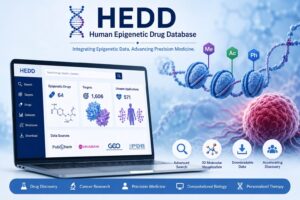
With these clinical relevance of epigenetic therapeutics, researchers over worldwide are increasingly focusing on the promising application of epigenetic drugs because of their ability to regulate gene expression without altering DNA sequences. However, managing and analyzing the enormous amount of epigenetic drug-related data has remained a major challenge. To address this gap, researchers at Jilin Normal University, China, has developed the Human Epigenetic Drug Database (HEDD), a comprehensive platform designed to integrate epigenetic drug information, experimental datasets, clinical trial data, and molecular structures into one accessible resource.
Development of HEDD
Development of HEDD followed a structured methodology approach which focused on data integration, curation, classification, and user accessibility.
- Bioinformatics data sources
Researchers collected epigenetic drug data from globally recognized biomedical databases, including:
- PubChem Compound – A public database used to access chemical compound structures, properties, and biological activity information.
- DrugBank- A comprehensive resource combining detailed drug data with drug target and pharmacological information.
- ZINC-A free database of commercially available chemical compounds used for virtual screening and drug discovery research.
- gov- A global registry providing information on clinical studies, trial phases, and therapeutic outcomes.
- BindingDB- A database containing experimentally measured binding affinities between proteins and drug-like molecules.
- GEO (Gene Expression Omnibus)– A public repository for high-throughput gene expression and genomic datasets.
- OMIM (Online Mendelian Inheritance in Man)– A catalogue of human genes and genetic disorders used in medical genetics research.
- Protein Data Bank (PDB)- A database storing 3D structural data of proteins, nucleic acids, and biomolecular complexes.
This multi-source integration ensured comprehensive coverage of drug-related information, experimental results, and molecular structures.
- Dataset Classification and Organization
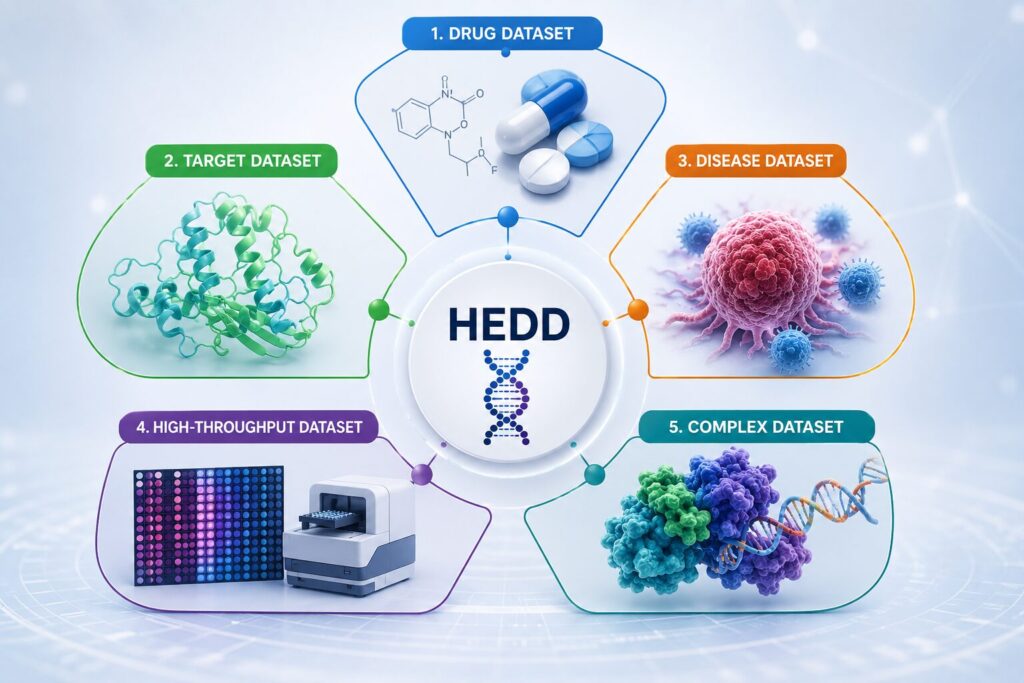
The raw experimental data was transformed into five structured dataset categories:
- Drug datasets
- Target datasets
- Disease datasets
- High-throughput datasets
- Complex structure datasets
This classification allows users to easily retrieve specific information based on research requirements.
Epigenetics drug classes
The HEDD includes 64 epigenetic drugs, categorized into major therapeutic classes such as:
- DNA methyltransferase inhibitors (DNMTi)- These drugs block DNA methylation enzymes to reactivate silenced genes and regulate abnormal gene expression.
- Histone deacetylase inhibitors (HDACi)- These compounds increase histone acetylation to promote gene activation and inhibit cancer cell growth.
- Histone methyltransferase inhibitors (HMTi)- These prevent histone methylation processes involved in abnormal gene regulation and disease progression.
- Histone demethylase inhibitors (HDMi)- These agents inhibit histone demethylation enzymes to restore balanced epigenetic signaling.
- Protein acetylation inhibitors (PAHi)- These molecules block proteins recognizing acetylated histones, affecting gene transcription and cellular functions.
- Protein methylation inhibitors (PMHi)- These inhibit proteins interacting with methylated histones to regulate chromatin structure and gene expression.
Key Dataset Statistics
The HEDD database contains:
- 64 drug datasets
- 1,606 target datasets
- 571 disease datasets
- 276 high-throughput datasets
- 57 complex molecular structure datasets
This large-scale integration significantly improves data accessibility for researchers and clinicians.
- Experimental Validation and High-Throughput Data Integration
A major methodological strength of HEDD is the inclusion of experimentally validated data obtained through:
- Bioassays
- Gene expression arrays
- DNA methylation profiling
- High-throughput sequencing
- X-ray crystallography
- Nuclear Magnetic Resonance (NMR) studies
The incorporation of high-throughput experimental datasets gave researchers access to genome-wide analyses, enabling deeper insights into how epigenetic drugs influence biological pathways.
- Development of Flexible Search and Visualization Tools
The HEDD platform is designed with advanced search capabilities that allow users to search datasets using:
- Drug names
- Diseases
- Target proteins
- Experimental types
In addition, Jmol visualization software is also integrated to provide interactive 3D molecular structures of drugs and drug-target complexes.
This feature significantly enhanced usability for molecular biologists, computational scientists, and pharmaceutical researchers.
HEDD: An impactful tool for epigenetic research and drug discovery
- Comprehensive Integration of Epigenetic Drug Data
HEDD is a centralized repository combining clinical, molecular, genomic, and structural data related to epigenetic drugs. Other databases fall short of flexibility and may not provide critical high-throughput datasets. HEDD addresses these limitations effectively.
The database enables researchers to access interconnected information across multiple dimensions of epigenetic therapeutics.
- Improved Drug Discovery and Drug Repurposing
Integration of diverse experimental datasets in HEDD can accelerate:
- Drug target identification
- Drug repurposing
- Structure-activity relationship analysis
- Computer-aided drug design (CADD)
For example, researchers can study how specific epigenetic drugs interact with target proteins and identify new therapeutic applications based on molecular signatures.
- Enhanced Understanding of Disease Mechanisms
The disease datasets in HEDD provides valuable insights into how epigenetic dysregulation contributes to diseases such as:
- Leukemia
- Lymphoma
- Multiple myeloma
- HIV-related conditions
- Breast cancer
This outcome is especially important for translational medicine, where understanding disease-specific epigenetic patterns can lead to personalized treatment strategies.
- Advancement of Precision Medicine
The integration of high-throughput genomic and methylation profiling data supports precision medicine initiatives. Researchers can analyze:
- Gene expression changes
- DNA methylation alterations
- Histone modification patterns
- Drug responsiveness biomarkers
These capabilities allow clinicians and scientists to identify patient-specific therapeutic approaches and improve treatment outcomes.
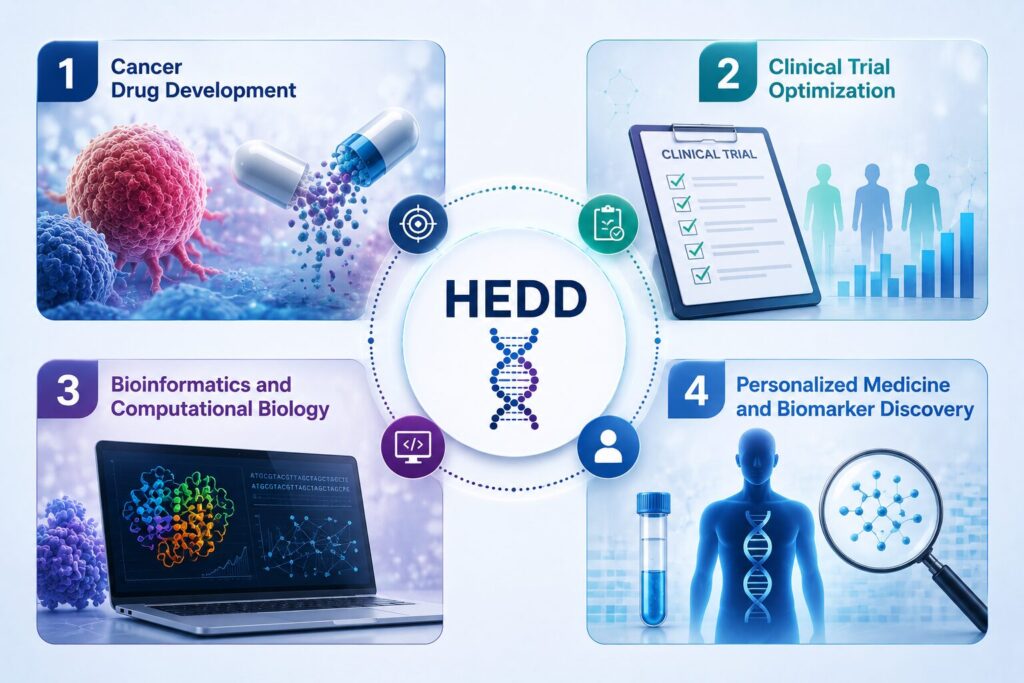
Applications of HEDD in Biomedical Research
The practical relevance of HEDD extends across multiple disciplines.
- Cancer Drug Development
HEDD provides pharmaceutical researchers with valuable molecular and clinical data for developing next-generation cancer therapies. Researchers can analyze inhibitor-target interactions and evaluate therapeutic potential before clinical testing.
This accelerates the drug development pipeline while reducing research costs.
- Clinical Trial Optimization
The database includes detailed clinical trial information from ClinicalTrials.gov, enabling clinicians to track:
- Drug efficacy
- Trial phases
- Disease-specific applications
- Treatment combinations
This information can help optimize future clinical trial designs and therapeutic strategies.
- Bioinformatics and Computational Biology
Computational biologists benefit from downloadable datasets and 3D molecular structures that support:
- Machine learning models
- Molecular docking studies
- Virtual screening
- Pharmacophore modelling
- Systems biology research
The database creates opportunities for AI-driven drug discovery and predictive therapeutic modelling.
- Personalized Medicine and Biomarker Discovery
HEDD’s integrated genomic datasets help identify biomarkers associated with drug sensitivity and resistance. This can guide precision oncology and personalized treatment planning for patients with complex diseases.
Future Insights
HEDD represents a significant advancement in epigenetics and biomedical informatics. By integrating experimental, clinical, genomic, and structural data into a centralized platform, HEDD provides a powerful resource for drug discovery, disease research, and personalized medicine.
As HEDD is continuously evolving, it may incorporate following improvements in future:
- Expansion to additional species such as mice
- Integration of AI-based predictive tools
- Inclusion of molecular docking simulations
- Continuous updating with new experimental data
- Enhanced pathway and gene network analysis
These developments will further strengthen HEDD’s role in advancing epigenetic drug research globally.