

Portable Oxford Nanopore MinION for Forensic SNP Genotyping and DNA identification
Why SNP Genotyping Matters in Forensic Science
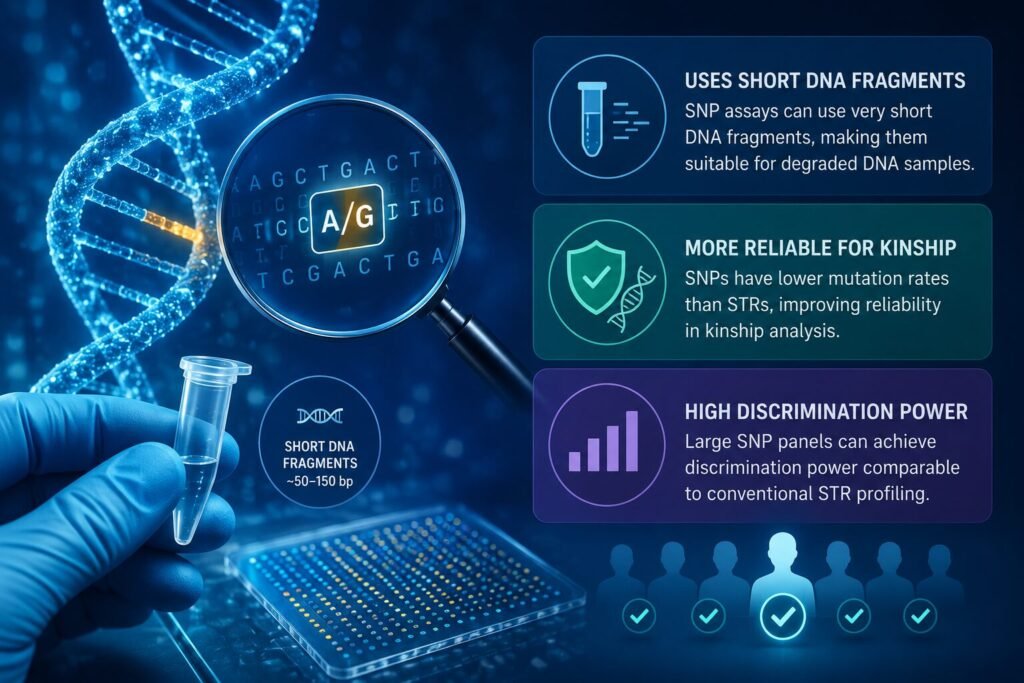
Advances in DNA sequencing continue to reshape forensic science. For many years, short tandem repeats (STRs) have been the standard markers used in forensic DNA profiling. However, SNPs offer several advantages in specific forensic situations because:
- SNP assays can use very short DNA fragments, making them suitable for degraded DNA samples.
- SNPs have lower mutation rates than STRs, improving reliability in kinship analysis.
- Large SNP panels can achieve discrimination power comparable to conventional STR profiling.
Scientists at the Laboratory of Pharmaceutical Biotechnology, Ghent University, Belgium developed a MinION by Oxford Nanopore Technologies (ONT), a portable next-generation sequencing (NGS) platform capable of generating DNA sequence data in real time. They further investigated whether this compact sequencing device could accurately perform forensic single nucleotide polymorphism (SNP) genotyping. The study represents a proof-of-principle evaluation of the MinION platform for forensic DNA analysis, assessing its technical feasibility, identifying the technical limitations, and highlighting improvements needed before routine forensic implementation.
Can Portable DNA Sequencing Transform Forensic Genetics?
High Overall Genotyping Accuracy
In this study a 52-SNP multiplex assay developed by the SNP for ID consortium, which was originally designed for forensic identification, was evaluated. The primary goal, however, was to determine whether Oxford Nanopore’s MinION sequencing platform could accurately genotype all 52 forensic SNP markers. For this, each of the 52 SNP regions was individually amplified using PCR based on the SNP for ID multiplex protocol. Quality assessment of the amplified DNA fragments ensured that only suitable products proceeded to sequencing.
The study successfully genotyped 51 out of 52 SNP loci correctly, demonstrating that nanopore sequencing can generate highly accurate forensic SNP profiles. Only one SNP locus produced an incorrect genotype because of allelic imbalance, suggesting that nanopore sequencing is technically capable of forensic SNP analysis when appropriate markers are selected.
During assessment, one of the major technical challenges was the requirement of longer DNA fragments (>100 base pairs) for the MinION sequencing software, while many forensic PCR products were shorter.
To overcome this limitation, the PCR products were purified individually, combined in equal quantities, and randomly ligated together into concatenated longer DNA fragments using Oxford Nanopore sequencing adapters. This innovative preparation strategy allowed the forensic SNP amplicons to meet the sequencing requirements of the MinION platform.
Sequencing Process
The prepared DNA library was then sequenced using the Oxford Nanopore MinION for a 24-hour run.
The sequencing generated:
- 776,816 total reads
- 367,920 high-quality two-directional (2D) reads
Two-directional reads combine information from both DNA strands, improving sequencing accuracy. In fact, the sequencing run generated a large number of reads for every SNP with an average mapped sequencing depth exceeding 17,000 reads per locus, providing sufficient data for confident SNP calling. Although read representation varied among loci, coverage remained adequate throughout the SNP panel.
Data Analysis
The SNP-containing subreads from the sequencing data were extracted and aligned against reference sequences. Then:
- Sequencing depth for every SNP was calculated.
- Mapping efficiency was evaluated.
- Allele frequencies were measured.
- Nanopore genotype calls were compared with Illumina sequencing results.
This comparative approach enabled a robust assessment of nanopore sequencing accuracy.
Homopolymer Regions Remain a Major Challenge
The most significant limitation identified by the study involved homopolymer sequences which are stretches of repeated identical bases.
Several problematic SNP markers were located within or adjacent to these regions. It was observed that nanopore sequencing frequently introduced insertion and deletion errors around homopolymers, which affected accurate SNP identification. These same loci had also been reported as problematic with other sequencing technologies, including Ion Torrent.
Improved Alignment Could Not Fully Resolve Errors
Specialized alignment settings designed specifically for Oxford Nanopore data was also tested. Although the settings increased the number of mapped reads, they also introduced additional mismatches and insertion-deletion errors.
As a result, alignment optimization alone did not eliminate the issues associated with homopolymer-containing SNP markers.
Marker Selection Is Critical
Rather than viewing nanopore sequencing itself as unsuitable, it was concluded that the problematic SNP markers should simply be excluded or replaced in future forensic SNP panels.
This finding provides a practical pathway for improving nanopore-based forensic genotyping.
Potential for Sample Multiplexing
When sequence capacities were assessed to support multiple forensic samples in a single sequencing run, same SNP profile was obtained even by reducing the dataset to only one-hundredth of the original sequencing reads.
These results suggest that modern MinION flow cells produce far more data than required for a single forensic sample, creating opportunities for cost-effective multiplexing.

Application of portable MinION Sequencer
Portable Forensic DNA Analysis
One of the MinION platform’s greatest advantages is portability.
Unlike many conventional sequencing instruments, the MinION is compact and capable of generating sequencing data in real time. This portability creates opportunities for more flexible forensic workflows where rapid DNA analysis may be beneficial.
Analysis of Degraded DNA
Forensic samples are mostly degraded and well suited for SNP assays as they rely on short PCR amplicons.
The study supports continued development of nanopore-based SNP analysis for situations where STR profiling may be less effective.
Future Forensic SNP Panel Design
In future, improved forensic SNP panels can be designed specifically optimized for nanopore sequencing.
In addition, avoiding SNPs located near homopolymer regions could substantially improve genotyping robustness.
High-Throughput Laboratory Workflows
The ability to sequence multiple samples simultaneously offers potential efficiency gains for forensic laboratories. As nanopore sequencing accuracy continues to improve, multiplexed forensic testing may become increasingly practical.
Future Insights
The Oxford Nanopore MinION is a proof-of-principle which was evaluated using a single reference DNA sample. It highlights the technical feasibility and growing potential of portable nanopore sequencing in forensic genetics.
However, there still remain a wide scope for evaluation of mixed DNA samples, degraded evidence samples, or routine forensic casework. Additionally, several SNP loci remained vulnerable to sequencing errors associated with homopolymer regions, indicating the need for further validation studies before widespread forensic implementation of this portable device.
As sequencing chemistry, software, and SNP panel design continue to advance, nanopore technology may become an increasingly valuable tool for forensic DNA analysis, particularly in applications requiring rapid, flexible, and high-throughput genotyping.






Pingback: Early Antibiotic use increases Antibiotic Resistance in Preterm Infants - Sci-Tech Bulletin