Just 4 Minutes of Daily Activity May Lower Cancer Risk
Sedentary Lifestyle and Cancer Risk
Modern lifestyles are increasingly inclining towards working for long hours, sedentary occupations, extensive screen time, commuting demands, and limited opportunities for regular exercise. During these hustles physical activity is often neglected, potentially contributing to adverse health outcomes and an increased risk of chronic diseases, including cancer. Insufficient physical activity can affect:
- Metabolic health
- Body weight
- Cardiovascular function
- Inflammation and other biological processes associated with cancer development.
Importantly, lack of structured exercise does not necessarily mean that individuals are completely inactive but what if cancer-prevention benefits could come from short bursts of vigorous movement embedded naturally into everyday life?
To validate this hypothesis, researchers from University of Sydney, investigated exactly this question by examining vigorous intermittent lifestyle physical activity (VILPA) i.e. brief, intense bursts of activity such as walking very quickly, climbing stairs or moving rapidly during daily routines, in 22,398 non-exercising adults.
The study findings highlight the potential importance of integrating brief, vigorous movement into busy daily routines. While such associations do not establish that VILPA directly prevents cancer, they emphasize the need to address physical inactivity and explore practical, time-efficient strategies for cancer prevention. For people who don’t exercise regularly, the idea of fitting a long workout into an already busy day can feel unrealistic.
What Is Vigorous Intermittent Lifestyle Physical Activity?
Vigorous intermittent lifestyle physical activity, or VILPA, describes short and sporadic bursts of vigorous physical activity performed as part of everyday life rather than as structured exercise.
Some of the VILPA activities include:
- Walking very quickly to catch a bus
- Rapidly climbing several flights of stairs
- Carrying groceries at a brisk pace
- Walking uphill quickly
- Brief bursts of fast movement while doing household activities
Traditional vigorous exercise generally involves planned sessions such as running, cycling or high-intensity interval training. VILPA, by contrast, can occur naturally throughout the day. The main focus specifically points at bouts lasting up to 1-2 minutes. When measured using a wrist-worn accelerometers in participants, more than 92% of recorded VILPA occurred in bouts lasting one minute or less, while 97.3% occurred in bouts lasting two minutes or less.
This makes the concept particularly relevant for people who aren’t exercising but may still be able to incorporate brief periods of higher-intensity movement into their routines.
Measuring Everyday Activity with Wearable Technology
In a prospective cohort study, 22,398 self-reported non-exercising adults were enrolled, with a mean age of 62 years. The group included 10,122 men and 12,276 women. Participants wore accelerometers on their dominant wrists for measuring the intensity and duration of physical activity objectively.
The participants were followed for an average of 6.7 years, representing approximately 149,650 person-years of follow-up. During this period, total cancer incidences were identified along with a composite outcome covering 13 cancer sites associated with low physical activity.
The investigation included examining the amount of daily VILPA was associated with subsequent cancer incidence, where VILPA accumulated in bouts of:
- Up to 1 minute
- Up to 2 minutes
The dose-response analyses then modelled the relationship between daily VILPA duration and cancer incidences.
How short vigorous activity lowers the cancer risk: A Near-Linear Relationship?
The study yielded some striking findings. Notably, cancer incidence declined as daily VILPA increased, demonstrating a near-linear dose-response relationship between the amount of vigorous intermittent lifestyle physical activity and cancer incidence.
The association was even stronger for cancers related to physical-activity levels than for total cancer incidence. For VILPA accumulated in bouts lasting up to 1-2 minutes, a minimum daily amount was found to be associated with a meaningful reduction in risk at approximately:
3.4 minutes per day for total cancer incidence
and
3.7 minutes per day for physical-activity-related cancer incidence.
Compared with participants recording no VILPA, these amounts were associated with approximately 17% lower total cancer incidence and 28% lower physical-activity-related cancer incidence, based on the reported hazard ratios.
What Happens at Around Four and a Half Minutes a Day?
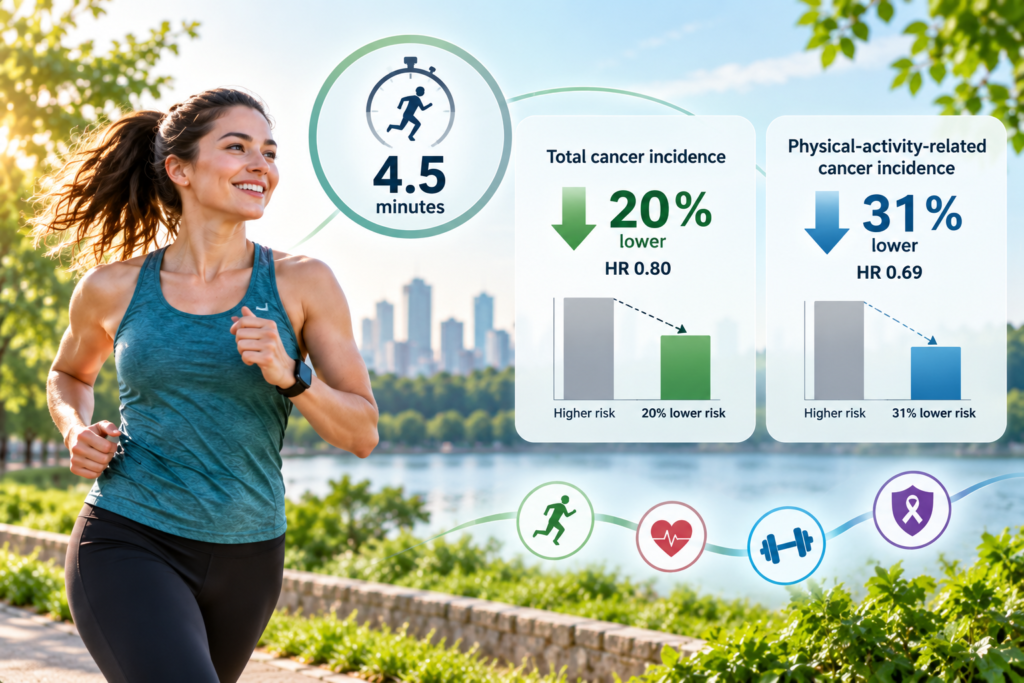
The median daily VILPA duration was recorded to be 4.5 minutes.
At this level, VILPA was associated with:
- 20% lower total cancer incidence
- 31% lower physical-activity-related cancer incidence
These numbers attracted considerable attention because they challenge the assumption that meaningful physical-activity benefits necessarily require long, structured exercise sessions.
However, the findings shouldn’t be interpreted as “4-minutes of exercise prevents cancer.” The study was observational, so the researchers identified a statistical association rather than establishing causation.
Why Short Bursts of Vigorous Activity is Important?
Vigorous physical activity is known to produce stronger physiological responses than light activity.
Short intense bursts can rapidly increase:
- Heart rate
- Breathing rate
- Cardiovascular demand
- Muscle recruitment
- Energy expenditure
The practical significance remains less in identifying one specific biological pathway and more in demonstrating that physical activity accumulated through everyday life may matter even when people don’t participate in traditional exercise.
VILPA as a New Perspective on Cancer Prevention:
We often think about physical activity as a tedious task that requires time, energy and efforts because public-health messages often focus on structured exercise: going to the gym, running, swimming, cycling or completing a specific workout.
Although these activities remain valuable but many people don’t exercise because of time constraints, lack of motivation, physical limitations, cost, accessibility or personal preference.
VILPA offers another concept:
Don’t necessarily create more time for exercise—use short opportunities for vigorous movement that already exist in your day.
- Taking the stairs instead of the elevator
- Walking rapidly between destinations
- Deliberately increasing the pace of routine movement
These simple movements could potentially contribute to daily VILPA which is now proven as a promising strategy for cancer prevention among people who are unable or unwilling to participate in leisure-time exercise.
The Role of Wearable Technology
The study also demonstrates the growing importance of wearable health technology in physical-activity research.
Because VILPA consists of very short bursts, traditional activity questionnaires may not capture it accurately. Wrist-worn accelerometers can continuously record:
- Movement intensity
- Movement duration
This gives a more detailed picture of everyday physical behaviour.
Wearable devices could potentially help people understand how much vigorous movement they naturally accumulate throughout a day. Over time, such technology could support personalized activity goals and behaviour-change strategies.
The broader opportunity is the convergence of:
- Wearable sensors
- Physical-activity monitoring
- Preventive health
- Personalized interventions.

Advantages of adopting VILPA in a busy schedule
- Making physical activity more accessible
VILPA doesn’t require a gym membership or a dedicated exercise session. This may make physical activity more achievable for people who struggle with conventional exercise.
- Designing micro-activity interventions
Health programs could encourage people to incorporate several short vigorous movement opportunities throughout the day rather than focusing exclusively on long workouts.
- Using wearable technology
Smartwatches and accelerometers could help quantify short activity bursts that conventional questionnaires might miss.
- Supporting cancer-prevention strategies
The findings provide a basis for investigating whether brief vigorous activity could become part of broader cancer-prevention interventions.
- Reaching inactive populations
Perhaps the most important application is targeting people who currently don’t exercise. The research specifically examined non-exercising adults, making its findings particularly relevant to this population.
Future Insights
Although VILPA has been proven to be effective in supporting cancer prevention, the message does not convey that people should abandon traditional exercise.
Instead, the research suggests another useful idea:
Every bit of vigorous movement may count.
For someone who doesn’t currently exercise, adding brief bursts of faster movement throughout the day may be more achievable than committing immediately to a structured exercise program.
That could mean walking faster for a minute, taking stairs quickly or adding brief vigorous movement opportunities during routine activities.
These small changes shouldn’t be viewed as a substitute for medical care, cancer screening or established physical-activity recommendations. Rather, they represent a potentially accessible way of increasing movement among people who currently do very little structured exercise and a promising effort one could make for themselves to prevent incidence of cancer.