Ebola Virus VP24 and VP35 Interactions Reveal New Antiviral Drug Targets
Ebola Virus Outbreak
Ebola Virus has once again caught attention of the researchers with its recent outbreak in Democratic Republic of Congo (DRC) and Uganda a Public Health Emergency of International Concern (PHEIC) in May 2026. This Ebola Bundibugyo strain is a rare variant of the virus which is responsible for mortality of about 50% and for which no licensed vaccine or targeted antiviral treatment currently exists.
Thus, the Ebola virus still holds its position as one of the world’s deadliest pathogens which spreads through blood, body fluids, contaminated surfaces and infected animals. After infecting the host cell the virus incubates for 2-21 days and causes symptoms such as:
- Fever
- Fatigue
- Vomiting
- Diarrhoea
- Internal and external bleeding
- Organ failure in severe cases
While vaccines and antibody therapies exist for limited strains, the outbreak of Ebola Bundibugyo virus reinforces the importance of continue search for broad-spectrum antiviral strategies that can stop multiple filoviruses before they spread.
Why Ebola Virus Assembly Matters
The Ebola virus belongs to the filovirus family, which includes Marburg virus and other severe hemorrhagic fever pathogens. Morphologically and structurally, all the strains of the Ebola virus have thread-like, enveloped, negative-sense single-stranded RNA, belonging to Filoviridae family with exact same set of 7 genes that code for 8 distinct proteins. However, these viruses primarily rely on the nucleocapsid to package and protect their RNA genome. Without proper nucleocapsid formation, the virus cannot replicate effectively or spread between cells. Although the nucleoprotein (NP), VP24, and VP35 are known to be essential for Ebola nucleocapsid assembly, the detailed view of how these components interact inside living infected cells remain to be discovered.
To understand the intricate details about the Ebola virus, a groundbreaking study was conducted at the Center for Vaccine Innovation, La Jolla Institute for Immunology, U.S.A. The scientists used advanced cryo-electron tomography (cryo-ET) to reveal the Ebola virus nucleocapsids assembly inside infected cells, uncovering structural details that may accelerate future antiviral drug development.
How Advanced Cryo-Electron Tomography revealed Ebola nucleocapsids assembly?
The research team employed a sophisticated imaging workflow centered on cryo-electron tomography (cryo-ET), combined with cryo-focused ion beam milling (cryo-FIB). This methodology allowed scientists to freeze infected cells rapidly and image viral structures in their near-native state without damaging cellular architecture.
Step 1: Cell Transfection and Viral Modeling
At first, HEK 293T cells were engineered to express Ebola virus proteins NP, VP24, and VP35. Truncated versions of NP were also created to compare structural differences during assembly. The researchers also used a biologically contained Ebola model called EBOV-GFP-ΔVP30, to simulate realistic infection conditions safely outside a biosafety level 4 (BSL-4) laboratory. This modified virus could replicate only in specialized cells expressing VP30, making it safer for laboratory analysis while preserving authentic viral assembly behaviour.
Step 2: Cryo-FIB Milling
Cryo-focused ion beam milling precisely shaved frozen cells into ultra-thin lamellae suitable for electron microscopy. This process preserved intracellular viral factories while enabling nanometer-scale imaging.
Step 3: Cryo-Electron Tomography
Cryo-ET generated three-dimensional reconstructions of Ebola nucleocapsids directly inside cells. Unlike traditional microscopy, cryo-ET captures structures in their natural biological environment. Image maps were produced with resolutions as high as 9 angstroms, detailed enough to identify protein layers and molecular interactions.
Step 4: Subtomogram Averaging and Structural Modeling
To improve image clarity, subtomogram averaging was used to computationally combining repeated nucleocapsid structures. These were then integrated into existing atomic models from protein databases to build a complete intracellular Ebola nucleocapsid model.
This combination of experimental imaging and computational modeling gave researchers an unprecedented look at Ebola virus assembly.
Discovery of the Ebola virus nucleocapsids Assembly
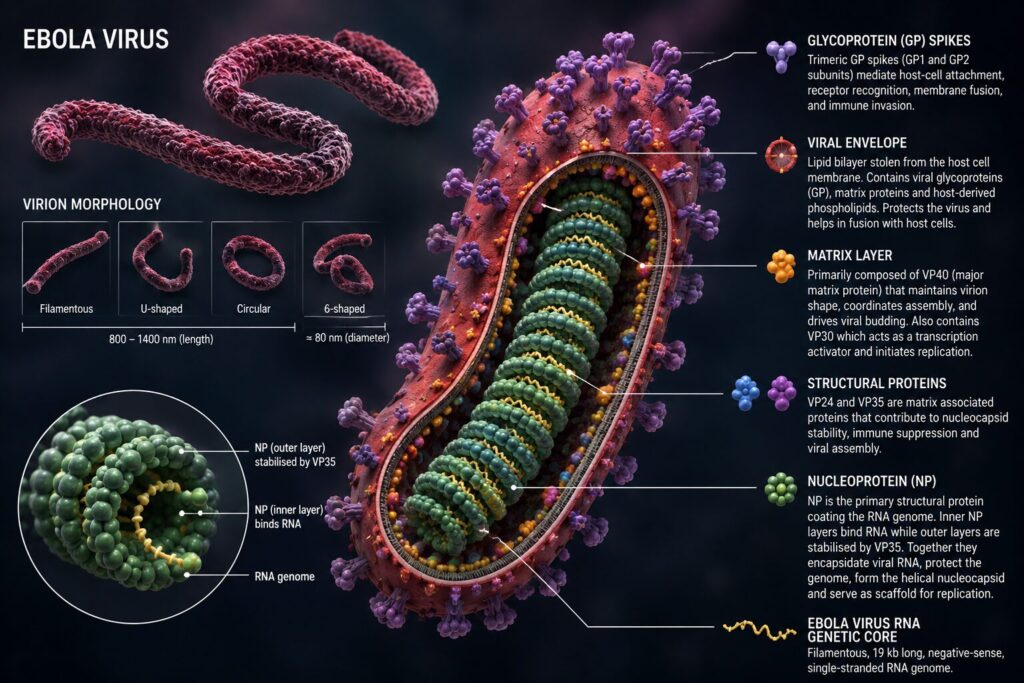
Ebola virus particles, called virions, have a distinctive long filamentous shape that appears thread-like and may be of variable length ranging from 800–1400 nm and diameter of approximately 80 nm. Under electron microscope, the virus may appear as branched, U-shaped, circular or as 6-shaped filaments.
- Ebola virus genetic core
The Ebola virus RNA is filamentous, enveloped, 19 kb long negative-sense, single-stranded and one of the most structurally complex RNA viruses.
- Viral Envelope
The virus RNA is packed with an outside viral envelope which is a lipid bilayer stolen from the host cell membrane during virion release. This envelope also contains viral glycoproteins responsible for attachment and entry. It also protects the virus and helps in fusing with the host cells.
In addition, the envelope also contains host-derived phospholipids, viral glycoprotein spikes (GP) and matrix proteins.
- Glycoprotein (GP) Spikes
From the viral envelope, trimeric glycoprotein (GP) spikes projects. Each GP spikes consists of GP1 and GP2 subunits, linked via disulfide bonds that mediate host-cell attachment, receptor recognition, membrane fusion, and immune invasion in the host cells.
- Matrix Layer
Beneath the viral envelope lies the matrix layer, primarily composed of the viral protein VP40 that maintains virion shape, coordinates viral assembly, and drives viral budding. In addition, the matrix also contains VP30 that functions as viral transcription activator and initiates Ebola replication.
- Structural Proteins
VP24 and VP35 are matrix associated proteins that contributes to nucleocapsid stability, immune suppression and viral assembly.
- Nucleoprotein (NP)
NP is the primary structural protein coating the RNA genome. The inner NP layers binds RNA while the outer layers are stabilised by VP35. These NP layers together encapsidates viral RNA, protects the genome, forms the helical nucleocapsid and serves as scaffold for replication.
- Discovery of a Previously Unknown Third NP Layer
The scientists have identified a third outer layer of nucleoprotein (NP) in the Ebola nucleocapsid. This layer exists in a monomeric, RNA-free state and is stabilized by interaction with VP35.
After detailed study of the structural functionality of this layer, it was found that Ebola simultaneously maintains two distinct NP states:
- RNA-bound NP that forms the structural core
- RNA-free NP that likely connects the nucleocapsid to viral matrix proteins
During this, the third outer NP layer acts as a flexible tether that helps incorporate the nucleocapsid into newly forming virus particles.
Visualization of Nucleocapsid Assembly Intermediates
After detailed imaging, multiple intermediate assembly stages of Virus was identified inside the cell:
- Loosely coiled NP polymers
- Regionally condensed NP structures
- Fully assembled nucleocapsids
Understanding these intermediate stages is critical because antiviral drugs could potentially disrupt assembly before mature virus particles form.
Nucleocapsid layer undergo structural changes during viral maturation
Intracellular nucleocapsids undergo further condensation when incorporated into mature virions.
Inside cells, nucleocapsids maintain a more open structure. During virion formation, however, the structures condense vertically into tighter assemblies. This dynamic structural transformation suggests that Ebola nucleocapsids remain adaptable throughout the viral life cycle, opening additional therapeutic opportunities for blocking maturation processes.
Future Insights
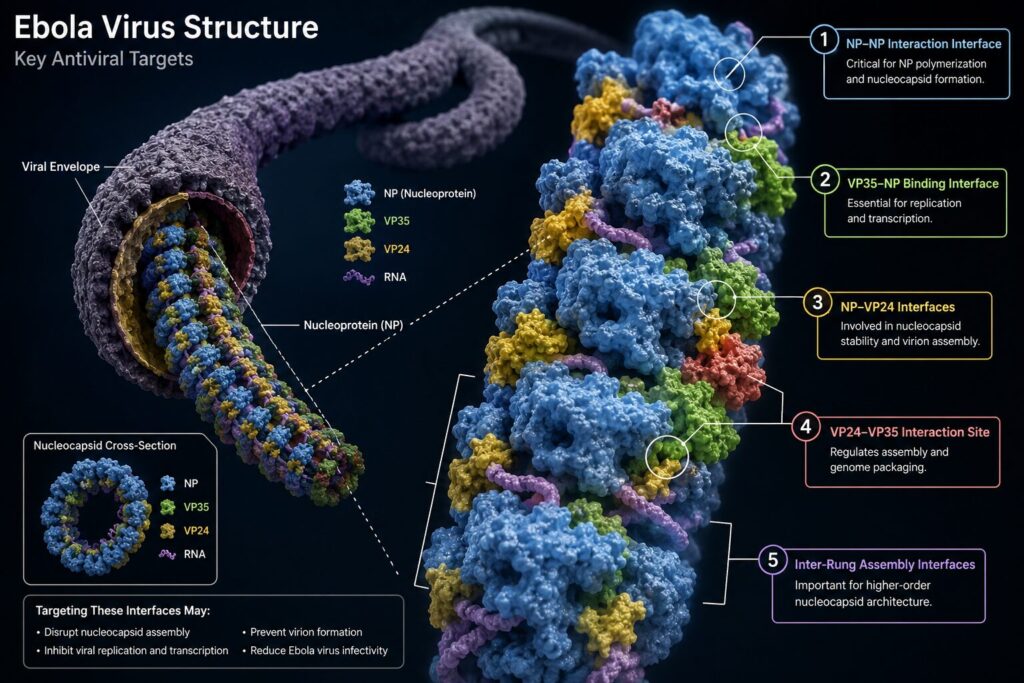
New highly conserved molecular interfaces have been identified that are involved in nucleocapsid assembly of the Ebola virus. These interfaces govern viral assembly and stability, making them promising drug targets.
The primary targets include:
- NP–NP Interaction Interface
This interface enables nucleoprotein (NP) molecules to polymerize along the viral RNA genome and form the helical nucleocapsid core. Disrupting this interaction could prevent proper nucleocapsid assembly.
- VP35–NP Binding Interface
VP35 binds NP and maintains the outer NP layer in a monomeric, RNA-free state. This interaction is critical for regulating nucleocapsid assembly and viral maturation. Blocking VP35-NP binding could interfere with virus replication.
- NP–VP24 Interfaces
Multiple interfaces between NP and VP24 stabilize the nucleocapsid structure. Since VP24 also contributes to immune evasion, targeting these interfaces may simultaneously weaken viral assembly and reduce the virus’s ability to suppress host immunity.
- VP24–VP35 Interaction Site
The study identified a structural interface between VP24 and the C-terminal domain of VP35. This interaction may help organize the outer nucleocapsid layer and maintain structural integrity.
- Inter-Rung Assembly Interfaces
Researchers discovered interactions between adjacent nucleocapsid layers that control nucleocapsid condensation and maturation inside virions. Targeting these interfaces could block the transition from immature to infectious viral particles.
These interactions are visualized in a realistic intracellular environment and provides biologically relevant insights that are far more applicable to drug development. The discovery of the outer NP layer and its interaction with VP35 reshapes current understanding of Ebola virus assembly. It also explains how the virus may tether its nucleocapsid to the viral membrane during budding and release.