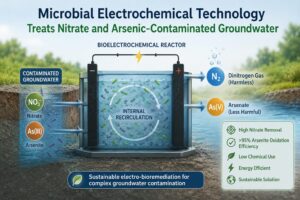
Microbial Electrochemical Technology Treats Nitrate and Arsenic-Contaminated Groundwater
A Sustainable Breakthrough for Treating Nitrate and Arsenic-Contaminated Groundwater
Apart from fresh river water, groundwater is one of the only important drinking water sources. However, in many regions, this vital resource is increasingly threatened by contamination from agricultural runoff, industrial waste, and naturally occurring toxic elements. Two of the most problematic pollutants are nitrate and arsenic, both of which pose serious risks to human health and environmental safety.
A recent research published by the researchers of the University of Girona, Spain, found an innovative solution called electro-bioremediation using microbial electrochemical technologies (METs). The study demonstrated how a bio-electrochemical reactor can simultaneously remove nitrate and oxidize toxic arsenite in contaminated groundwater using electroactive microorganisms, providing a promising pathway toward more sustainable, energy-efficient groundwater treatment systems with real-world applicability.
Hazards of Nitrate and Arsenic Contamination
Nitrate contamination is primarily linked to intensive agriculture and fertilizer use. High nitrate concentrations in drinking water can cause severe health issues, especially in infants and vulnerable populations. Regulatory agencies in Europe and across the world have established strict nitrate limits in drinking water to reduce these risks.
Arsenic contamination is equally dangerous. In groundwater, arsenic commonly exists as arsenite [As(III)] and arsenate [As(V)]. Arsenite is the more toxic, mobile, and soluble form, making it particularly difficult to manage. Conventional arsenic treatment methods often rely on chemical oxidation and precipitation, which require substantial chemical inputs and can generate secondary waste streams.
The coexistence of nitrate and arsenic contamination is increasingly common in groundwater systems worldwide. Traditional treatment methods typically address only one contaminant at a time, increasing operational complexity and cost.
What Is electro-bioremediation?
Electro-bioremediation combines microbiology and electrochemistry to treat contaminated water. In microbial electrochemical systems, electroactive bacteria use electrodes as electron donors or acceptors, enabling biological oxidation and reduction reactions without requiring large quantities of external chemicals.
The researchers have developed a continuous-flow bioelectrochemical reactor designed to:
- Reduce nitrate into harmless dinitrogen gas (N₂)
- Oxidize toxic arsenite [As(III)] into less harmful arsenate [As(V)]
- Operate under groundwater-like conditions
- Maintain high treatment efficiency with low energy input
The process is particularly attractive because arsenate is easier to remove through conventional adsorption or precipitation methods after oxidation.
How these Electro-bioremediation reactors work?
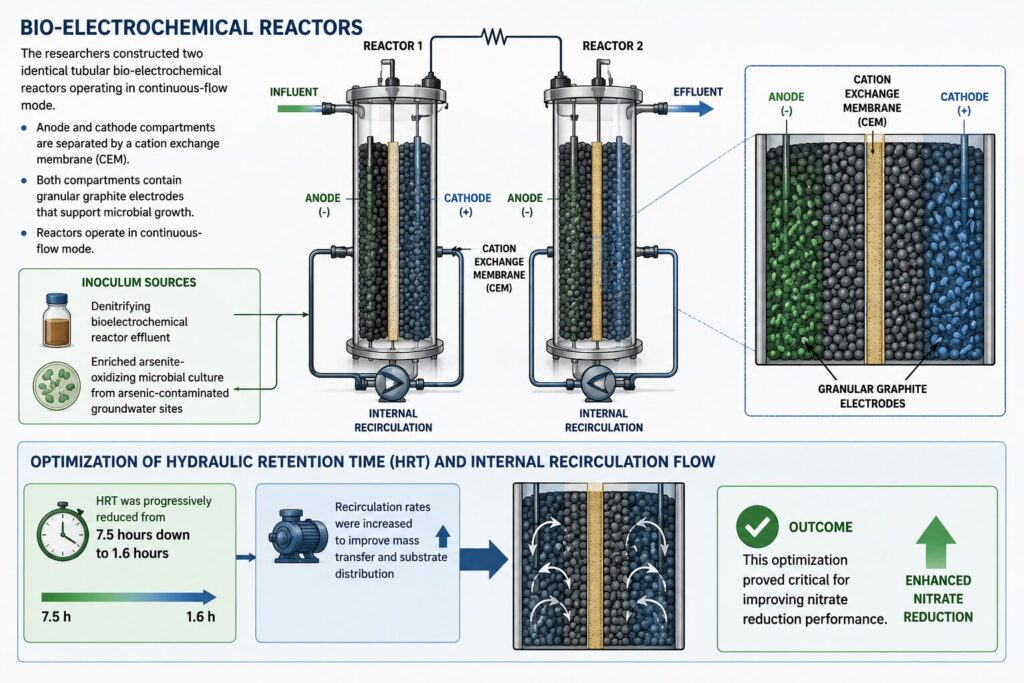
The researchers have constructed two identical tubular bio-electrochemical reactors that operates in continuous-flow mode. The reactor design separated the anode and cathode compartments using a cation exchange membrane, while both compartments contained granular graphite electrodes that supported microbial growth.
These reactors were inoculated with effluents from a denitrifying bioelectrochemical reactor and an enriched arsenite-oxidizing microbial culture collected from arsenic-contaminated groundwater sites.
One of the major focuses of the study was optimizing hydraulic retention time (HRT) and internal recirculation flow. HRT was progressively reduced from 7.5 hours down to 1.6 hours while increasing recirculation rates to improve mass transfer and substrate distribution within the reactor.
This optimization proved critical for improving nitrate reduction performance.
Key Research Outcomes
- Highly Efficient Nitrate Removal
The bioelectrochemical system achieved impressive nitrate reduction performance, reaching a maximum nitrate reduction rate of 519 g N-NO₃⁻ m⁻³ day⁻¹. This occurred at a hydraulic retention time of 2.3 hours with approximately 90% nitrate removal efficiency.
Importantly, the process converted nitrate almost entirely into harmless nitrogen gas with minimal accumulation of nitrite or nitrous oxide, both of which can create additional environmental problems. The treated water successfully met drinking water quality standards for nitrate and nitrite concentrations.
- Complete Arsenite Oxidation
The reactor also demonstrated exceptional stable arsenite oxidation performance, with more than 95% arsenite oxidation efficiency reaching a maximum oxidation rates of 90 g As(III) m⁻³ day⁻¹
Even at short hydraulic retention times, arsenite concentrations in the effluent remained below analytical detection limits. This is significant because converting arsenite into arsenate greatly simplifies downstream arsenic removal processes.
- Stable Performance Under Low Conductivity Conditions
Groundwater typically has lower conductivity than industrial wastewater, which can limit electrochemical treatment performance.
Despite these constraints, the reactor maintained high efficiency throughout the study. The researchers demonstrated that microbial electrochemical systems can function effectively under realistic groundwater conditions.
- Internal Recirculation Improved Reactor Efficiency
One of the key innovations in these reactors were fluid dynamics inside the reactor. Initially, nitrate removal rates were relatively low due to poor mass transfer. After introducing internal recirculation, nitrate reduction performance increased dramatically.
The recirculation system:
- Improved proton transport
- Reduced pH imbalances
- Enhanced substrate diffusion
- Increased microbial activity
This optimization increased nitrate reduction rates by nearly seven times compared to non-recirculated operation.
Understanding the Microbial Communities that Drives the process
A detailed microbial community analysis was performed using DNA sequencing techniques. Researchers identified several dominant bacterial genera involved in the treatment process, including:
- Sideroxydans
- Achromobacter
- Denitratisoma
Among these, Achromobacter agilis emerged as a likely key organism responsible for arsenite oxidation coupled with nitrate reduction.
This microbial community demonstrated strong adaptability and resilience even in the presence of elevated arsenite concentrations.
Can these Microbial bioelectrochemical technologies (METs) help to get rid of nitrate and arsenate contaminants?
Sustainable groundwater treatment: Traditional nitrate and arsenic treatment methods are often expensive, energy-intensive, and chemically dependent. The electro-bioremediation system offers a more sustainable alternative by leveraging naturally occurring microbial processes and electrical stimulation.
Reduced Chemical Consumption: As the reactor uses electrodes as electron donors and acceptors, the system minimizes the need for continuous chemical addition, lowering operational costs and reducing chemical waste generation.
Decentralized Water Treatment: The compact reactor design makes this technology potentially suitable for decentralized groundwater treatment systems in rural or remote communities where centralized treatment infrastructure is unavailable.
Integration with Existing Treatment Systems: The arsenite oxidation step could easily integrate with existing arsenic removal technologies such as adsorption or precipitation systems, improving overall treatment efficiency.
Climate-Friendly Water Treatment: Unlike some conventional denitrification systems, the reactor produced minimal nitrous oxide emissions, an important greenhouse gas consideration for future water treatment technologies.
Challenges and Future Research Directions
Few challenges can be taken in the direction to implement the Microbial bioelectrochemical technologies, by focussing on:
- Long-term operational stability
- Scaling the technology for municipal applications
- Reducing reactor costs
- Improving energy efficiency
- Testing performance with real contaminated groundwater under varying environmental conditions
Researchers also identified several arsenite oxidation pathways occurring simultaneously within the reactor, including biological and abiotic mechanisms. Understanding these pathways in greater detail could further improve reactor performance.