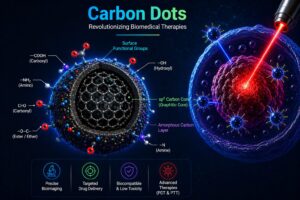
Carbon Dots are revolutionising cancer diagnosis, drug delivery, and advanced therapies
What are Carbon Dots?
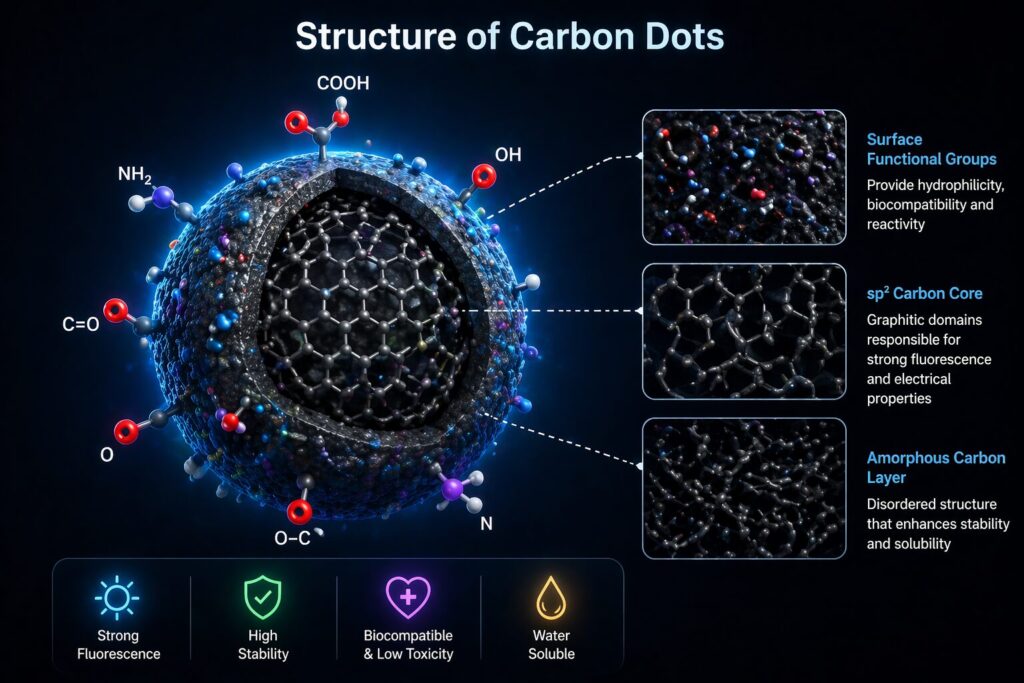
The rapid evolution of nanotechnology in the biomedical sciences is reshaping disease diagnosis and treatment. There has been one of the most promising breakthroughs with the serendipitous discovery of carbon dots (CDs). These are tiny, carbon-based nanoparticles, typically less than 10 nanometres in size, and are appealing for various systems owing to their unique combination of brilliant fluorescence, high photostability, good biocompatibility, and versatility. Carbon Dots are not just a scientific novelty but a promising nanomaterial that has the potential to revolutionise the clinical sector.
Application of Carbon Dots in Cancer
A million new cases of cancer are diagnosed each year, retaining its position as one of the leading causes of death worldwide. Traditional chemotherapies cause damage to healthy cells, leading to severe side effects, and major challenges still exist in early diagnosis and targeted treatment, making it difficult to utilise advanced surgery, chemotherapy, and radiotherapy. At this point, nanotechnology, and specifically carbon dots, offer a meaningful shift. CDs offer precision in the detection and treatment of cancer, also helping to reduce toxicity while improving effectiveness.
- Imaging using Carbon Dots
The major advantages of carbon dots are their optical properties. They exhibit strong fluorescence, which makes them highly effective for bioimaging, where CDs can illuminate the cancer cells, making them easier to detect even at early stages. Studies show that CDs can penetrate cell membranes and accumulate in cytoplasm or nucleus, as precise fluorescent probes that can be used in live-cell imaging, allowing real-time tracking of cancer progression and treatment response.
- Biocompatibility of Carbon Dots
Carbon Dots have consistently demonstrated low cytotoxicity across a wide range of cell types. CDs are studied to maintain high cell viability at effective high concentrations. This reduces the risk of adverse effects and opens the door to safer diagnosis and use of CDs in clinical practice, including imaging inside the human body.
- Targeted drug delivery using Carbon Dots
In addition to imaging diagnosis, CDs offer effectiveness in targeted drug delivery with increased specificity. CDs can be engineered to carry chemotherapy drugs directly to tumour sites. Drug loading, for example, doxorubicin onto carbon dot carriers, has been shown to significantly improve drug accumulation in cancer cells while reducing damage to healthy tissue. This has opened the way to enhance the efficiency of chemotherapies while minimising the side effects, which is a critical factor in the quality of life.
Furthermore, CDs can be engineered to bind the overexpressed cancer cell receptors, making them a high-precision targeted drug delivery system. In mixed cell environments, these functionalized CDs have demonstrated the ability to distinguish cancer cells from normal ones with high accuracy. This level of specificity has clear practical applications in early diagnosis, biopsy guidance, and even surgical precision, where identification of tumour boundaries is crucial.
- Phototherapy using Carbon Dots
CDs possess strong light absorption and high photostability. In photodynamic therapy (PDT), CDs generate reactive oxygen species when exposed to specific wavelengths of light, leading to cancer cell death, while in photothermal therapy (PTT), the CDs convert light into heat, effectively burning the tumour cells without harming surrounding tissue. Thus, PDT and PTT offer a minimally invasive option that can be precisely controlled, reducing recovery time and complications.
Can Carbon Dots be used as a therapeutic and diagnostic platform?
A tremendous scope of CDs is that they can be used as “Nanotheranostics” which can simultaneously detect cancer cells and deliver treatment, streamlining the entire clinical process. For example, a patient could receive a single injection that both highlights tumour locations through imaging and initiates targeted therapy. This integrated approach has the potential to reduce treatment time, improve outcomes, and lower healthcare costs.
Are Carbon Dots cost-effective?
Carbon Dots can be produced at low cost on a large scale. CDs can be synthesized using relatively simple and some of the low-cost methods that use natural or waste materials, such as plant extracts or food byproducts. This makes large-scale production more feasible and supports broader accessibility in healthcare systems, including in resource-limited settings.
Surface chemistry helps in the modification of chemical groups on the surface of carbon dots. Properties of CDs, including fluorescence intensity, targeting ability, and drug-loading capacity, can be fine-tuned, allowing their application for specific types of cancer or treatment strategies. In practice, this means more personalized medicine, where therapies are designed based on the patient’s specific condition.
While the results are promising, long-term safety, large-scale clinical trials, and regulatory approvals are all necessary steps are required. The application of CDs in cancer diagnosis and therapeutics has a wide scope for research that may pave a defined solution to cancer patients, providing a practical pathway toward more precise and less invasive cancer care. As research continues to evolve, carbon dots could play a central role in the future of personalized medicine, helping clinicians detect cancer earlier, treat it more effectively, and ultimately improve patient outcomes.