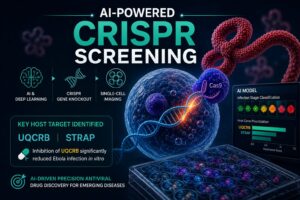
AI-Powered CRISPR screening reveals new therapeutic targets for Ebola virus infection
Ebola virus disease (EVD) continues to pose a serious global health threat in 2026, particularly in parts of Central and East Africa where periodic outbreaks place enormous pressure on already fragile healthcare systems. The growing public health challenge has accelerated research into advanced technologies like artificial intelligence (AI) and advanced targeted gene therapies to identify new therapeutic targets and develop faster, more precise antiviral strategies against deadly viral infections.
Traditional Ebola genetic screening methods often relied on pseudotyped viruses or simplified replication systems that failed to fully mimic authentic Ebola infection. This limitation made it difficult to identify host factors involved in later stages of viral replication.
How AI and CRISPR Revolutionize Ebola Research
Researchers from MIT, the Broad Institute, Boston University, have developed an advanced optical pooled screening (OPS) platform capable of evaluating authentic Ebola infection at the single-cell level. For this, more than 39 million cells and identified 998 host genes that regulate Ebola virus infection were analysed, opening the door to new antiviral strategies with practical clinical relevance.
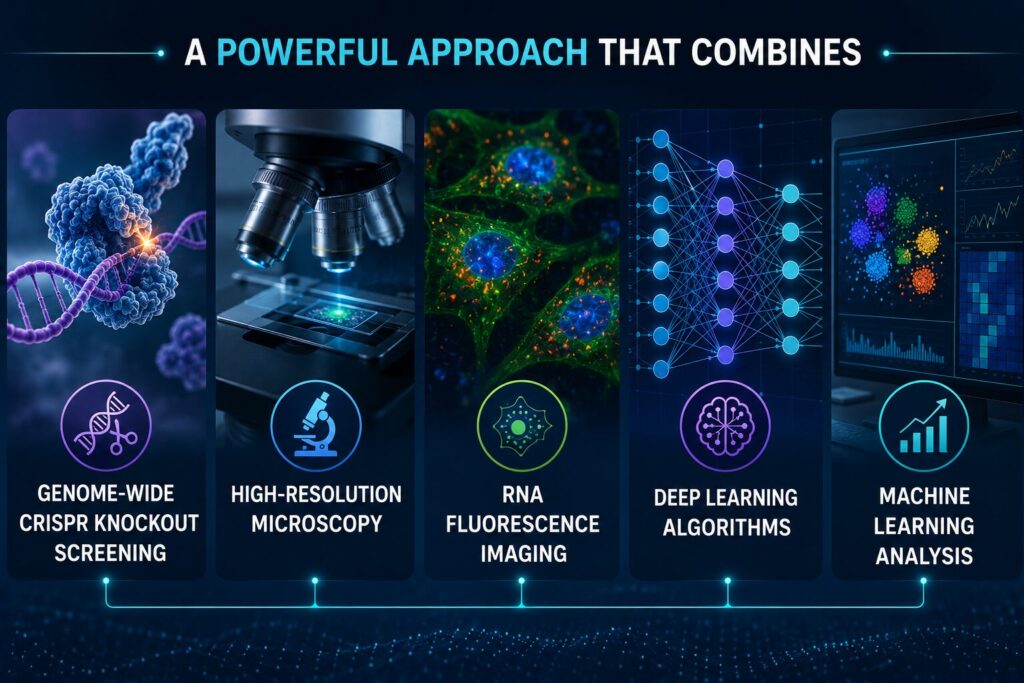
This approach combined:
- Genome-wide CRISPR knockout screening
- High-resolution microscopy
- RNA fluorescence imaging
- Deep learning algorithms
- Machine learning analysis
This integrated strategy allowed to study how host genes influence every stage of Ebola infection, from viral entry to RNA replication and viral budding.
Combining CRISPR, AI, and Single-Cell Imaging
HeLa-TetR-Cas9 cells were infected with Ebola virus along with approximately 80,000 single-guide RNAs (sgRNAs) targeting nearly 20,000 genes.
These cells were then analyzed using six imaging markers, including:
- Ebola VP35 protein
- Ebola VP35 RNA
- c-Jun transcription factor
- LAMP1 lysosomal marker
- Vimentin
- Nuclear DAPI staining
Viral RNA production was measured with unprecedented sensitivity using hybridization chain reaction fluorescence in situ hybridization (HCR-FISH).
Deep Learning for viral infection analysis
To process the enormous imaging dataset, convolutional autoencoders and random forest machine learning models were employed. These AI systems classified Ebola infection into four major stages:
- Faint infection signal
- Punctate inclusion body formation
- Cytoplasmic viral spread
- Peripheral viral budding
The deep learning model successfully distinguished subtle infection dynamics that conventional intensity-based analysis could not detect. Further, more than 3,000 cells were labelled to train the neural network model, enabling the system to recognize specific Ebola replication patterns across millions of images.
Identification of Ebola host regulators
The genome-wide CRISPR screening identified 998 genes that significantly altered Ebola infection dynamics.
Some of the most important previously known regulators confirmed in the study included:
- NPC1 receptor
- HOPS complex proteins
- Cathepsins
- PIK3C3
- CAD pyrimidine biosynthesis factor
In addition, many previously unknown host regulators were discovered, including entire protein complexes such as:
- GET complex
- GARP complex
- CIA complex
- COG complex
These findings dramatically expand the understanding of how Ebola hijacks host cellular machinery.
Application of AI -powered CRISPER screening model
Discovery of UQCRB as a therapeutic target
Using the developed AI-based CRISPER screening model, a molecular target of EBOLA, UQCRB was identified. It is a mitochondrial respiratory chain protein which is a key regulator of Ebola replication.
The deep learning analysis revealed that UQCRB knockout cells accumulated abnormal “punctate” Ebola protein structures, suggesting disruption of viral replication after entry into the cell. To validate these findings, Ebola infected cells were treated with terpestacin, a small-molecule UQCRB inhibitor. The treatment significantly reduced Ebola infection while maintaining relatively normal cell viability.
This result is particularly important because it demonstrates immediate translational potential. Instead of targeting the virus directly, scientists may be able to develop host-targeted antiviral therapies that reduce the likelihood of viral resistance.
STRAP protein reveals new insights into Ebola replication
Another major breakthrough finding of the developed model was discovery of the protein STRAP (Serine/Threonine Kinase Receptor Associated Protein), which appears to regulate the balance between Ebola viral RNA and protein synthesis.
The machine learning models identified STRAP as one of only two genes where knockout caused increased viral RNA relative to viral protein levels. Experimentally, the results verified that indeed STRAP-deficient cells accumulate high levels of viral RNA but produce significantly fewer infectious virus particles. These findings may be a promising information for the development of antiviral drugs that may disrupt the viral RNA processing pathways, impairing the Ebola’s virulence.
Validation Across Multiple Filoviruses
To strengthen the reliability of their findings, 12 secondary validation screening was conducted using Ebola virus (EBOV), Sudan virus (SUDV) and Marburg virus (MARV). To validate the findings in vitro, different cell types and infection time points were used. In vitro evaluations displayed strong reproducibility, with high correlations between primary and secondary AI-based screening results. The results demonstrated that different filoviruses exploit host biology in unique ways. This insight could guide the development of broad-spectrum antiviral therapies.
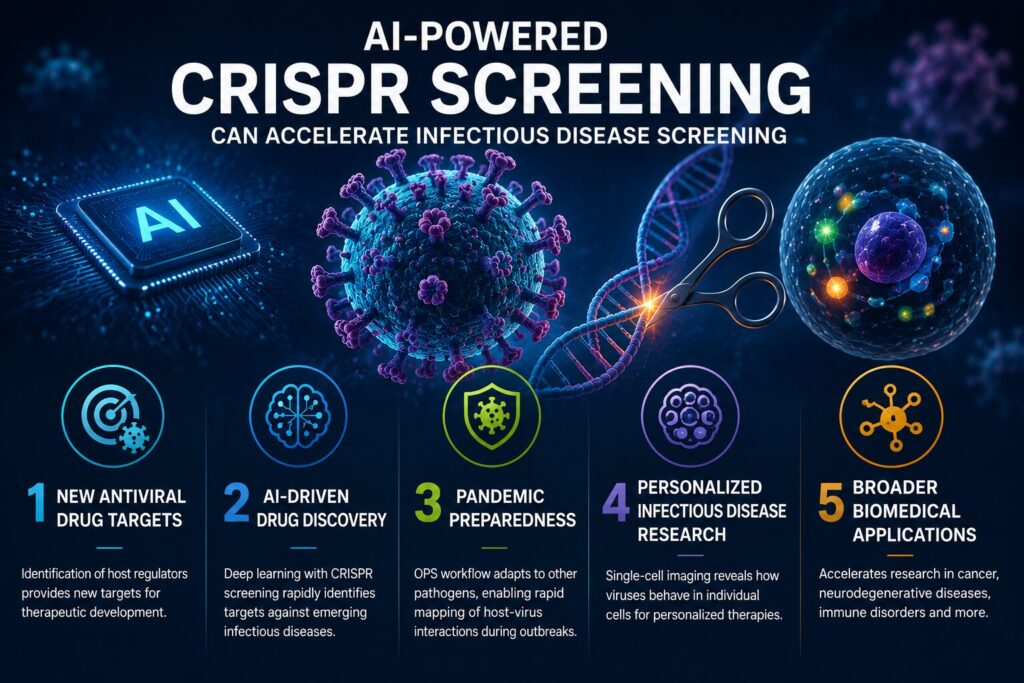
How AI-powered CRISPER screening can accelerate infectious disease screening
The study demonstrates how combining artificial intelligence, CRISPR technology, and advanced imaging can uncover actionable biological insights at an unprecedented scale. By identifying nearly 1,000 host regulators of Ebola infection, a valuable resource has been created that may fast-track the development of future antiviral drugs.
- New Antiviral Drug Targets
The identification of host regulators like UQCRB provides entirely new targets for therapeutic development. Host-directed antivirals may remain effective even as viruses mutate.
- AI-Driven Drug Discovery
The integration of deep learning with CRISPR screening demonstrates a scalable platform for rapidly identifying drug targets against emerging infectious diseases.
- Pandemic Preparedness
The OPS workflow could be adapted for other dangerous pathogens, including future pandemic viruses. Researchers can rapidly map host-virus interactions during outbreaks.
- Personalized Infectious Disease Research
Single-cell imaging allows scientists to study how viruses behave differently in individual cells, potentially enabling more personalized therapeutic approaches in the future.
- Broader Biomedical Applications
Beyond virology, this methodology could accelerate research into cancer biology, neurodegenerative diseases, and immune disorders by uncovering hidden cellular regulatory pathways.
As AI-driven biomedical research continues to evolve, studies like this illustrate how interdisciplinary science can transform infectious disease treatment and global pandemic preparedness.