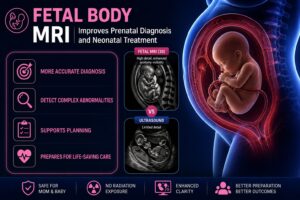
Fetal Body MRI Improves Prenatal Diagnosis and Neonatal Treatment
How Fetal Body MRI Is Transforming Prenatal Diagnosis and Neonatal Care
Congenital abnormalities remain one of the leading causes of neonatal complications worldwide. Early and accurate diagnosis of fetal abnormalities is critical because it allows clinicians to plan treatment, prepare families, and improve outcomes for newborns requiring immediate intervention after birth.
Ultrasound has long been the standard imaging method in prenatal care; however, scientists have emphasized the use of fetal body MRI, which is reshaping prenatal diagnostics and surgical planning. The new imaging reconstruction methods can create highly detailed three-dimensional visualizations of fetal abnormalities involving the head and neck, thorax, abdomen, pelvis, and spine. that help clinicians make more informed decisions.
Why is the Need for Advanced Fetal Imaging
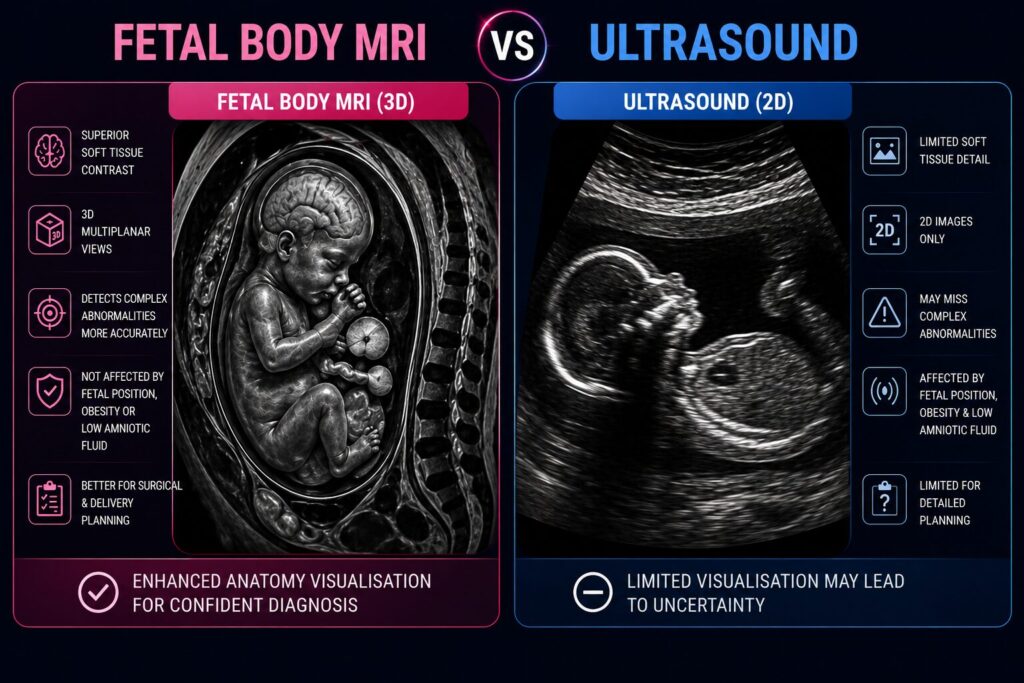
Prenatal imaging has traditionally relied on ultrasound because it is safe, accessible, and capable of providing real-time images of the fetus. However, ultrasound also has limitations. Factors such as maternal body habitus, fetal positioning, low amniotic fluid levels, and complex anatomical abnormalities can make accurate diagnosis difficult.
On the contrary, fetal MRI is increasingly being used as a complementary imaging technique because it provides superior soft tissue contrast and more precise anatomical detail. Unlike ultrasound, MRI can generate highly detailed images of internal fetal structures without being limited by bone shadowing or maternal obesity. The clinicians specifically focused on fetal body MRI rather than fetal brain imaging, because body imaging has historically been more challenging due to fetal motion and the deformable nature of body structures.
Full body MRI contributes to:
- Detection of congenital anomalies
- Classification of abnormalities
- Prognostication of fetal outcomes
- Decision-making for fetal intervention
- Surgical planning before birth
- Neonatal treatment preparation
Advanced MRI Reconstruction Techniques
Traditional fetal MRI often produces multiple two-dimensional image slices that can become misaligned because the fetus moves during scanning.
To address this challenge, the researchers highlighted the use of:
- Motion-correction algorithms
- Deformable slice-to-volume registration
- Three-dimensional reconstruction
- 3D segmentation
- Volumetric measurements
These technologies allowed the clinicians to reconstruct high-resolution 3D images from fetal MRI scans. The reconstructed images can then be viewed from multiple angles and manipulated digitally to improve diagnostic accuracy.
Key Advantages of full body MRI
- Improved Detection of Complex Congenital Abnormalities
The researchers found that fetal MRI provides significant advantages in evaluating complex anatomical abnormalities that may not be fully visible on ultrasound.
For example, in fetuses with head and neck masses, MRI allowed clinicians to visualize:
- Tumor boundaries
- Airway compression
- Tissue composition
- Relationship between masses and surrounding organs
MRI is particularly effective in distinguishing between lymphatic malformations and teratomas because different tissue types respond differently on T1- and T2-weighted imaging.
This distinction is clinically important because the treatment approach and risk of airway obstruction differ between conditions.
- Better Surgical and Delivery Planning
MRI can identify fetuses that may require the EXIT procedure, also known as ex-utero intrapartum treatment. This highly specialized procedure allows surgeons to secure the newborn’s airway while the infant remains connected to placental circulation during cesarean delivery.
Researchers found that MRI measurements of airway compression and polyhydramnios could predict which fetuses would require this life-saving intervention with high sensitivity and specificity.
This has major implications for:
- Obstetric planning
- Neonatal intensive care preparation
- Surgical team coordination
- Reduction of emergency delivery complications
- Enhanced Three-Dimensional Visualization
Traditional MRI images are often difficult to interpret because fetal movement can distort anatomical alignment. By applying motion-correction and 3D reconstruction methods, clinicians can now create highly accurate volumetric models of fetal anatomy.
These reconstructed images offer several practical benefits:
- Improved visualization of anatomical relationships
- More accurate lesion measurements
- Better parental counseling
- Enhanced multidisciplinary collaboration
- Improved surgical simulation and planning
- Complementary Role Alongside Ultrasound
Although there has been advancements and clinical advantages of MRI, Ultrasound still remains the primary screening tool because it is:
- Widely available
- Cost-effective
- Real-time
- Portable
- Safe for routine use
MRI becomes especially valuable when ultrasound findings are inconclusive or when detailed anatomical clarification is needed.
This combined imaging approach improves diagnostic confidence and supports more personalized prenatal care.
Practical Applications of Fetal Body MRI
The practical applicability of the research extends across several areas of maternal-fetal medicine.
Prenatal Diagnosis
Fetal MRI improves diagnostic precision in cases involving:
- Congenital diaphragmatic hernia
- Airway obstruction
- Abdominal wall defects
- Spinal dysraphism
- Neck tumors
- Thoracic malformations
More accurate diagnosis allows clinicians to predict outcomes and tailor treatment strategies.
Fetal Surgery and Intervention
In conditions requiring prenatal or immediate postnatal surgery, MRI helps obstetricians to evaluate:
- Organ displacement
- Lung development
- Tumor invasion
- Airway patency
- Surgical access routes
This improves both patient safety and procedural outcomes.
Neonatal Intensive Care Preparation
One of the most valuable applications involves preparing neonatal intensive care teams before delivery.
When severe abnormalities are identified prenatally, hospitals can:
- Assemble multidisciplinary teams
- Prepare specialized surgical equipment
- Coordinate operating room availability
- Arrange advanced airway support
- Reduce delays in emergency treatment
This proactive approach can significantly improve survival rates and reduce neonatal complications.
Family Counselling and Shared Decision-Making
Detailed imaging helps families better understand the diagnosis, expected outcomes, and treatment options. This supports informed decision-making and reduces uncertainty during high-risk pregnancies.
Future Directions in Fetal MRI Research
In future MRI offers opportunities for fetal MRI research and the emerging areas include:
- Artificial intelligence-assisted image reconstruction
- Faster MRI acquisition techniques
- Automated anomaly detection
- Improved fetal motion correction
- Functional MRI assessment of fetal organs
- Expanded use in fetal cardiac imaging
As imaging technologies continue to evolve, fetal MRI will become increasingly integrated into routine high-risk prenatal care.